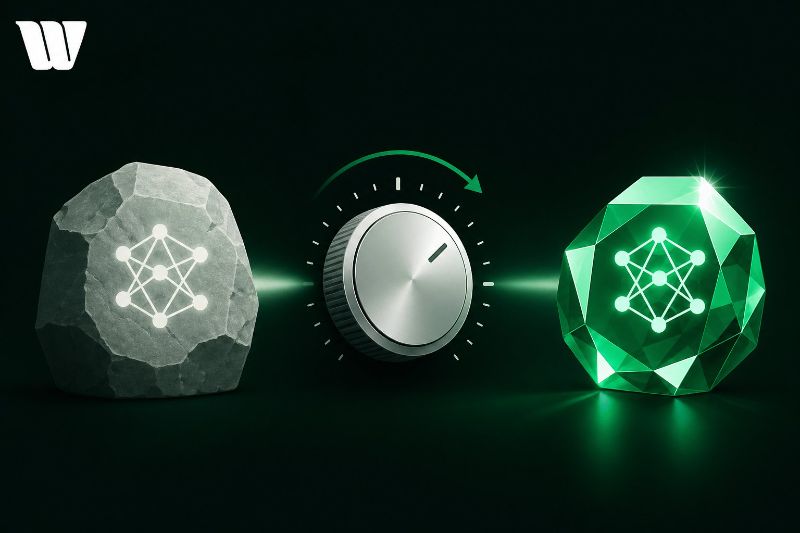
Fine-tuning lets you adapt a pre-trained AI model to a specific task using a smaller, domain-focused dataset. Instead of training from scratch, you update the model's existing weights with targeted examples, saving time and compute resources. It's widely used in healthcare, legal, and customer service applications where general-purpose models need sharper precision. Understanding the process, approaches, and limitations will help you decide if it's the right strategy for your project.
Key Takeaways
- Fine-tuning adapts a pre-trained AI model to a specific task using a smaller, domain-specific dataset without training from scratch.
- It updates model weights using existing knowledge, reducing computational costs and cutting training time from weeks to hours.
- Key approaches include Full Fine-Tuning, LoRA, and RLHF, each balancing flexibility, memory efficiency, and human alignment differently.
- Applications span healthcare, legal, retail, and customer service, where fine-tuned models often outperform general-purpose LLMs.
- Limitations include catastrophic forgetting, overfitting, and data dependency, making quality training data and careful monitoring essential.
What Is Fine-Tuning in AI?
Fine-tuning is the process of taking a pre-trained AI model and further training it on a smaller, task-specific dataset to adapt its behavior for a particular use case.
It builds on transfer learning, where a model trained on large-scale data transfers its learned representations to a new domain. Rather than training from scratch, you update the model's existing weights using domain-specific examples, enabling precise model adaptation without requiring massive computational resources.
The base model already understands general patterns, syntax, or visual features, depending on its architecture. Fine-tuning refines those learned patterns to match your target task.
This approach reduces training time, lowers data requirements, and consistently outperforms models built without a pre-trained foundation, making it a practical and efficient strategy across NLP, computer vision, and beyond.
How Fine-Tuning Differs From Training a Model From Scratch
Training a model from scratch means initializing random weights and learning every pattern, relationship, and feature entirely from raw data—a process that demands massive datasets, significant compute, and weeks or months of training time.
Fine-tuning leverages transfer learning, starting with a pre-trained model's existing knowledge and performing targeted model adaptation on a specific task.
The contrast is stark:
- Cost: Scratch training requires millions in compute; fine-tuning costs a fraction
- Data: Scratch training needs billions of examples; fine-tuning works with thousands
- Time: Scratch training runs for weeks; fine-tuning completes in hours
- Risk: Scratch training offers no guarantees; fine-tuning builds on proven, validated foundations
You're not rebuilding a skyscraper—you're renovating an existing one.
When Fine-Tuning Is the Right Choice for Your Project
Fine-tuning makes sense when you're working with a well-defined task, have domain-specific data, and can't justify the compute costs of training from scratch.
You'll want to assess whether your project has a narrow enough scope that a pre-trained model's existing knowledge only needs targeted adjustment rather than wholesale replacement.
If your dataset is small but high-quality and your task closely resembles what the base model already does, fine-tuning is likely your most efficient path forward.
Identifying Fine-Tuning Scenarios
When does fine-tuning actually make sense for your project? Transfer learning becomes valuable when your domain requires specialized knowledge that general models lack. Domain adaptation through fine-tuning delivers precision when standard models consistently underperform on your specific data.
Consider fine-tuning when you're facing these critical situations:
- Your industry uses specialized terminology that general models misinterpret, causing costly errors.
- You possess labeled domain-specific data that captures nuances no pre-trained model has encountered.
- Baseline model performance falls considerably short of your application's accuracy requirements.
- Your use case demands consistent stylistic or behavioral patterns that prompt engineering alone can't reliably produce.
If your project checks any of these boxes, fine-tuning isn't just an option—it's your most strategic path toward a model that genuinely serves your needs.
Assessing Project-Specific Needs
Before committing resources to fine-tuning, you'll need to systematically evaluate whether your project's constraints and objectives actually justify the investment. Start by auditing your available domain-specific data. Insufficient data collection will undermine any fine-tuning effort before it begins—you'll typically need thousands of high-quality, labeled examples to achieve meaningful performance gains.
Next, conduct baseline model evaluation using a pre-trained model against your target task. If the performance gap is minimal, fine-tuning may be unnecessary. However, if the base model consistently fails on domain-specific terminology, edge cases, or specialized reasoning, that gap signals a legitimate fine-tuning opportunity.
Also assess your computational budget, timeline, and team expertise. Fine-tuning demands GPU resources, iterative experimentation, and rigorous validation cycles—investments that only make sense when the performance requirements genuinely can't be met otherwise.
How the Fine-Tuning Process Works, Step by Step
Starting with a pre-trained model, the fine-tuning process follows a structured pipeline that transforms general-purpose weights into task-specific ones. Transfer learning enables you to leverage existing model adaptation rather than training from scratch.
You'll curate your dataset selection carefully, then adjust hyperparameter tuning settings to control learning rate, batch size, and epochs.
Here's what this process actually demands from you:
- Commit to clean, labeled data — your model's quality mirrors your dataset's integrity
- Freeze early layers strategically — preserve foundational knowledge while retraining upper layers
- Monitor validation loss obsessively — overfitting can silently destroy your model's generalizability
- Iterate without shortcuts — rushed hyperparameter tuning produces brittle, unreliable outputs
Each step compounds the previous one, meaning a single overlooked decision can cascade into significant performance failures downstream.
Full Fine-Tuning, LoRA, and RLHF: The Main Approaches Compared
When fine-tuning a model, you'll encounter three primary approaches, each with distinct tradeoffs.
Full fine-tuning updates every parameter in the network, giving you maximum flexibility but demanding significant compute and memory resources.
LoRA takes a leaner path by injecting trainable low-rank matrices into the model's layers, while RLHF goes further by incorporating human feedback to align the model's outputs with preferred behavior.
Full Fine-Tuning Explained
Full fine-tuning updates every parameter in a pre-trained model's neural network during training on a new dataset. This approach maximizes transfer learning by letting the model fully adapt its weights to your specific task, making it the most powerful form of model optimization available.
You'll gain complete control, but the cost is substantial:
- Computational expense: You need high-end GPUs and extensive training time
- Catastrophic forgetting: The model risks losing valuable pre-trained knowledge
- Data requirements: You must supply large, high-quality labeled datasets
- Storage demands: Every updated parameter requires dedicated infrastructure
Full fine-tuning delivers superior performance when your task diverges considerably from the original training objective. If your resources match the requirements, no other approach gives you deeper model adaptation.
LoRA's Efficient Approach
The computational demands of full fine-tuning push it out of reach for most teams, but Low-Rank Adaptation (LoRA) delivers comparable results at a fraction of the cost. Instead of updating all model weights, LoRA injects small trainable matrices into the transformer layers, leaving the original parameters frozen. This architecture reduces trainable parameters by up to 10,000x, slashing memory requirements dramatically.
LoRA benefits extend beyond cost savings. You'll train faster, require less GPU infrastructure, and preserve the base model's general knowledge.
LoRA applications span domain-specific customization, multilingual adaptation, and task-specific instruction tuning across models like LLaMA and GPT variants.
You can even stack multiple LoRA adapters, switching between specialized behaviors without retraining the entire model, making it the practical default for most production fine-tuning pipelines.
RLHF's Human Alignment
Reinforcement Learning from Human Feedback (RLHF) solves a problem that LoRA and full fine-tuning can't address alone: aligning model outputs with human preferences, values, and safety constraints.
When alignment challenges arise, human feedback becomes the training signal itself, not just labeled data.
RLHF tackles what technical fine-tuning methods miss:
- Harmful outputs — human raters flag dangerous, biased, or misleading responses directly
- Subtle preference gaps — you capture nuanced human judgment that loss functions can't measure
- Safety boundaries — models learn what they shouldn't say, not just what they should
- Value alignment — responses reflect real-world ethical standards, not statistical patterns alone
You're fundamentally teaching the model to optimize for human approval, transforming subjective quality into a measurable reinforcement signal.
How Companies Are Using Fine-Tuning Right Now
Across three major industries—healthcare, legal, and customer service—companies are actively deploying fine-tuned models to solve domain-specific problems that general-purpose LLMs can't handle reliably.
In healthcare, models fine-tuned on clinical notes improve diagnostic coding accuracy.
Legal firms use fine-tuned models trained on case law to accelerate contract review.
In customer service, companies fine-tune models on historical support tickets to power customer support automation that matches brand tone and resolves queries faster.
Retailers leverage fine-tuning for personalized marketing, training models on purchase history and behavioral data to generate targeted messaging at scale.
Each deployment shares a common pattern: you start with a capable base model, then adapt it narrowly using domain-specific data, producing a specialized tool that outperforms general alternatives on targeted tasks.
Where Fine-Tuning Falls Short
Fine-tuning delivers real gains in narrow domains, but it breaks down in predictable ways once you push past its design constraints. Understanding the limitations of fine-tuning helps you avoid costly deployment failures and clears up common misconceptions about fine-tuning as a universal fix.
Watch for these failure points:
- Catastrophic forgetting — the model loses general knowledge as it overwrites pre-trained weights with domain-specific patterns.
- Data dependency — poor-quality or insufficient training data produces confidently wrong outputs.
- Overfitting — tight tuning on small datasets makes the model brittle outside familiar examples.
- Scope creep illusions — teams assume a fine-tuned model generalizes broadly, then discover it fails on adjacent tasks it was never trained to handle.
For many business uses, such as writing in your brand's voice, you don't need to change the model at all. Written context does that job. In Willo, a short summary of the business and its voice under Settings → Memory shapes everything it writes, and you can correct it there at any time. See What Willo remembers.
Frequently Asked Questions
How Much Does Fine-Tuning a Large Language Model Typically Cost?
Fine-tuning costs vary widely—you'll spend $100 to $300K+ depending on model size and data. Your cost breakdown includes compute, storage, and labor. Factor these budget considerations carefully before committing to a fine-tuning project.
What Hardware or Computing Resources Are Needed for Fine-Tuning?
You'll need high-memory GPUs (like A100s or H100s) to handle intensive computations efficiently. Guarantee sufficient data storage for your datasets and model checkpoints, plus fast interconnects if you're running distributed multi-GPU training setups.
How Long Does a Typical Fine-Tuning Process Take to Complete?
Fine-tuning duration varies widely—you'll typically spend hours to weeks completing model adaptation, depending on dataset size and hardware. Transfer learning shortens this process considerably, letting you leverage pre-trained weights for faster, more efficient training cycles.
Can Fine-Tuning Introduce or Amplify Biases in an AI Model?
Yes, fine-tuning can introduce or amplify biases if your training data contains skewed representations. You'll need to prioritize bias mitigation strategies and ethical considerations, carefully auditing datasets and monitoring outputs to prevent harmful, discriminatory model behavior.
Is Fine-Tuning Legal When Using Proprietary or Copyrighted Training Data?
Fine-tuning with proprietary or copyrighted data can expose you to legal risks. You must respect data ownership rights and licensing agreements. Ethical considerations require you to obtain explicit permissions before using protected datasets in your fine-tuning pipeline.
Conclusion
Fine-tuning gives you a practical path to deploying AI that actually fits your use case without rebuilding everything from scratch. You've seen how it works, where it excels, and where it breaks down. Whether you're choosing LoRA for efficiency or RLHF for alignment, your decision should match your data constraints, compute budget, and performance targets. It's not a universal fix, but when applied correctly, it's one of the most cost-effective tools you've got.