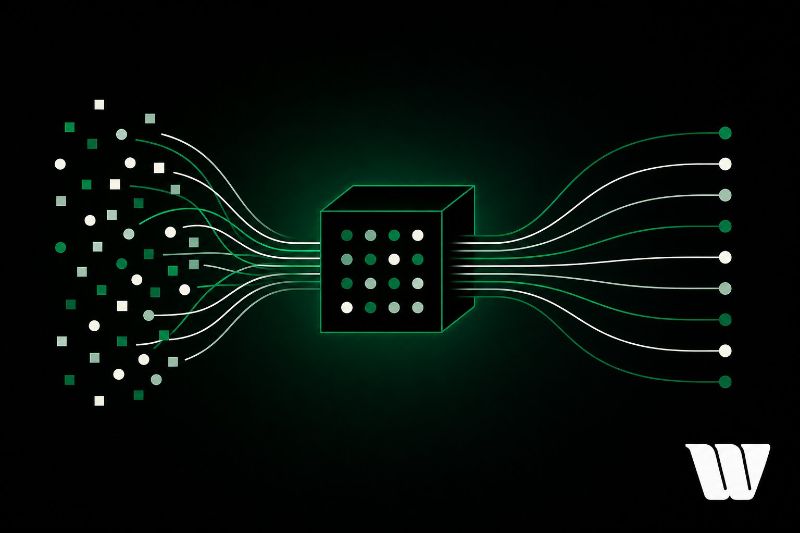
Large language models are neural networks trained on massive text datasets to predict and generate human-like language. They don't truly understand words, they identify statistical patterns across billions of examples, compressing meaning into numerical representations called embeddings. Built on transformer architecture, they process your input through stacked attention layers, then generate responses one token at a time. If you want to understand exactly how these systems work, and where they break down, keep going.
Key Takeaways
- LLMs are neural networks trained on massive text datasets that predict and generate human-like language by learning statistical patterns.
- The transformer architecture powers modern LLMs, using attention mechanisms and layered processes to refine language representations progressively.
- LLMs generate text sequentially, selecting one token at a time based on probability distributions across their vocabulary.
- Rather than memorizing data, LLMs identify statistical co-occurrence patterns to develop contextual and semantic understanding.
- LLMs have key limitations, including hallucinations, biased outputs, lack of true creativity, and inability to understand context like humans.
What Is a Large Language Model, Really?
A large language model (LLM) is a neural network trained on massive text datasets to predict and generate human-like language by learning statistical patterns across billions of parameters.
You're dealing with a machine learning system that processes natural language through transformer-based architectures, enabling sophisticated text generation across diverse application areas.
LLMs don't "understand" language the way humans do. Instead, they're probabilistic engines optimizing next-token predictions.
When you assess them through model evaluation frameworks, performance metrics like perplexity, BLEU scores, and benchmark accuracy reveal their true capabilities.
User interaction shapes how these models behave in deployment, while ethical implications, including bias amplification, misinformation risks, and consent issues around training data, demand serious consideration.
Understanding what an LLM actually is clarifies both its power and its limitations.
How Large Language Models Learn From Billions of Words
When you train a large language model, you're feeding it massive datasets pulled from books, websites, academic papers, code repositories, and digitized archives, fundamentally a compressed snapshot of human knowledge.
The model doesn't memorize this data; instead, it identifies statistical patterns across billions of word sequences, learning which tokens predictably follow others in a given context.
Through repeated exposure and mathematical weight adjustments, you end up with a system that's internalized the structural and semantic regularities of language at an extraordinary scale.
Training Data Sources
Ethical considerations remain critical, as training corpora may contain copyrighted material, personal information, or culturally biased narratives that shape model behavior in problematic ways.
Pattern Recognition Process
Learning patterns from raw text isn't as simple as memorizing sentences, it's a layered, statistical process where the model builds increasingly abstract representations of language. You can think of it as the model learning to predict what comes next by analyzing co-occurrence patterns across billions of tokens.
Through this process, the model develops contextual understanding, recognizing that "bank" means something different near "river" versus "finance." It also captures semantic similarities between words and phrases, mapping related concepts into compressed numerical spaces called embeddings.
Each transformer layer refines these representations, extracting progressively higher-level linguistic features, syntax, then semantics, then pragmatics.
The model doesn't follow explicit rules; it derives them implicitly through exposure to vast, diverse text distributions, making the learned patterns surprisingly robust and generalizable.
The Transformer Architecture Explained
The Transformer architecture is the backbone of every modern LLM, and understanding it means understanding how these models actually process and generate language.
You're dealing with stacked transformer layers that chain together attention mechanisms, feedforward networks, layer normalization, and residual connections into a unified processing pipeline.
Positional encodings inject sequence order since the architecture itself has no inherent sense of position.
- Multi-head attention lets the model simultaneously attend to different representation subspaces
- Residual connections prevent gradient degradation across deep stacks
- Layer normalization stabilizes training efficiency across variable input distributions
- Feedforward networks apply non-linear transformations after each attention operation
- Scalability challenges directly impact model interpretability as parameter counts grow exponentially
Each component compounds complexity, making architectural decisions critical to downstream performance.
How Large Language Models Generate Text One Token at a Time
Every time an LLM produces output, it's executing a sequential prediction process where each token gets generated one at a time, conditioned on everything that came before it.
During token generation, the model processes your entire input context, runs it through its transformer layers, and outputs a probability distribution across its vocabulary. It then samples from that distribution to select the next token.
That token immediately joins the context, and sequential processing repeats. The model re-evaluates the entire sequence, now including the newly generated token, before predicting the next one.
This autoregressive loop continues until the model produces a stop token or reaches its context limit. You're fundamentally watching a sophisticated next-token predictor iterate over itself thousands of times to construct coherent, contextually grounded responses.
Why Large Language Models Get Things Wrong
When you interact with an LLM, you'll notice it sometimes produces confident, fluent responses that are factually wrong, a phenomenon called hallucination.
This occurs because the model doesn't retrieve stored facts; it predicts statistically probable token sequences based on patterns learned during training.
If your training data contains errors, gaps, or outdated information, the model's outputs will inevitably reflect those limitations.
Hallucinations and Factual Errors
Despite their impressive capabilities, LLMs don't actually "know" anything in the way humans do, they predict statistically likely token sequences based on patterns learned during training. This fundamental mechanism produces reliability issues, including hallucinations where models generate confident but fabricated responses.
You'll encounter these core accuracy challenges:
- Hallucination causes: Models prioritize coherent-sounding outputs over factual correctness.
- Error types: Fabricated citations, false statistics, and invented historical events.
- Data biases: Training corpora embed systemic inaccuracies that propagate into responses.
- Context misunderstanding: Ambiguous prompts trigger plausible but incorrect interpretations.
- Validation techniques: Cross-referencing outputs against authoritative sources mitigates user impact.
Understanding these failure modes lets you apply appropriate skepticism when deploying LLMs in high-stakes environments requiring precision and verifiable accuracy.
Training Data Limitations
The ethical implications extend beyond accuracy.
Biased training data can reinforce harmful stereotypes and marginalize minority perspectives at scale.
Without training transparency, you can't audit what information shaped a model's behavior, making accountability nearly impossible.
Addressing these limitations requires deliberate sourcing, rigorous filtering, and diverse contributor pipelines before training even begins.
What Large Language Models Still Can't Do
Large language models have made remarkable strides, yet they still hit hard walls in several critical areas. You'll find these systems struggle beyond pattern recognition, exposing fundamental gaps in machine cognition.
- Contextual understanding: LLMs misread nuanced, multi-layered conversations requiring situational awareness.
- Emotional intelligence: They can't genuinely interpret or respond to human emotional states authentically.
- Common sense: Basic real-world logic frequently eludes their probabilistic architecture.
- Real-time reasoning: They can't dynamically update knowledge or process live information streams.
- Ethical considerations and creativity limits: LLMs generate outputs without moral judgment and recombine existing patterns rather than producing genuinely novel ideas.
Recognizing these boundaries helps you deploy LLMs strategically, understanding where human oversight remains non-negotiable and where automation genuinely delivers value.
Frequently Asked Questions
How Much Does It Cost to Train a Large Language Model?
Training costs vary widely, you're looking at millions of dollars for large models. Your resource requirements include powerful GPUs, electricity, and infrastructure. You'll need careful budget considerations to optimize model efficiency and minimize unnecessary computational expenses.
Which Large Language Model Is Best for My Specific Business Use Case?
You'll need to conduct a use case analysis, comparing performance metrics across models aligned with your business requirements. Evaluate industry applications, user feedback, scalability options, and integration challenges to determine which LLM best fits your model comparison criteria.
Can Large Language Models Understand and Process Images or Video?
Like a Renaissance artist mastering multiple mediums, you'll find that modern LLMs leverage multimodal capabilities, enabling image processing, visual understanding, cross-modal learning, video analysis, and data integration, transforming raw visual inputs into meaningful, contextually rich linguistic interpretations.
How Do I Fine-Tune a Large Language Model on My Own Data?
You'll fine-tune an LLM by applying data preprocessing techniques to clean and format your dataset, then training the model on it. Monitor performance using model evaluation metrics like perplexity and F1-score to optimize results.
Are Large Language Models a Threat to Human Jobs?
Like a double-edged sword, LLMs drive job displacement yet fuel skill evolution. You'll face economic impact across sectors, but creative collaboration, ethics considerations, and industry adaptation determine whether you're replaced or empowered.
Conclusion
You've now seen how LLMs transform raw text into probabilistic predictions through transformer architectures, attention mechanisms, and token-by-token generation. Here's a striking figure worth remembering: GPT-4 processes roughly 1.8 trillion parameters during inference. Yet despite that computational scale, you've learned why these models still hallucinate, lack true reasoning, and can't reliably ground facts. Understanding these mechanisms isn't optional, it's essential for deploying LLMs responsibly in any technical environment.