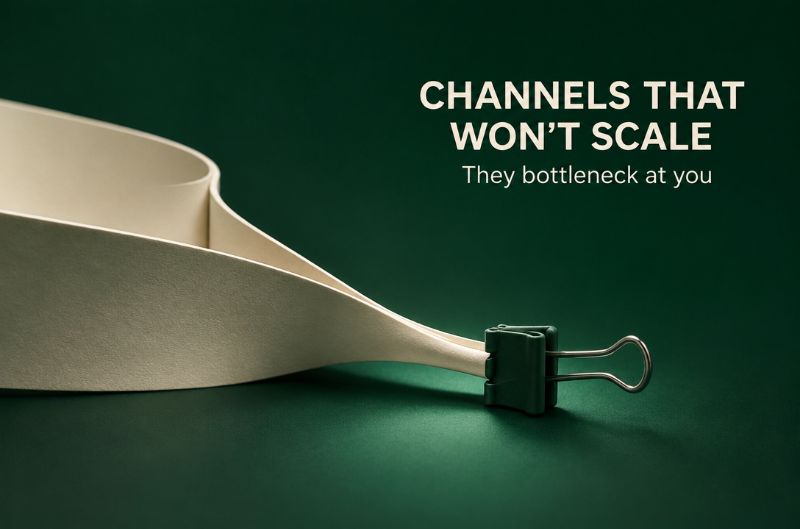
A distribution channel that won't scale past you shows clear warning signs: your customer acquisition cost rises as you spend more, your reach stalls without consistent personal effort, and growth halts the moment you step away. You're fundamentally the system. If removing your top tactic causes leads to dry up, you've built dependency, not infrastructure. Track these signals early, and you'll know exactly which channels are ceilings in disguise — and what to do about it.
Key Takeaways
- Rising Customer Acquisition Cost (CAC) signals a channel struggling to scale efficiently beyond your current involvement and resources.
- If removing a top tactic collapses results, the channel depends entirely on your personal effort to function.
- Stalling week-over-week reach growth against flat conversion rates indicates market saturation within that channel.
- Heavy reliance on third-party platforms risks disruption through algorithm changes, limiting scalable and independent audience growth.
- Recycled audience overlap across channels signals exhausted reach, making sustainable growth beyond current levels nearly impossible.
What Makes a Distribution Channel Unscalable
A distribution channel becomes [unscalable](distribution channel becomes unscalable) when the cost or effort required to acquire each additional customer grows faster than the revenue that customer generates. These channel limitations appear in predictable patterns: rising ad costs, shrinking organic reach, or personal time becoming the primary growth input.
Scalability factors include automation potential, audience size, cost-per-acquisition trends, and how much the channel depends on your direct involvement. When you're the mechanism driving growth, the channel stops scaling the moment you do.
Market adaptability also matters. Channels that perform well in early traction often lose efficiency as you push into broader, less targeted audiences. Engagement metrics tell this story early. Declining audience engagement rates signal that your message is reaching people it wasn't built for, which inflates acquisition costs before revenue catches up.
Recognizing these signals early lets you redirect resources toward channels built to grow without you as the bottleneck. Tracking which channels actually drive conversions requires the right marketing attribution model, since incorrect attribution can misdirect budgets and reduce pipeline volume before you realize the channel was never working.

Warning Signs the Channel Runs on You, Not a System
When your calendar fills with outreach tasks before revenue appears, that's the clearest signal your distribution channel runs on effort rather than infrastructure. You're the engine, not the system.
Watch for these dependency dynamics: every new customer requires your direct involvement, leads dry up when you stop posting or following up, and referrals only happen because you personally asked. None of that compounds without you.
Growth limits appear when you can't take a week off without pipeline stalling. If onboarding requires your explanation, closing requires your presence, and retention requires your relationship, you've built a job disguised as a business.
The operational test is simple. Remove yourself for 30 days and measure what survives. If the answer is very little, your channel isn't a channel—it's a manual process wearing one. Real distribution works while you sleep, not only while you're working. Platforms built around autonomous AI agents can execute across marketing, finance, and operations without requiring your presence at every step, which is precisely what a scalable channel demands.
When Someone Else's Rules Cap Your Reach
Platforms set the rules, and those rules can change overnight. When your distribution lives inside someone else's ecosystem, you're exposed to platform limitations that can shrink your reach without warning. Algorithm changes buried in a policy update can cut your visibility in half. Audience restrictions can prevent you from reaching specific demographics you've built your offers around. These aren't edge cases—they're documented patterns across social, search, and marketplace platforms.
The deeper problem is control issues. You don't own the channel, so you can't defend it. Engagement barriers get introduced without your input, and dependency risks compound the longer you build on rented ground. If a platform decides your content violates new rule constraints, your entire distribution strategy stalls.
The strategic move is treating third-party platforms as traffic sources, not infrastructure. Your owned channels—your email list, your site, your customer data—are where scalable distribution actually lives. Solopreneurs who rely too heavily on external platforms often find their decision-making slowed and focus shifted away from business operations toward managing the constraints of software and channels they don't control.
The Hidden Costs That Outpace Your Revenue
Some distribution channels look profitable until you account for everything they actually cost. Hidden expenses pile up fast, creating revenue discrepancies that shrink your margins before you notice.
Watch for these four cost patterns that signal growth limitations:
- Platform fees and commissions that increase as your volume grows, creating dependency risks that punish your success instead of rewarding it.
- Operational inefficiencies like manual order processing, customer service overhead, or fulfillment bottlenecks that require hiring before you're ready.
- Market saturation costs where rising ad spend or intensifying competition forces you to pay more to reach the same audience size.
- Compliance and integration expenses tied to third-party rules that add unpredictable overhead as your business scales.
If your costs grow faster than your revenue, the channel isn't scaling with you. It's scaling against you. Tracking your total sales and marketing costs against new customers acquired helps you catch this imbalance before it becomes structural. Identify these patterns early before they become structural problems you can't easily exit.
Channels That Mimic Growth While Building Dependency
Certain distribution channels are engineered to look like growth engines while quietly making you dependent on their infrastructure. You're seeing rising traffic, growing follower counts, or increasing marketplace orders — but none of that activity belongs to you. That's the growth illusion in action: metrics that feel like momentum but don't translate into owned audience relationships or predictable revenue.
The dependency dynamics become visible when you try to exit. Your customer data lives inside someone else's system. Your reach requires continuous ad spend to maintain. Your rankings disappear the moment you stop feeding the algorithm. Every channel that controls access between you and your customers is extracting leverage, not just facilitating transactions.
Ask yourself what happens to your revenue if that platform changes its terms tomorrow. If the answer is significant disruption, you haven't built distribution — you've rented it. That distinction determines whether your business scales or stalls. Businesses that rely on a single channel expose themselves to concentrated risk, which is why tracking your CAC to LTV ratio across channels reveals which relationships you own versus which ones own you.
How to Test a Channel's Ceiling Before You Hit It
Recognizing that you've rented distribution rather than built it is only half the problem — the other half is knowing when a channel's ceiling is approaching before you've overcommitted resources to it. Strong channel evaluation means tracking scalability metrics early, not after growth stalls.
Run these four tests before doubling down on any channel:
- Increase spend by 20% and measure CAC movement — if acquisition costs rise disproportionately, you're compressing available audience.
- Track week-over-week reach growth against conversion rate — divergence signals saturation, not opportunity.
- Remove your top-performing tactic for two weeks — if results collapse, you've built fragility, not a channel.
- Map your audience overlap across channels — high overlap means you're recycling the same buyers, not expanding reach.
These tests surface ceiling pressure before it becomes a revenue problem, giving you time to diversify rather than scramble. Channels that cannot sustain organic referral growth or show declining retention rates are especially vulnerable to hitting ceilings early, making it critical to track organic referral metrics alongside paid acquisition performance from the start.
When to Cut a Channel and What to Build Instead
Cutting a channel is the right move when your ceiling tests return consistent red flags across two or more signals — rising CAC, stalling reach, collapsed results after tactic removal, or recycled audience overlap. Don't wait for revenue to drop before you act on the data.
When you cut, replace with channel alternatives that offer measurable reach into audiences you haven't already exhausted. If you've maxed out a community-driven channel, shift toward search-intent channels like SEO or paid search where demand already exists. If referrals plateaued, build programmatic partnerships or affiliate structures with defined performance thresholds.
Your growth strategies should prioritize channels with compounding returns — ones where effort builds equity over time rather than requiring constant reinvestment. Use Willo to restructure your landing pages, offers, and capture flows around the new channel quickly, so you're not losing momentum during the shift. Speed matters when you're reallocating resources. Platforms built on end-to-end business automation can compress the time between channel pivots and execution by handling infrastructure, content, and operational setup without requiring you to rebuild from scratch.
Frequently Asked Questions
Can a Distribution Channel Become Unscalable After Initially Showing Strong Growth?
Yes, a channel can hit growth limits fast. Watch for market saturation, declining ROI, and weakening scalability factors—they signal channel longevity risks, meaning you'll need to diversify before revenue stalls completely.
How Many Channels Should a Business Actively Use at One Time?
Focus on one to three channels in your growth strategy. You'll dilute your efforts with more. Master channel diversity only after you've proven consistent, scalable revenue from your primary distribution source.
Does Audience Size on a Channel Affect Whether It Can Scale?
Yes, audience size matters, but don't rely on it alone. A large, disengaged audience won't convert. Prioritize audience engagement and channel diversity to guarantee your revenue potential isn't capped by one platform's reach.
Should New Businesses Avoid Dependent Channels Entirely From the Start?
No, you don't need to avoid dependent channels entirely in your initial strategy. They can drive early revenue fast. Just don't let them dominate. Build channel independence alongside them before you actually need it.
Can Switching Channels Mid-Growth Damage Existing Customer Relationships Permanently?
Yes, switching channels mid-growth can permanently damage customer loyalty. You're disrupting established touchpoints customers trust, creating real relationship management gaps. Evaluate channel evaluation trade-offs carefully—growth risks include lost revenue when loyal customers don't follow you to new platforms.