To calculate your customer acquisition cost (CAC), divide your total sales and marketing costs by the number of new customers acquired in the same period. For example, if you spend $10,000 and gain 100 customers, your CAC is $100. You'll need to include ad spend, salaries, tools, and incentives for accurate results. Keep exploring to uncover what your CAC actually means for your bottom line.
Key Takeaways
- CAC is calculated by dividing total sales and marketing costs by the number of new customers acquired in a given period.
- Include all relevant costs such as ad spend, sales salaries, commissions, tools, and customer incentives for accurate results.
- Exclude retention costs from your calculation, as CAC should only reflect expenses tied to acquiring new customers.
- Compare CAC against Customer Lifetime Value using the standard 3:1 CLV-to-CAC ratio to assess sustainability.
- Calculate CAC per marketing channel by dividing channel-specific costs by customers acquired through that channel.
What Is Customer Acquisition Cost?
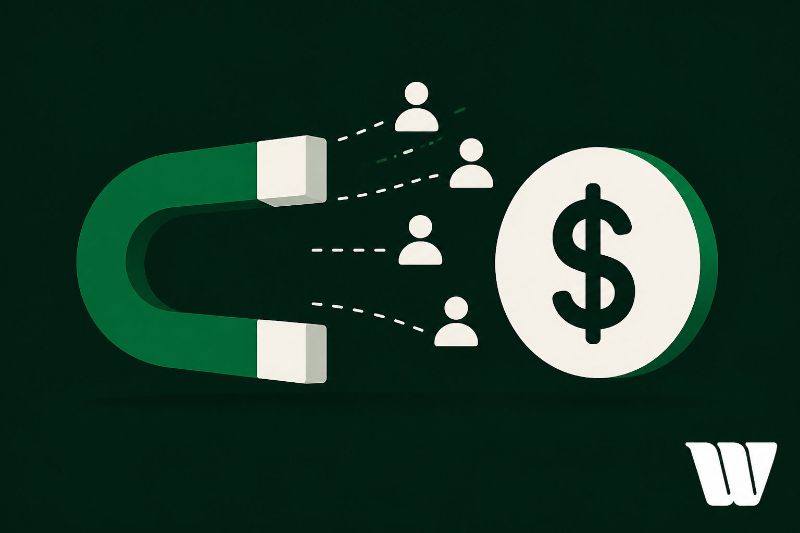
Customer acquisition cost (CAC) measures the total amount a business spends to win a new customer. It captures every dollar invested in sales, marketing, and related overhead required to convert a prospect into a paying customer.
You need to track CAC because it directly reveals your marketing efficiency. A high CAC signals that your acquisition strategy is draining resources faster than revenue can justify. A low CAC indicates you're scaling smartly.
CAC doesn't operate in isolation, though. Pairing it with customer retention metrics gives you a fuller financial picture. Retaining customers reduces your reliance on expensive acquisition cycles, improving your unit economics over time.
Understanding CAC puts you in control of smarter budget decisions, stronger growth strategies, and more sustainable business performance.
The CAC Formula, Broken Down Simply
The CAC formula is straightforward: divide your total sales and marketing costs by the number of new customers acquired during the same period.
CAC = Total Sales & Marketing Costs ÷ New Customers Acquired
For example, if you spend $10,000 and acquire 100 customers, your CAC is $100.
Understanding CAC importance means recognizing what this number reveals about your business efficiency. A high CAC signals that your effective strategies aren't converting well enough, while a low CAC indicates strong marketing performance relative to spend.
You'll want to include all relevant costs — salaries, ad spend, tools, and overhead — to get an accurate calculation.
Partial data produces misleading results, and misleading results lead to poor investment decisions. Precision here is non-negotiable.
What Costs Should You Include in Customer Acquisition Cost?
Accuracy in your CAC calculation hinges entirely on what you include in the numerator. Every dollar directly tied to winning new customers belongs here. That means marketing expenses, advertising costs, and lead generation spend all count.
Don't overlook sales salaries, commissions, and the software tools your team relies on daily. Customer incentives like discounts or referral bonuses reduce friction but carry real costs—include them.
Onboarding costs and training expenses often get ignored, yet they're part of closing the acquisition loop. Draw a clear boundary: only include costs tied to acquiring new customers, not retaining existing ones.
Mixing retention spend into your CAC inflates the number and distorts your decision-making. Track each cost category consistently across periods to guarantee your data stays comparable and actionable.
What Is a Good CAC Relative to Customer Lifetime Value?
Knowing your CAC in isolation tells you almost nothing—what matters is how it stacks up against Customer Lifetime Value (CLV). The standard CAC comparison benchmark is a 3:1 CLV-to-CAC ratio. If your CLV is three times your CAC, you're generating sustainable returns.
Drop below that, and you're burning cash faster than you're building value.
Use CAC benchmarks specific to your industry, since ratios vary considerably across sectors. Track CAC trends over time to catch deteriorating efficiency before it damages profitability.
CAC optimization becomes essential when your ratio tightens—focus on reducing acquisition costs or increasing average customer value.
A strong ratio signals healthy unit economics. A weak one demands immediate strategic adjustment before scaling accelerates your losses.
How to Calculate CAC by Marketing Channel
Calculating CAC at the aggregate level masks critical performance differences between your marketing channels. To get actionable insight, you'll need to isolate costs and customers acquired per channel.
Apply this formula individually to each source:
- Social media: Ad spend ÷ customers acquired through social campaigns
- Paid advertising: Total ad costs ÷ paid-attributed conversions
- Email marketing: Platform fees + labor ÷ email-driven acquisitions
- Referral programs: Incentive costs ÷ referred customers converted
- Content marketing: Production + distribution costs ÷ content-attributed customers
- Organic traffic: SEO investment ÷ organic-converted customers
Once you've calculated channel-specific CAC, compare each against your LTV benchmark.
This reveals which channels deserve increased budget allocation and which ones are quietly draining resources without delivering proportional returns.
Why Is Your CAC High: and How Do You Fix It?
Effective CAC strategies start with data. Audit your funnel stage by stage—identify where prospects drop off and why.
If conversion rates are low, optimize landing pages, CTAs, and onboarding flows. If targeting is broad, narrow your audience segments.
Cost reduction doesn't always mean spending less—it means spending smarter. Shift budget toward high-performing channels, improve lead quality through better qualification, and leverage retention to reduce acquisition pressure.
Small, systematic improvements across each touchpoint compound into considerably lower CAC over time.
Frequently Asked Questions
How Does CAC Differ Across Various Industries and Business Models?
You'll find CAC variations differ considerably based on industry benchmarks, customer lifetime value, and acquisition channels. Your marketing strategies and cost factors shape spending—SaaS companies typically spend more acquiring customers than e-commerce businesses do.
Can CAC Be Used to Evaluate the Performance of Sales Teams?
Yes, you can use CAC to evaluate sales team performance by measuring sales efficiency directly. Track individual and team acquisition costs to optimize team incentives, ensuring you're rewarding reps who consistently close customers at lower, sustainable costs.
How Often Should a Company Recalculate Its Customer Acquisition Cost?
You should recalculate your CAC monthly to track revenue impact and adjust spending efficiently. Quarterly deep-dives help refine your long-term strategy, ensuring you're making data-driven decisions that consistently optimize your customer acquisition efforts.
Does CAC Calculation Change for Seasonal Businesses or Promotional Periods?
Yes, your CAC calculation absolutely changes during seasonal strategies and promotional impacts. You'll want to isolate campaign-specific spending and conversions separately, ensuring you're accurately measuring true acquisition efficiency rather than blending inflated promotional periods with standard operational costs.
How Do Free Trials or Freemium Models Affect Customer Acquisition Cost Calculations?
When using freemium strategies, you'll include all user acquisition costs, then divide only by paying conversions. Track trial conversions separately to accurately reflect true CAC, ensuring your data-driven decisions account for non-converting free users' costs.
Conclusion
You now have everything you need to calculate, analyze, and optimize your customer acquisition cost. Don't just run the formula once—track it consistently across channels, compare it against lifetime value, and use it to cut wasteful spend. Your CAC is one of the clearest signals of business health you've got. Treat it that way, and you'll make smarter growth decisions faster than your competitors ever will.