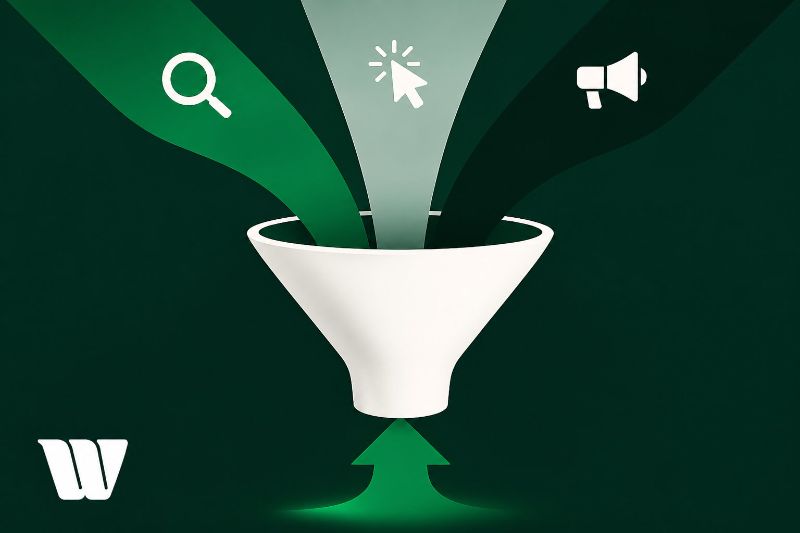
Acquisition channels are the pathways you use to attract and convert new customers — think organic search, paid ads, social media, email, referrals, and affiliates. Each channel carries different costs, timelines, and ROI profiles. SEO drives 50%+ of web traffic at no cost per click, while paid ads deliver immediate visibility. Relying on one channel puts your growth at risk. The right mix depends on your business type, budget, and goals — all of which are worth understanding in detail.
Key Takeaways
- Acquisition channels like organic search, paid ads, social media, and referrals guide potential customers from discovery to purchase decision.
- SEO drives over 50% of website traffic at no cost per click once pages achieve strong search rankings.
- Paid ads deliver immediate visibility through precise demographic, behavioral, and intent-based targeting across multiple ad formats.
- Diversifying across multiple channels reduces risk and creates compounding growth opportunities unavailable through single-channel strategies.
- Channel selection should match business type, with B2B favoring LinkedIn and SEO, while e-commerce prioritizes paid social and email.
What Are Acquisition Channels and Why Do They Matter?
Acquisition channels are the specific pathways through which businesses attract and convert new customers—think organic search, paid ads, referrals, or social media. Each channel represents a distinct entry point in the customer journey, shaping how prospects discover, evaluate, and ultimately choose your brand.
Why do they matter? Because channel diversity directly impacts your revenue stability and growth potential. When you rely on a single channel, you're exposed to algorithm changes, rising ad costs, or platform shifts that can cripple your pipeline overnight.
Diversifying across multiple channels distributes risk and creates compounding growth opportunities.
Understanding which channels drive your highest-quality customers—not just volume—lets you allocate budget strategically, optimize conversion rates, and build a more resilient, scalable acquisition engine over time.
Win Customers Through Organic Search With SEO
When done right, SEO compounds over time in a way paid channels simply can't—organic search drives over 50% of all website traffic across industries, yet it costs nothing per click once you've earned the ranking.
Your content strategy determines which queries you're eligible to rank for, while keyword optimization guarantees you're targeting terms with sufficient volume and commercial intent.
Prioritize pages that align with buyer intent over vanity traffic. Track rankings, click-through rates, and conversion data to identify which content actually moves the needle.
Unlike ads, a well-optimized page continues generating qualified traffic months or years after publication.
SEO rewards consistency—audit your site regularly, build authoritative backlinks, and update underperforming content to maintain and strengthen your positions over time.
Paid Ads: The Fastest Acquisition Channel for Immediate Reach
When you run paid ads, you're fundamentally paying platforms like Google or Meta to place your brand directly in front of potential customers—instantly.
Unlike SEO, which builds momentum over time, paid ads generate traffic the moment your campaign goes live, making them the fastest acquisition channel available.
The real power, however, lies in targeting: you can zero in on specific demographics, behaviors, and purchase intent signals to guarantee your budget reaches the audiences most likely to convert.
How Paid Ads Work
Paid ads operate on a simple premise: you pay to place your message in front of a targeted audience, and in return, you get immediate visibility.
Platforms like Google, Meta, and LinkedIn offer diverse ad formats — search, display, video, and sponsored content — each serving specific funnel stages. You bid for placement using models like cost-per-click (CPC) or cost-per-thousand-impressions (CPM), and the platform's algorithm determines when and where your ad appears.
Campaign optimization is ongoing — you'll continuously test creatives, adjust bids, refine audience segments, and analyze conversion data to maximize ROI.
Unlike organic channels, paid ads deliver measurable, scalable results quickly. The trade-off? Costs compound over time, making strategic budget allocation and performance tracking non-negotiable for sustainable growth.
Targeting the Right Audience
Even with the most compelling creative, your paid ads will underperform if they reach the wrong audience — targeting is where campaigns are won or lost.
Audience segmentation lets you deliver targeted messaging to users most likely to convert, maximizing every dollar spent.
Prioritize these segmentation strategies:
- Demographics: Filter by age, income, location, and job title
- Behavioral data: Target users based on past purchases or browsing patterns
- Lookalike audiences: Reach prospects mirroring your best existing customers
- Retargeting: Re-engage users who've already interacted with your brand
- Interest-based targeting: Align messaging with users' documented preferences
Platforms like Meta and Google provide granular targeting controls.
Use them strategically — narrow audiences reduce wasted spend, while broad targeting generates data to refine future segments.
Social Media, Email, Referral, and Affiliate Channels Explained
Beyond paid search and organic traffic, four additional channels—social media, email, referral, and affiliate—offer distinct acquisition pathways, each with its own cost structure, audience dynamic, and scalability profile.
Social engagement drives brand visibility through shares, comments, and community interaction, but requires consistent content investment.
Email segmentation lets you deliver personalized messaging to high-intent subscribers, typically yielding strong conversion rates at low marginal cost.
Referral incentives activate your existing customer base as a growth engine, converting satisfied users into motivated advocates.
Affiliate partnerships extend your reach through performance-based compensation, meaning you pay only when results materialize.
Analyzing each channel's CAC, LTV ratio, and conversion velocity helps you allocate budget strategically, ensuring you're not spreading resources thin across underperforming acquisition pathways.
Which Acquisition Channels Are Actually Worth the Investment?
Not every acquisition channel deserves equal investment, so you'll need to measure ROI by tracking cost per acquisition (CPA), customer lifetime value (CLV), and conversion rates for each channel.
Once you've got that data, you can identify which channels consistently deliver high-value customers at the lowest cost.
Prioritizing those high-impact channels—whether it's organic search, paid ads, or referrals—lets you allocate your budget strategically rather than spreading resources too thin.
Measuring Channel ROI Effectively
Knowing which acquisition channels drive real returns requires more than tracking surface-level metrics like clicks or impressions—you need a framework that ties channel spend directly to revenue outcomes.
Use attribution models to assign credit accurately across touchpoints, and leverage analytics integration to unify your data sources. Strong tracking tools eliminate guesswork by connecting cost efficiency metrics to actual conversion metrics.
Focus your measurement strategy on these essentials:
- Channel performance: Compare revenue generated against spend per channel
- ROI benchmarks: Set baseline expectations before scaling budgets
- Attribution models: Choose first-touch, last-touch, or multi-touch based on your funnel
- Data visualization: Turn raw numbers into actionable insights quickly
- Conversion metrics: Monitor cost-per-acquisition, not just traffic volume
Consistent measurement separates profitable channels from budget drains.
High-Impact Channels Worth Prioritizing
Once you've established how to measure ROI, the next challenge is deciding where to actually allocate your budget. Data consistently shows that certain channels outperform others across acquisition costs and lifetime value metrics.
SEO and content marketing deliver compounding returns. Unlike paid ads, optimized content generates traffic long after publication, lowering your cost-per-acquisition over time.
Paid search captures high-intent users actively searching for solutions, making conversion rates substantially higher than passive channels.
Influencer partnerships perform strongest when aligned with niche audiences rather than broad reach. Micro-influencers typically generate higher engagement rates and more qualified leads than macro-influencers.
Email acquisition consistently ranks among the highest-ROI channels, with conversion rates outpacing most social platforms.
Prioritize channels that match your audience's behavior, your budget's tolerance for risk, and your team's execution capacity.
The Right Acquisition Channels for Your Type of Business
Choosing the right acquisition channels boils down to understanding your business model, target audience, and unit economics.
Niche specific strategies and smart budget allocation separate high-performing businesses from those wasting spend on mismatched channels.
Match your channel selection to your business type:
- B2B SaaS: Prioritize LinkedIn Ads, SEO, and content marketing for long sales cycles.
- E-commerce: Leverage paid social, Google Shopping, and email retargeting.
- Local businesses: Focus on Google Business Profile, local SEO, and community ads.
- Marketplaces: Use referral programs and influencer partnerships to drive dual-sided growth.
- High-ticket services: Invest in webinars, outbound outreach, and thought leadership content.
Your channel mix must reflect your customer acquisition cost thresholds and lifetime value ratios.
How to Combine Acquisition Channels Into One Scalable Strategy
Matching channels to your business type gets you started, but running each channel in isolation caps your growth potential.
Cross channel synergies unleash compounding returns when you apply channel integration strategies that connect paid, organic, and owned media.
Use customer journey mapping to identify where audiences drop off, then deploy audience segmentation insights to retarget them across touchpoints.
A holistic marketing approach treats your data as a unified asset, not siloed reports.
Apply performance optimization techniques by reallocating budget toward channels that convert existing warm audiences first.
Resource allocation strategies should follow attribution data, not assumptions.
These sustainable growth tactics let you scale intelligently, reinvesting wins from high-performing channels into experimental ones without destabilizing your baseline revenue.
Integration isn't optional—it's your competitive advantage.
Frequently Asked Questions
How Do Acquisition Channels Differ From Retention Channels in Marketing?
Acquisition channels attract new customers to start their Customer Journey, while retention channels keep existing ones engaged. You'll maximize ROI through strategic Channel Integration, combining both to reduce churn and lower your overall customer acquisition costs effectively.
What Metrics Should I Track to Measure Acquisition Channel Performance?
You'll want to track traffic sources, conversion rates, cost-per-acquisition, and ROI. Use audience segmentation to analyze performance by demographics, then leverage that data for channel optimization, ensuring you're allocating budget toward your highest-performing acquisition channels.
How Long Does It Typically Take to See Results From New Channels?
You'll see timeline variations across channels: paid ads deliver results within days, while SEO takes 3-6 months. Set realistic initial expectations by tracking early data signals, adjusting strategy based on performance benchmarks you've established for each channel.
Can Small Businesses With Limited Budgets Effectively Use Multiple Acquisition Channels?
Yes, you can effectively use multiple channels on a tight budget. Prioritize cost-effective tactics like SEO first, then strategically allocate resources across two channels. Smart channel prioritization and budget strategies maximize your ROI without overspending.
How Do Seasonal Trends Impact the Effectiveness of Different Acquisition Channels?
Seasonal variations directly impact channel performance. You'll see paid ads spike in Q4 while SEO builds year-round momentum. Analyze your historical data strategically, then shift budgets toward channels that consistently outperform during your peak seasons.
Conclusion
Choosing the right acquisition channels isn't guesswork—it's a strategic decision backed by data. You've now got a clear picture of how SEO, paid ads, social media, email, referrals, and affiliates each perform differently depending on your goals and business type. Don't spread yourself thin across every channel. Instead, prioritize what your metrics support, test consistently, and scale what converts. Your most profitable growth strategy starts with knowing exactly where your customers come from.