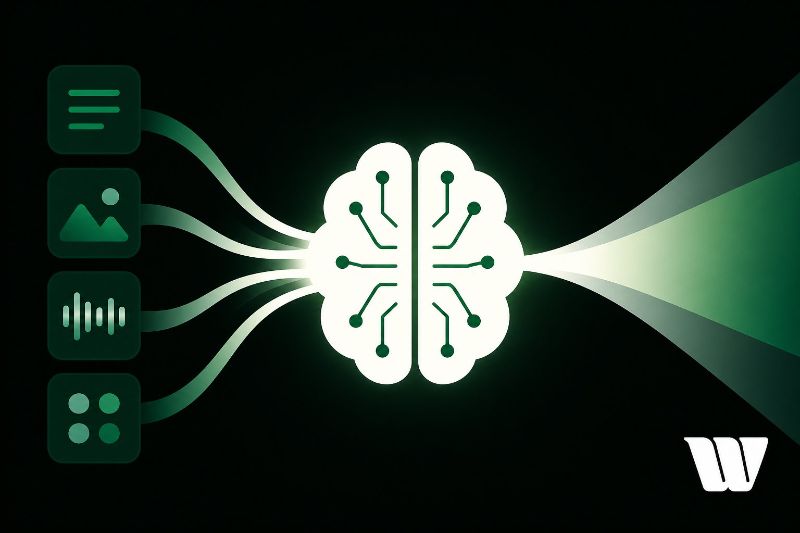
Multimodal AI lets you move beyond the constraints of single-input systems by processing text, images, and audio together within a unified model. It uses specialized modules for each data type, aligning their representations in a shared embedding space to enable cross-modal reasoning. Transformer-based architectures like GPT and Gemini dominate this space through flexible attention mechanisms. If you want to understand how this technology works, where it's applied, and what's holding it back, there's much more to unpack.
Key Takeaways
- Multimodal AI processes text, images, audio, and video within a single unified model using specialized modules aligned in a shared embedding space.
- Unlike single-mode AI, multimodal systems integrate multiple data types, enabling richer contextual understanding and better performance in complex real-world tasks.
- Text is tokenized, images analyzed via vision models, and audio converted into spectrograms, enabling structured numerical representations for cross-modal fusion.
- Key applications include healthcare diagnostics, autonomous vehicles, retail search, customer service, and manufacturing predictive maintenance.
- Challenges include alignment obstacles, high computational resource demands, and ethical concerns like deepfake governance and responsible deployment.
What Is Multimodal AI and How Does It Work?
Multimodal AI refers to artificial intelligence systems that can process, interpret, and generate information across multiple data types—text, images, audio, and video—within a single unified model. Unlike unimodal systems, these architectures encode each data type through specialized modules, then align representations within a shared embedding space. This alignment enables cross-modal reasoning, where understanding one modality actively informs another.
You'll find that multimodal integration strategies vary markedly—from early fusion, where raw inputs combine before processing, to late fusion, where modality-specific outputs merge afterward.
Transformer-based architectures, such as those powering GPT and Gemini, dominate current implementations due to their flexible attention mechanisms.
These capabilities translate directly into user experience enhancement, enabling more intuitive, context-aware interactions that mirror how humans naturally perceive and communicate across sensory channels.
Multimodal AI vs. Single-Mode AI: What's the Difference?
While single-mode AI systems constrain themselves to one data type—a language model processing only text, or a vision model interpreting only images—multimodal systems integrate several modalities simultaneously, enabling richer contextual understanding.
Single mode limitations become apparent when isolated models misinterpret ambiguous inputs lacking cross-modal context. A text-only system, for instance, can't resolve visual ambiguity, while an image-only model can't incorporate linguistic nuance.
Multimodal integration strategies address these gaps by fusing data streams through techniques like early fusion, late fusion, or hybrid architectures. Early fusion combines raw inputs before processing; late fusion merges outputs post-processing. You'll find hybrid approaches balance both, optimizing performance across diverse tasks.
These strategies collectively allow multimodal systems to outperform their single-mode counterparts across complex, real-world applications requiring simultaneous interpretation of heterogeneous data.
How Multimodal AI Processes Text, Images, and Audio
When you interact with a multimodal AI system, it processes your text input through transformer-based architectures that tokenize and encode linguistic patterns, while simultaneously applying convolutional or vision transformer models to extract spatial features from your images.
For audio, the system converts your sound waves into spectrograms or frequency representations, which neural networks then analyze to identify phonemes, tones, and contextual meaning.
Understanding how each of these modalities gets processed—and ultimately fused—gives you a clearer picture of why multimodal systems outperform their single-mode counterparts in real-world applications.
Text Data Processing Methods
Text sits at the core of most multimodal AI systems, and processing it effectively requires converting raw strings into structured numerical representations the model can manipulate.
You'll encounter several foundational methods that drive accurate understanding:
- Preprocessing pipeline — applies text normalization, named entity recognition, and topic classification to clean and structure raw input before modeling begins.
- Representation learning — uses contextual embeddings and language modeling to encode semantic relationships across token sequences.
- Analytical layers — perform sentiment analysis, semantic analysis, and feature extraction to derive meaning beyond surface-level syntax.
- Output refinement — leverages text summarization and data augmentation to improve generalization and reduce information loss during cross-modal fusion.
Each method compounds the next, giving your multimodal system progressively richer linguistic context to align with visual and audio signals.
Image Recognition Techniques
Moving from linguistic representations into visual data, image recognition techniques give multimodal AI systems the ability to extract structured information from raw pixel arrays.
You'll find that visual feature extraction relies heavily on convolutional neural networks, which detect edges, textures, and spatial hierarchies across image layers.
Deep learning frameworks like PyTorch and TensorFlow enable you to build scalable architectures that handle complex image classification methods, including object detection, semantic segmentation, and scene understanding.
Your model's accuracy depends considerably on training datasets—ImageNet, COCO, and Open Images provide labeled examples that calibrate feature detectors across diverse visual domains.
Attention mechanisms further refine this process, allowing the system to weight salient regions selectively before integrating visual embeddings with other modality representations downstream.
Audio Signal Interpretation
Key processing tasks your system must handle:
- Sound pattern recognition — identifying recurring acoustic structures across diverse environments.
- Speech emotion detection — classifying affective states from prosody and tonal variation.
- Music genre classification — distinguishing stylistic patterns through harmonic and rhythmic features.
- Environmental sound classification — categorizing ambient sounds like traffic or machinery.
You'll also apply audio data augmentation—pitch shifting, time stretching, noise injection—to prevent overfitting and improve model generalization across real-world acoustic conditions.
What Multimodal AI Is Actually Being Used for Right Now
Beyond theoretical frameworks, multimodal AI is already driving measurable impact across industries. You'll find real world applications embedded in healthcare diagnostics, where systems simultaneously analyze radiology images, patient records, and clinical notes to support faster, more accurate diagnoses.
In autonomous vehicles, sensor fusion combines visual, lidar, and audio data streams to enable real-time navigation decisions. Retail platforms deploy multimodal models to match product images with descriptive text, improving search precision and conversion rates.
Industry trends indicate accelerating adoption in customer service, where AI agents interpret voice tone, written queries, and contextual history simultaneously. Manufacturing environments leverage visual inspection paired with operational telemetry to predict equipment failures before they occur.
These deployments aren't experimental—they're generating quantifiable ROI and reshaping how organizations design their core operational workflows.
The Biggest Challenges Holding Multimodal AI Back
Despite its rapid progress, multimodal AI faces two core obstacles that you'll encounter in any serious deployment: data alignment complexities and steep computational resource demands.
When you're working across modalities like text, image, and audio, aligning heterogeneous datasets so the model learns coherent cross-modal relationships is a non-trivial engineering challenge.
Compounding this, you're dealing with architectures that require considerably more processing power, memory, and training time than their single-modality counterparts.
Data Alignment Complexities
When different data types don't share a natural common ground, aligning them becomes one of multimodal AI's hardest unsolved problems. Data synchronization issues emerge when temporal mismatches occur between audio waveforms and video frames, forcing models to infer missing correlations.
Feature extraction challenges compound this further, as each modality operates within entirely different mathematical spaces.
You'll encounter four critical alignment obstacles:
- Temporal drift between audio and visual streams corrupts cross-modal learning
- Semantic gaps between text embeddings and image feature vectors resist direct mapping
- Resolution mismatches across modalities create incompatible representation densities
- Annotation inconsistencies introduce labeling conflicts that destabilize training
Without robust alignment strategies, your model fundamentally processes disconnected information streams, severely limiting its ability to synthesize coherent cross-modal understanding.
Computational Resource Demands
Training and deploying multimodal AI systems demand computational resources that dwarf those required by single-modality models. You're dealing with exponentially higher hardware requirements as each additional modality multiplies memory, storage, and processing speed needs.
Resource allocation becomes a critical bottleneck—distributing compute across text encoders, vision transformers, and audio processors simultaneously creates severe infrastructure demands.
Scalability issues compound quickly. As you scale these systems, energy consumption rises sharply, making sustainable deployment increasingly difficult.
Model optimization techniques like quantization and pruning help, but they introduce accuracy trade-offs you must carefully manage. Computational efficiency remains elusive because cross-modal attention mechanisms carry enormous overhead.
Without purpose-built hardware accelerators and refined architectural strategies, you'll consistently encounter performance ceilings that prevent real-world multimodal applications from reaching their full potential.
Where Multimodal AI Is Headed Next
As multimodal AI systems grow more capable, the next frontier involves tighter sensory integration, longer-context reasoning, and real-time interaction across modalities.
You'll see these advances reshape industries, redefine user experience, and unleash creative potential previously constrained by single-modality architectures.
Key developments you should track:
- Expanded integration strategies — unified models processing video, audio, text, and sensor data simultaneously
- Accessibility improvements — real-time captioning, scene narration, and adaptive interfaces serving diverse users
- Educational benefits — personalized, multimodal tutoring systems adjusting to individual learning patterns
- Ethical considerations — governance frameworks addressing deepfakes, consent, and industry impacts across healthcare, law, and media
Future applications will demand that you evaluate both capability gains and systemic risks, ensuring deployment remains responsible, measurable, and aligned with human-centered design principles.
Frequently Asked Questions
How Much Does It Cost to Build a Multimodal AI System?
Building a multimodal AI system's cost varies widely—you're looking at $50K to $10M+, depending on cost factors like data complexity, team expertise, and your development timeline, which typically spans six months to several years.
Can Multimodal AI Models Run Locally on Personal Devices?
Yes, you can run multimodal AI models locally, but you'll need to meet demanding hardware requirements. Local deployment typically requires high-end GPUs, substantial RAM, and significant storage to handle text, image, and audio processing efficiently.
Which Programming Languages Are Best for Developing Multimodal AI Applications?
Python's your best choice for developing multimodal AI applications. You'll leverage powerful Python libraries like TensorFlow and PyTorch, ensuring framework compatibility, optimizing model performance, and streamlining data preprocessing across text, image, and audio modalities efficiently.
Are There Open-Source Multimodal AI Models Available for Public Use?
Yes, you can access several open-source models like LLaVA, OpenFlamingo, and CLIP. They're built on community contributions, letting you integrate multimodal AI capabilities—spanning text, images, and audio—directly into your own applications.
How Do Multimodal AI Systems Handle Data Privacy and User Security?
Multimodal AI systems protect you through data anonymization strategies that strip identifiable information and user consent frameworks that govern how your text, images, and audio inputs are collected, processed, stored, and shared across integrated modalities.
Conclusion
Multimodal AI isn't just an incremental upgrade—it's a fundamental shift in how machines interpret and respond to the world. As you've seen, combining text, images, and audio reveals capabilities that single-mode systems simply can't match. You'll want to watch how alignment challenges, computational costs, and ethical constraints shape its trajectory. The architecture is maturing rapidly, and understanding its mechanics now positions you to evaluate its real-world impact with precision.