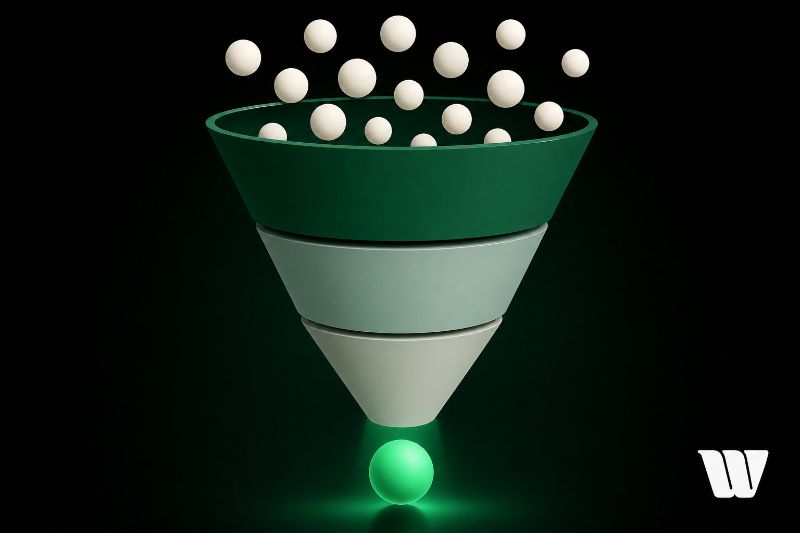
A marketing funnel maps your customer's journey from first discovering your brand to taking a desired action—whether that's a purchase, sign-up, or booking. Each stage (awareness, consideration, and decision) requires a different strategy, and losing 79% of leads before conversion is the average for businesses that don't optimize theirs. Fixing leaks, targeting the right audience, and personalizing your messaging turns passive browsers into paying customers. Stick around—there's a lot more to unpack.
Key Takeaways
- A marketing funnel maps the customer journey from brand discovery through awareness, consideration, and decision stages to final conversion.
- Each funnel stage requires distinct strategies, including audience segmentation, targeted messaging, and content that drives engagement and trust.
- Funnel leaks are common, with businesses losing over 79% of leads before conversion due to targeting and messaging misalignments.
- Personalization, social proof, and urgency tactics like limited-time offers and scarcity alerts significantly increase conversion rates throughout the funnel.
- Tools like HubSpot, ActiveCampaign, and Google Analytics 4 optimize funnel performance through lead scoring, automation, and precise data tracking.
What Is a Marketing Funnel, Really?
A marketing funnel maps the journey your prospects take from first discovering your brand to completing a desired action—whether that's making a purchase, signing up, or booking a call.
It's a structured framework built on funnel psychology, designed to guide buyers through awareness, consideration, and decision stages. You use audience segmentation and customer personas to deliver the right message at each stage.
Your content strategy fuels engagement tactics that keep prospects moving forward, while lead nurturing builds trust over time.
Every touchpoint along the buyer journey is an opportunity to apply conversion optimization principles that reduce friction and increase commitment.
When you align each funnel layer strategically, you transform cold traffic into qualified leads—and qualified leads into paying customers.
The Stages of a Marketing Funnel: From First Click to Final Sale
Every marketing funnel moves prospects through distinct stages—awareness, consideration, and decision—each requiring a different strategy to keep momentum going.
You're not just generating clicks; you're engineering a sequence of micro-conversions that systematically build trust and reduce friction until a purchase becomes the logical next step.
Understanding where prospects drop off at each stage gives you the data you need to tighten your funnel and turn more first clicks into final sales.
Funnel Stages Breakdown
Whether you're running paid ads, organic content, or email campaigns, every lead you attract moves through a series of predictable stages before converting — and knowing exactly what happens at each stage is what separates guessing from a strategy that scales.
Funnel visualization techniques let you map each stage clearly — awareness, consideration, and decision — so you can identify exactly where leads drop off and why.
Buyer journey mapping takes this further by aligning your messaging, offers, and touchpoints to match what your prospect actually needs at each stage.
Without this structure, you're wasting budget on the wrong audience at the wrong time.
With it, you're engineering a system where every stage feeds the next — predictably moving leads from first click to final sale.
Converting Clicks Into Sales
Most clicks never become customers — not because the product is wrong, but because the funnel is. Every drop-off point costs you revenue, and most losses happen between the click and the checkout.
Click optimization isn't just about traffic — it's about intent alignment. When your landing page matches what the ad promised, conversions climb. When it doesn't, you bleed leads.
Sales psychology drives the gap between browsing and buying. Urgency, social proof, and frictionless design aren't manipulation — they're architecture. You're guiding a decision, not forcing one.
Audit your funnel like a data analyst. Track where users exit, what they hesitate on, and why they abandon carts.
Then fix one variable at a time. Precision outperforms guesswork every time.
Why Most Marketing Funnels Leak (And How to Fix Yours)
Even the most carefully constructed funnel loses prospects at every stage—studies show that the average business loses over 79% of leads before they ever convert.
You need to pinpoint exactly where your funnel bleeds by tracking drop-off rates at each stage, since a weak awareness stage demands a completely different fix than a broken checkout process.
Once you've identified your leak points, proven strategies like retargeting campaigns, streamlined landing pages, and friction-reducing checkout flows can systematically patch the holes and push your conversion rates upward.
Common Funnel Leak Causes
There are 5 core reasons your marketing funnel leaks—and understanding them is the first step to plugging the holes.
First, you're targeting the wrong audience, meaning unqualified leads enter and exit quickly.
Second, your messaging misaligns across funnel stages, breaking trust and momentum.
Third, you're relying on common misconceptions—like assuming more traffic automatically means more conversions. It doesn't.
Fourth, weak calls-to-action create decision paralysis, stalling prospects mid-funnel.
Fifth, you're skipping funnel optimization techniques like A/B testing, heatmaps, and behavioral analytics that reveal exactly where drop-offs occur.
Each leak compounds the others. A misaligned message attracts the wrong traffic; poor CTAs fail those who do stay.
Fix these five systematically, and your funnel stops hemorrhaging potential revenue at every stage.
Identifying Your Weak Stages
Before you can fix a leaking funnel, you need to pinpoint exactly where prospects are dropping off—and that requires data, not guesswork. Start by tracking conversions at every stage and measuring engagement across each touchpoint. Analyzing drop-offs reveals which pages, emails, or ads are losing prospects before they advance.
Once you're identifying bottlenecks, dig deeper by segmenting audiences to understand which groups disengage first. Evaluating content performance shows whether your messaging resonates or repels.
Then focus on optimizing touchpoints where friction exists, enhancing user experience to reduce unnecessary barriers. Testing strategies like A/B experiments confirm what's actually working.
Refining messaging based on real behavioral data—not assumptions—transforms weak stages into conversion engines. Fix the leak at its source, and your entire funnel performs stronger.
Proven Leak-Fixing Strategies
Run consistent performance analysis to measure what's actually working.
Funnel optimization isn't a one-time fix—it's an ongoing cycle of testing, measuring, and refining.
Data tells you where to act; your execution determines whether prospects convert.
How to Attract the Right People at the Top of the Marketing Funnel
Attracting the right people at the top of the funnel isn't about casting the widest net — it's about casting the right one.
Start with demographic research to define your target audience precisely. Then build a content strategy that speaks directly to their pain points. Use SEO tactics to capture high-intent search traffic before competitors do.
Deploy lead magnets that deliver immediate value, reinforcing your value proposition from the first touchpoint. Strengthen brand awareness through strategic influencer partnerships that reach pre-qualified audiences.
Apply engagement techniques across social media platforms where your audience already spends time. Every channel you activate should serve a measurable purpose.
When you align audience data with intentional outreach, you stop attracting everyone — and start attracting the right ones.
Email Sequences, Retargeting, and the Tactics That Nurture Leads
Once you've captured a lead, the real work begins — and most conversions don't happen on the first touch. Research shows it takes 6–8 touchpoints before a prospect converts. That's where lead nurturing becomes critical.
Use email automation to deploy follow up sequences triggered by specific behaviors — page visits, downloads, or abandoned carts. These conversion triggers move prospects forward without manual effort.
Layer in retargeting strategies across paid channels to re-engage users who've gone cold.
Sharpen results through customer segmentation. Not every lead has the same intent, so content personalization based on funnel stage dramatically increases relevance.
Track engagement metrics — open rates, click-throughs, and session duration — to identify what's working and cut what isn't. Data tells you exactly where leads stall and what pushes them to act.
How to Convert Warm Leads Into Paying Customers
Nurturing leads gets them to the door — converting them means knowing exactly when and how to push it open. Your conversion tactics must be precise and well-timed.
Use personalized offers based on behavioral data — past clicks, viewed pages, and purchase patterns signal intent.
Deploy social proof strategically: testimonials, case studies, and real numbers eliminate doubt fast. Trust building accelerates when prospects see others succeeding with your product.
Layer in urgency creation through limited-time deals or low-stock alerts — scarcity drives decisions.
Your follow up strategies should trigger at peak engagement moments, not arbitrary intervals. Customer engagement metrics tell you when a lead is ready.
Stop guessing — let data dictate your move, and you'll consistently turn warm interest into committed purchases.
The Software Stack Behind a High-Converting Marketing Funnel
Your software stack either accelerates conversions or quietly kills them. Every tool you choose directly impacts funnel optimization, user experience, and revenue outcomes.
Start with CRM solutions that support lead scoring, so your team prioritizes high-intent prospects automatically. Layer in automation features to trigger personalized follow-ups based on real behavior, not assumptions.
Your analytics tools must deliver precise data tracking across every funnel stage. Without clean attribution, you're optimizing blindly. Connect your ad platforms, landing pages, email sequences, and CRM through tight software integration — gaps between tools create drop-off points you'll never diagnose.
Platforms like HubSpot, ActiveCampaign, and Google Analytics 4 work well together when configured intentionally. Build your stack around conversion data, not feature lists, and you'll consistently move prospects forward.
Frequently Asked Questions
How Long Does It Typically Take to Build a Complete Marketing Funnel?
Building a complete marketing funnel typically takes 4–12 weeks, depending on your timeline factors like budget, team size, and complexity. You'll move through funnel stages faster when you've got clear goals and data-driven strategies guiding each conversion step.
Can Small Businesses With Limited Budgets Still Implement Effective Marketing Funnels?
Yes, you can build effective funnels on a tight budget. Use cost-effective strategies like email marketing and social media, apply customer segmentation to target the right audience, and you'll maximize conversions without overspending.
What Metrics Should I Track to Measure My Funnel's Overall Performance?
Track conversion rates at each of your funnel stages, plus traffic volume, bounce rates, cost-per-lead, and customer acquisition costs. These metrics'll reveal where you're losing prospects and which stages need immediate optimization.
How Often Should I Update or Redesign My Existing Marketing Funnel?
You should review your funnel quarterly and apply funnel optimization strategies whenever data signals declining conversions. Don't wait for failure—adjust redesign frequency based on performance metrics, audience shifts, or significant market changes impacting your results.
Are Marketing Funnels Still Relevant With Today's Complex Customer Buying Journeys?
Yes, marketing funnels remain relevant. You can't ignore customer behavior patterns that naturally follow funnel stages. Data consistently shows structured funnels boost conversions by guiding prospects strategically, even within today's complex, non-linear buying journeys.
Conclusion
Your marketing funnel isn't a set-it-and-forget-it system—it's a living framework you'll continuously optimize. Track your conversion rates at every stage, identify where prospects drop off, and test targeted fixes methodically. The businesses winning today aren't those with the biggest budgets; they're the ones who understand their data, tighten their messaging, and remove friction ruthlessly. Build your funnel deliberately, measure what matters, and you'll turn strangers into loyal, paying customers consistently.