Adalo is a visual no-code platform for database-driven apps on iOS, Android, and the web. You design on a multi-screen canvas. Ada, Adalo’s AI assistant (beta), can generate and edit from natural language. You publish one project to the Apple App Store, Google Play, and a web/custom domain.
That is a different job from an AI company-in-a-box. Adalo is strongest when you already know you need a native mobile app (plus web) without a mobile engineering team. It is a weaker match if you mainly need research, a brand, a public marketing site, Stripe for a company, and agents that keep operating after publish.
Curious how it stacks up against Willo? Check out our comparison between Adalo and Willo.
What is Adalo?
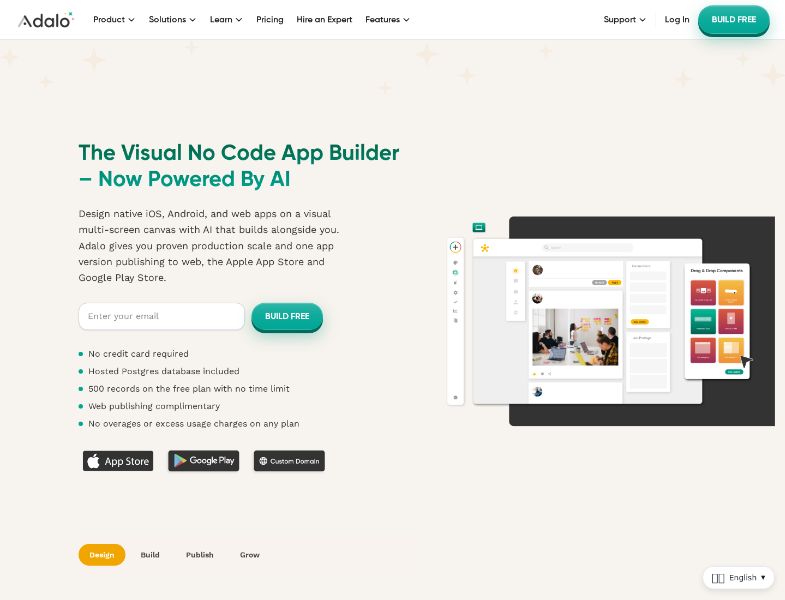
Adalo is a visual AI app builder for entrepreneurs and business teams who need custom apps without code or developers. Capabilities include:
- Native iOS and Android store builds from the same canvas as the web app
- Hosted Postgres (relational collections) or external backends (Xano on Team; REST / Sheets on paid tiers)
- Payments (Stripe; IAPHUB for digital goods, subject to Apple/Google rules)
- Push notifications, geolocation, custom actions, Zapier/Make
- Component marketplace (free and premium)
- Ada for prompt-based build and edit (included; labeled beta on pricing)
Adalo says the platform has been used to create 1M+ apps, with 2M+ unique end users and 20M+ average daily data requests, plus 99% average uptime.
How Adalo works
A typical path looks like this:
- Sign up (no card on Free). Design screens on the multi-screen canvas.
- Optionally prompt Ada to generate or edit screens, components, and data models.
- Connect the built-in database or an external API/Xano.
- Preview on device and share a test URL (testers do not consume editor seats).
- On a paid plan, publish to web / custom domain and submit store builds (AAB for Play; native iOS via Adalo’s publishing flow).
A 14-day trial unlocks most premium features except store and custom-domain publishing.
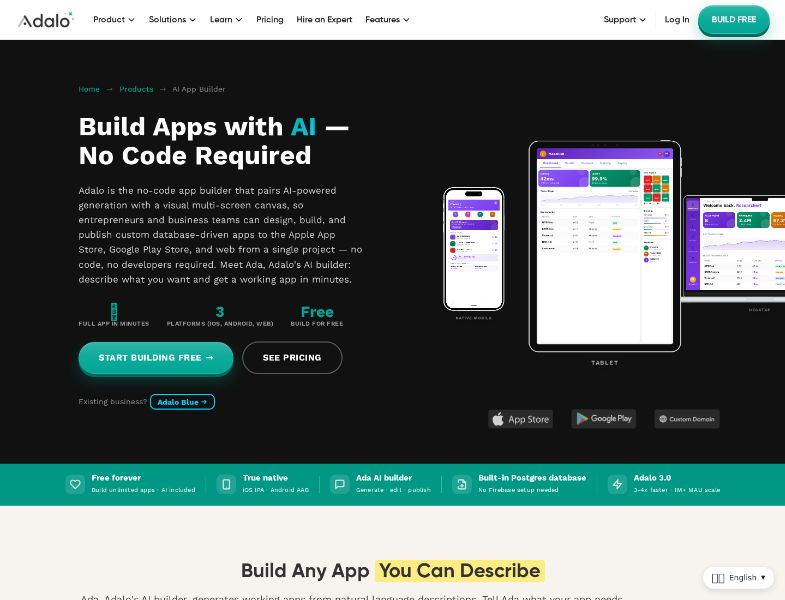
Key features
Visual canvas and components
Adalo’s differentiator versus page-by-page builders is seeing every screen on one canvas. The product includes 200+ components, custom fonts (Starter+), formulas and AND/OR logic (Professional+), design versions (Professional+), and version history (Team).
Ada AI
Ada is included on all plans with no token or usage charge. The pricing cards still say Prompt-Building And Prompt-Editing (Beta). You are not required to use AI; the canvas remains the source of truth.
Data and integrations
- Built-in hosted Postgres on every plan (Free: 500 records per app).
- Paid storage caps in the comparison table: 5 GB / 25 GB / 125 GB per team on Starter / Professional / Team.
- Professional: custom integrations, custom actions, Google Maps/geolocation.
- Team: Xano, App & Collections API, Notifications API.
- Zapier, Make, Stripe, HubSpot, Gmail, Supabase, and REST appear in marketing; confirm each connector in-product.
Publishing
- Free: build/test; web on Adalo’s complimentary terms. Store and custom domain require Starter+.
- One published app can go to web + both stores and still count as one published app if it shares the Adalo database. External-database apps count separately (pricing FAQ).
- Unpublishing a store app stops actions for end users and turns it back into a Test App.
What you do not get
Editable code export is not currently available. CSV export of collections is documented. Store binaries are for distribution, not a handoff of React Native/Flutter source.
Pricing and plans
Adalo’s public pricing emphasizes no usage-based charges. The annual toggle is advertised as Save 20%; monthly billing is Pay 20% more. Displayed cards are $0 / $36 / $52 / $160 per month billed annually. Confirm the monthly checkout price rather than inferring it from the 20% language.
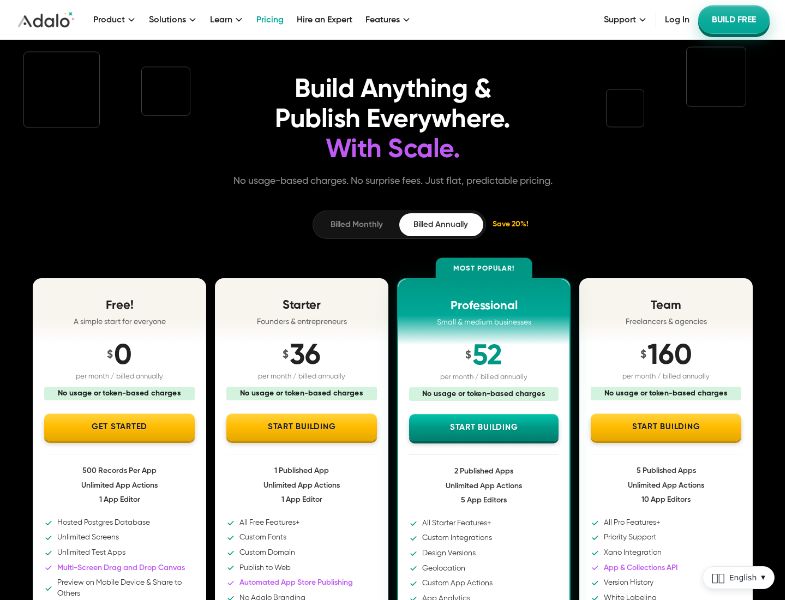
| Plan | Annual effective (as shown) | Published apps | Editors | Notable inclusions |
|---|---|---|---|---|
| Free | $0 | 0 | 1 | 500 records/app, Ada (beta), unlimited test apps/screens |
| Starter | $36/mo | 1 | 1 | Custom domain, web + automated store publishing, no Adalo branding |
| Professional | $52/mo | 2 | 5 | Integrations, geolocation, push, analytics, formulas, design versions |
| Team | $160/mo | 5 | 10 | Priority support, Xano, APIs, version history, white label |
| Adalo Blue | Custom | Custom | Custom | Dedicated / on-prem / legacy data (blue.adalo.com) |
Add-ons: +$25/mo per extra published app; +$15/mo per extra editor.
Not included: Apple Developer ($99/year) and Google Play Developer ($25 one-time).
Billing rules: prorated upgrades; no double charge. Downgrade between paid plans creates non-expiring credits, not a card refund. There are no refunds if you cancel to Free; access continues until period end. Non-payment can strip paid features.
Help docs mention a Business plan for agencies. The public pricing page lists Team and Adalo Blue — confirm the SKU in your account if you are quoting for an agency.
What this means in practice: Starter is cheap if you have one live app. Agencies should price Team + extra apps. There is no per-MAU meter on the public page — the constraint is apps, editors, and storage (and Free’s 500 records).
User feedback and reputation
G2 rates Adalo 4.4 / 5 from 7 reviews (85% five-star, 14% three-star). That is a small sample, not a category consensus.
Recurring themes from those reviews:
- Liked: ease of use; almost no coding; fast MVPs; internal DB or API backends; community/examples.
- Disliked: no source-code export; a 3/5 review said the product was fine to test but not scalable past about 5,000 users, with store-review risk. That describes one team’s experience and is not an official Adalo limit. Adalo’s current marketing claims much larger scale, and the review is from December 2024, so it may predate later infrastructure work.
GetApp shows 3.5 / 5 from 25 reviews, a second, more mixed listing.
Pros and cons
Pros
- Genuine native store path from a no-code canvas
- Ada included with no token meter (still beta)
- Flat pricing, no app-action overages on the public page
- Built-in database; Xano on Team
- Free forever to design and test (500 records)
Cons
- No editable code export — lock-in is real
- Tiny G2 sample; mixed GetApp score
- Extra apps/editors and Apple/Google fees sit on top of $36
- Ada is beta; some Professional features (push, geo, custom actions) are gated
- Not a marketing company or growth engine
- Unpublish / downgrade can take live apps offline
Limitations and challenges
- Source ownership. If procurement requires a GitHub repo of app source, Adalo does not currently offer editable code export.
- Scale narrative vs reviews. Marketing says millions of users; at least one verified G2 reviewer left after about 5,000. Ask Adalo for current 3.0 architecture details if you expect consumer scale.
- Store rules. Digital goods often cannot use Stripe inside iOS/Android; IAPHUB / store billing applies.
- Plan SKUs. Help docs mention a Business plan, while public pricing lists Team and Adalo Blue — confirm before you quote.
- Monthly vs annual. Annual billing is advertised as 20% off; confirm the monthly checkout price rather than inferring it.
Who Adalo is best for
- Founders shipping an MVP to both stores
- Small teams that want a visual canvas, not a code IDE
- Agencies on Team/white-label with a handful of client apps
- Builders who accept staying on Adalo’s hosted runtime
Who may want an alternative
- People whose real need is a public company (brand, SEO site, payments, ongoing marketing)
- Teams that must own exportable source
- Products that only need a marketing site or web SaaS (Bubble, WeWeb, FlutterFlow may fit better depending on code-export needs)
- Operators who will not learn a mobile canvas
Willo as an alternative
Willo is an AI business builder, not a native-app studio. You describe an idea. Agents research, brand, deploy a website to your GitHub repo, and keep working on content and operations. Chat is free; credits pay for shipped work. Plans: Free $0 (40 credits), Starter $25, Builder $49, Growth $99, Scale $199.
Willo will not replace Adalo if the deliverable is an App Store binary. It is a better fit if you still need a company, a public site, and a payment flow more than a native app.
Frequently asked questions
Is Adalo free?
Yes. Free forever to build and test (500 records/app). Publishing to stores or a custom domain starts on Starter.
What is the cheapest way to get on the App Store with Adalo?
Starter at $36/month billed annually, plus Apple’s $99/year and Google’s $25 one-time fee.
Does Adalo include AI?
Yes. Ada is on every plan with no extra token fee. Pricing still marks it beta.
Can I export my Adalo app as code?
Not editable source. CSV for data; store files for publishing.
Does Adalo charge per user or per action?
Paid plans have no usage-based / per-action charges.
Conclusion
Adalo is a straightforward way to design once and publish native iOS, Android, and web without a mobile team, at a flat monthly price. Read the no-export FAQ before you bet a long-term product on it. Do not expect a marketing company or a GitHub-owned site to come with the canvas.
If what you actually wanted was the business around the app, start free on Willo.