Adalo and Willo both let a non-engineer ship something useful. They solve different problems.
Adalo is a visual app builder powered by AI. You design database-driven native iOS, Android, and web apps on a multi-screen canvas. Ada, Adalo’s AI assistant (beta), can generate and edit from prompts. You publish one project to the Apple App Store, Google Play, and the web. The job is apps — especially mobile apps that need store listings.
Willo is an AI business builder. You describe an idea. Agents research the market, create a brand, deploy a website to your GitHub repo, prepare Stripe, and keep working on content, marketing, and operations. Chat is free. Credits pay for work that ships.
If you need a native mobile app in the App Store and Play Store from a visual canvas, Adalo is usually the better fit for that use case. If you want to create and operate the business — research, brand, public site, payments, and weekly agent work — Willo is built for that job.
Quick decision
| You need… | Better starting point |
|---|---|
| Native iOS + Android + web from one visual project | Adalo |
| App Store / Play Store publishing without writing code | Adalo |
| A hosted Postgres database and flat-fee app plans (no per-action meter) | Adalo |
| A public marketing site, brand, and Stripe from a one-line idea | Willo |
| Agents that keep writing, marketing, and operating after launch | Willo |
| Code and assets you own in GitHub if you cancel | Willo |
| Editable source-code export of the app | Neither as a first-class Adalo feature |
What is Adalo?
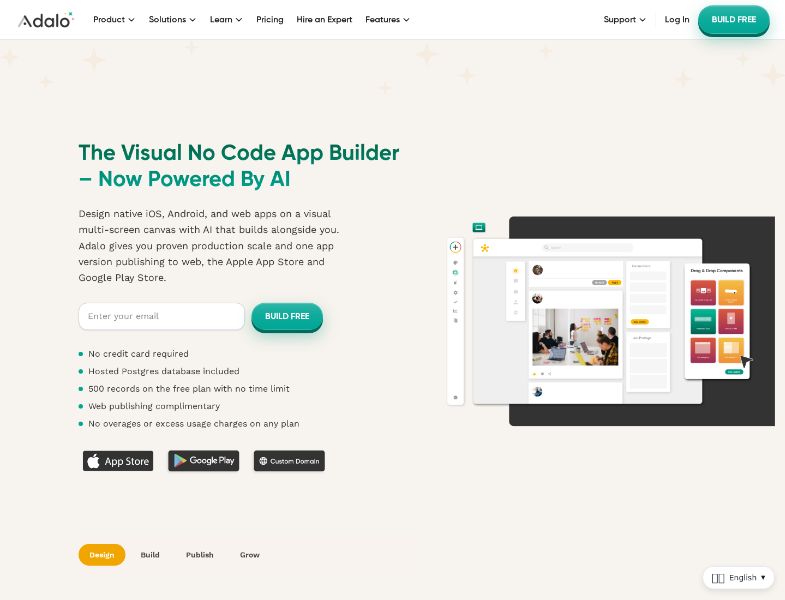
Adalo is a visual no-code / AI platform for custom database-driven apps on iOS, Android, and web. Design on a multi-screen canvas, generate with Ada, then publish one version to stores and a custom domain.
A typical Adalo workflow looks like this:
- Design on a drag-and-drop canvas (see every screen, not only one page at a time).
- Build data in a hosted Postgres database, or connect Xano, REST, Google Sheets, and other sources (feature availability varies by plan).
- Publish to web, Apple App Store, and Google Play from the same project.
- Grow with payments (Stripe / IAPHUB), push notifications, geolocation, Zapier/Make, and analytics on higher plans.
The Free plan includes no credit card, hosted Postgres, 500 records, unlimited time, complimentary web publishing on Adalo’s terms, and no overages or excess usage charges on any plan.
Adalo says the platform has been used to create 1M+ apps, with 2M+ unique end users and 20M+ average daily data requests. It also reports 99% average app uptime and infrastructure built to handle 5,000,000 users and beyond.
Adalo’s help documentation says editable code export is “Not currently” available. You can export collection data as CSV. Native store builds (IPA / AAB) are generated for publishing, not as an editable React Native/Flutter project.
What is Willo?
Willo is an AI business builder for founders, operators, solopreneurs, agencies, and local businesses. You describe an idea in chat. Agents research the market, produce a brand and living roadmap, generate a website, deploy it to your GitHub repo, and keep working on content, SEO, email, and operations.
Chat is always free. You spend credits only on work that ships. One plan covers every business in the account through a shared credit pool.
On Day 1, Willo aims to deliver a website, brand, roadmap, repo, analytics, and an email list ready to capture leads. See What to Expect. Willo is explicit about what it is not: not a get-rich-quick scheme, not a substitute for product-market fit, and not a set-and-forget lottery ticket. You still steer.
Every plan gets backend infrastructure from the start, including Free. With paid plans, you also get access to the Autonomous Growth Engine, Stripe Connect revenue tools, email and contact management, and analytics. Higher plans open up additional capabilities like custom domains, team access, business transfers, Shopify integration, and increased backend compute.
Adalo vs Willo: feature-by-feature
| Area | Adalo | Willo |
|---|---|---|
| Primary job | Native + web apps from a visual canvas | Launch and operate a business from an idea |
| Starting input | Canvas + Ada prompts (beta) | A business idea in chat |
| AI | Ada: prompt-building and prompt-editing, included on all plans, with no token meter | Agents that research, brand, build, write, and run scheduled work; unlimited free chat |
| Public marketing site | Responsive web apps; not positioned as SEO/AEO growth | First-class: AI website, SEO/AEO, GitHub + hosting |
| Backend / data | Hosted Postgres; Xano on Team; REST / Sheets / external collections on paid tiers | Provisioned backend from Free: database, auth, APIs, cloud storage |
| Native mobile | True native store publishing (Starter+); IPA and APK/AAB from one canvas | Responsive web; not positioned as App Store / Play binaries |
| Payments | Stripe in-app; IAPHUB for digital goods; Apple/Google rules for store apps | Stripe Connect from Starter; Shopify from Builder |
| Code export | Not currently available for editable source. CSV data export. Store build files for publishing | Site deploys to your GitHub repo; cancel and keep what was built |
| Custom domain | Starter and above | Builder and above |
| Collaboration | App editors / collaborators (1 / 1 / 5 / 10 by plan); extra editors $15/mo | Invite your team from Builder; business transfer from Builder |
| Pricing model | Flat monthly plans; no usage-based app-action charges | Credits for shipped work; shared pool |
| Ownership if you leave | Hosted on Adalo; no editable code export. Unpublishing stops live actions | GitHub repo, site, Stripe, email list |
AI and building style
Adalo’s AI is in the canvas. Ada is included on all plans with no extra token charge. The pricing page still labels Ada as beta. You can keep building visually if you never use prompts.
Willo’s AI works more like an operating team than a screen designer. Unlimited chat is free. Credits are spent on tasks that ship.
Mobile vs company
This is the real split. Adalo’s cheapest paid path is explicitly App Store + Play Store publishing. Willo does not sell native store builds.
Adalo does not research a market, name a brand, or run weekly SEO/email for you. Homepage copy mentions “LLMs, PPC and SEO help” as growth support — that is not the same as Willo’s Autonomous Growth Engine, and it is not documented as a full marketing OS.
Pricing and cost
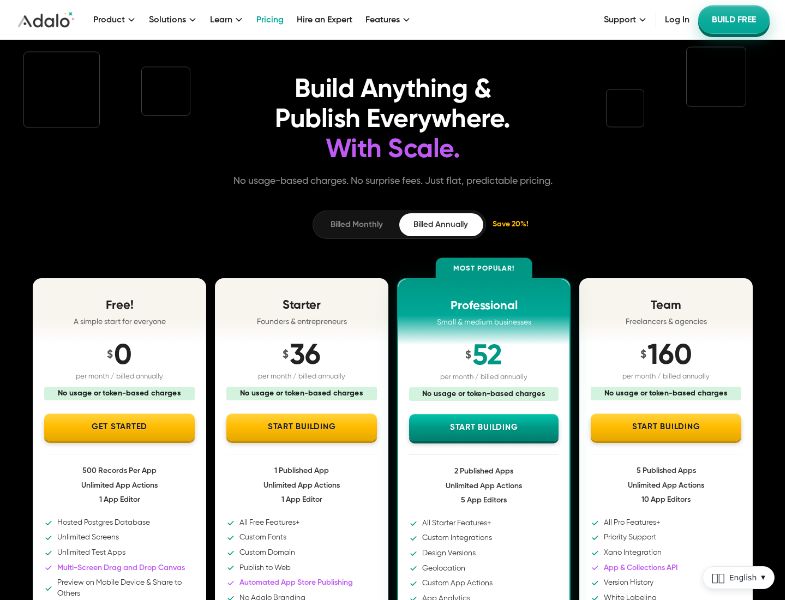
Adalo’s public pricing lists Free $0, Starter $36, Professional $52, Team $160 as per month, billed annually, with a “Save 20%” annual toggle and “Pay 20% more” on monthly. The comparison table also lists $0 / $36 / $52 / $160 per month. Because monthly prices can change, confirm the current toggle at checkout.
Adalo (self-serve)
| Plan | List price (billed annually) | Published apps | Editors | Storage | Highlights |
|---|---|---|---|---|---|
| Free | $0 | 0 (test apps unlimited) | 1 | 500 records/app | Hosted Postgres, unlimited screens, Ada (beta), preview/share |
| Starter | $36/mo | 1 | 1 | 5 GB/team | Custom fonts & domain, web + automated app-store publishing, no Adalo branding |
| Professional | $52/mo | 2 | 5 | 25 GB/team | Custom integrations & actions, design versions, geolocation, analytics, formulas, push |
| Team | $160/mo | 5 | 10 | 125 GB/team | Priority support, Xano, App & Collections API, version history, white labeling |
| Adalo Blue | Custom (blue.adalo.com) | Custom | Custom | Custom | Dedicated infra, on-prem, custom/legacy data sources |
Add-ons: extra published app $25/mo; extra editor $15/mo.
Trial: 14 days of most premium features except app-store or custom-domain publishing.
Refunds: Subscriptions auto-renew, and Adalo’s terms say there are no refunds for cancellations. Downgrade between paid plans creates non-expiring account credits, not a card refund. Cancel takes effect at end of billing cycle.
Store accounts (not Adalo): Apple Developer $99/year and Google Play Developer $25 one-time, according to Adalo’s pricing information.
Published-app counting: One Adalo database published to web + both stores still counts as one published app. Apps on external databases count separately.
Adalo’s public pricing page lists Team and Adalo Blue. If you need a Business-tier SKU, confirm its availability in your account.
Willo
| Plan | Price | Credits | Businesses |
|---|---|---|---|
| Free | $0 | 40 one-time | Up to 2 |
| Starter | $25/mo | 150/mo | Up to 3 |
| Builder | $49/mo | 300/mo | Up to 6 |
| Growth | $99/mo | 600/mo | Up to 12 |
| Scale | $199/mo | 1,300/mo | Up to 25 |
Chat is unlimited and free. Credits are a shared pool. Rollover: none on Free/Starter; 1 month on Builder+. Top-ups start at 50 credits for $11.
How the bills actually compare
- Adalo’s bill is flat seats/apps, not traffic. A live native app can sit on Starter at $36/mo (annual) plus Apple/Google fees — cheaper than hiring a mobile team, and still not a Willo-style company OS.
- Extra published apps ($25) and editors ($15) add up for agencies.
- Willo’s bill grows with credits spent on shipped work. It will not get you an App Store binary.
Ease of use and onboarding
Adalo. G2 rates Adalo 4.4/5 from 7 reviews, a small sample. Reviewers praise ease of use and speed to an MVP. GetApp shows 3.5/5 from 25 reviews, a more mixed sample. Individual G2 comments mention no source export, while one 3/5 review says scaling past about 5,000 users led the reviewer to leave Adalo. These are individual experiences, while Adalo reports much larger scale on its 3.0 infrastructure.
Who is Adalo best for?
- Founders who need native iOS and Android plus web from one no-code project
- Teams that want a visual canvas (and optional Ada prompts) rather than a prompt-only builder
- Builders who prefer flat monthly pricing with no per-action meter
- Agencies shipping several client apps (Team plan, extra apps/editors, white label)
- Existing businesses that need dedicated infrastructure (Adalo Blue)
Who is Willo best for?
- Founders, solopreneurs, operators, agencies, and local businesses with an idea who need a public company presence
- People who want research, brand, site, Stripe, and ongoing content/ops from one chat
- Anyone who wants the site in GitHub and to cancel without losing the files
- Operators running multiple small businesses on one shared credit pool
Pros and cons of each
Adalo
Pros
- One project → web + App Store + Play Store
- Visual multi-screen canvas plus Ada (included, no token meter)
- Hosted Postgres; no usage-based app-action charges on paid plans
- Starter at $36/mo (annual) is a relatively cheap native-publish path
- Stripe, push, geolocation, Xano (Team), Zapier/Make
Cons
- Not a company-in-a-box: no Willo-style research, brand system, or growth engine
- No editable source export
- You stay on Adalo hosting to keep the app alive
- G2 sample is tiny (7); GetApp 3.5/25 is mixed; some users cite scale/performance
- Extra apps and editors are add-ons; store developer accounts are extra
- Ada still labeled beta
Willo
Pros
- Built to start and run a business, not only an app UI
- Free unlimited chat; pay for shipped work
- GitHub deployment and an explicit keep-what-you-built off-ramp
- Shared credits; transfer/handoff for agencies
- Stripe and (from Builder) Shopify, plus SEO/AEO
Cons
- No visual multi-screen mobile canvas
- You still need to guide the direction and review the work
When to choose Adalo
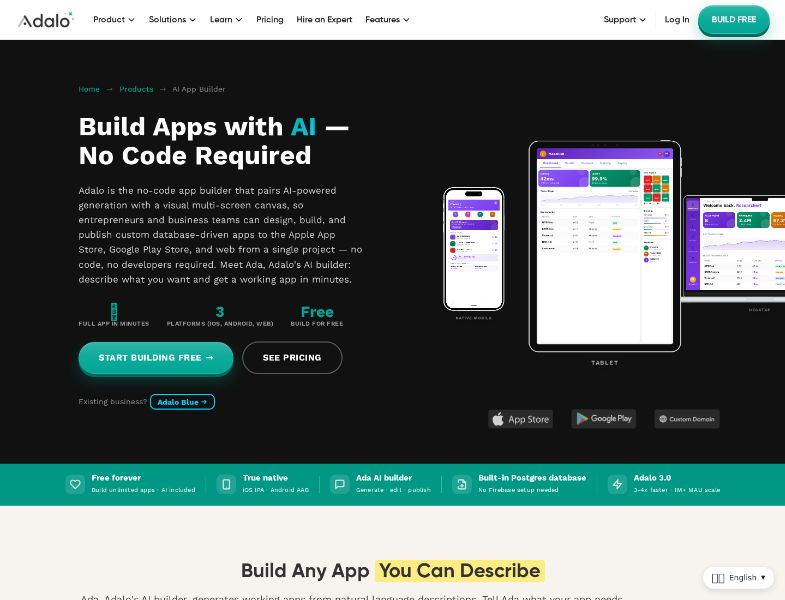
Choose Adalo when the artifact you need is a mobile (and web) application in the stores: a consumer app, a booking app, a marketplace MVP, or an internal tool that must feel native. Choose it when a visual canvas and flat-fee publishing matter more than owning React/Flutter source.
When to choose Willo
Choose Willo when the artifact you need is a business: positioning, brand, a public site customers can find, payments, and an AI team that keeps executing after publish.
Many teams will not treat these as substitutes. You might run Willo for the company site and Adalo for the native app.
Frequently asked questions
Can Adalo replace my public website?
You can publish a responsive web app and (on Starter+) a custom domain. Adalo is positioned around apps and stores, not a marketing-site plus growth engine.
Can Willo replace Adalo for the App Store?
No. Willo is not documented as producing IPA/AAB store builds.
Does Adalo export code?
Editable code export is not currently available. CSV export of collections is. Store binaries are for publishing.
Does Adalo have a free plan?
Yes. Free forever for building/testing: 500 records per app, unlimited screens and test apps, Ada (beta). Store and custom-domain publishing start on Starter.
Does Adalo charge per user?
Paid plans have no per-action or usage-based charges. Limits are published apps, editors, and storage (plus the Free record cap).
Conclusion
Adalo is a strong answer to “we need a native app in the stores without a mobile team.” Willo is a strong answer to “we need the business itself — site, brand, payments, and an AI team that keeps working.”
If you are evaluating Adalo because you want an AI that turns an idea into a company, start free on Willo and see what Day 1 ships.
Start free on Willo — no credit card required.