Zite and Willo both use AI to turn plain-language ideas into working software. The similarity is real, but their priorities are different.
Zite is an AI no-code platform for building business apps, databases, and workflows. It is designed for teams that need internal tools, dashboards, portals, CRMs, approval systems, inventory trackers, and other operational software without hiring a conventional development team.
Willo is an AI business builder. It can create apps and backend systems, but it also helps research, launch, market, and operate a business. Its agents cover areas such as product, marketing, research, marketing, content, support, and finance.
The practical choice is straightforward: choose Willo when you want AI to build the software and coordinate more of the business around it, with the underlying repository and business assets under your ownership. Choose Zite when you want your team to build and maintain business software inside a managed no-code platform..
Zite vs Willo at a glance
| Area | Zite | Willo |
|---|---|---|
| Primary category | AI no-code business app builder | AI business builder and operating system |
| Core output | Apps, databases, forms, and workflows | Businesses, websites, apps, software, backends, automations, content, and operating systems |
| Typical workflow | Prompt an app, inspect the plan and logic, edit visually, connect data, and publish | Describe the outcome in chat; agents research, build, ship, and help operate it |
| Best for | Operations teams and businesses building internal tools or portals | Founders, operators, solopreneurs, agencies, local businesses, and nontechnical idea owners |
| Built-in database | Yes | All plans support databases and backend systems |
| Authentication and permissions | Yes, including app access and data permissions; some advanced controls are plan-dependent | Paid plans support authentication; Willo's public pages emphasize user approval and asset ownership more than a packaged enterprise permission system |
| Workflows | Native visual workflows, schedules, and webhooks | Custom automations and operational agents across the business |
| Unlimited users | Yes, on every Zite plan | Willo pricing is based on credits and number of businesses, not advertised per-user limits |
| Hosting | Managed by Zite | Willo builds and hosts projects while giving customers ownership of core accounts and assets |
| Code export | No public code-export or self-hosting option | Willo states that customers own the GitHub repository |
| Free plan | 50 monthly credits, unlimited apps and users, 5,000 records, 1,000 workflow runs | 40 one-time credits and up to 2 businesses |
| Starting paid price | Pro: $15/month billed annually | Starter: $25/month |
What is Zite?

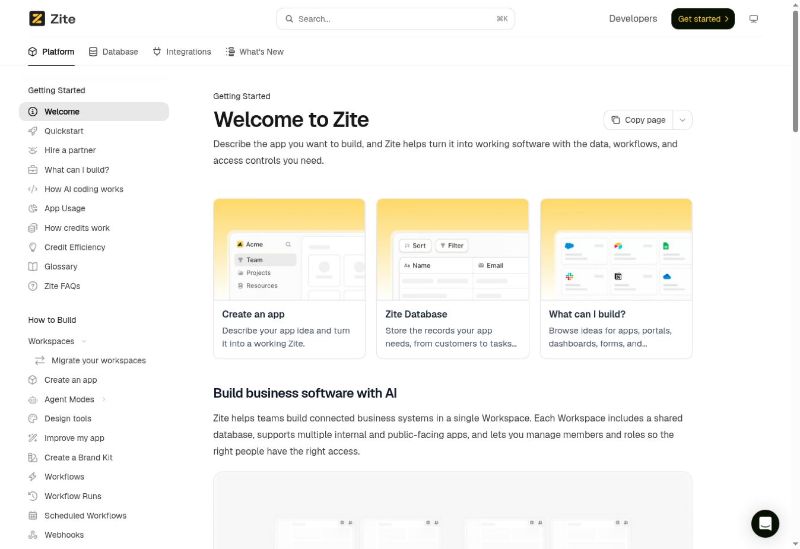
Zite calls itself "the AI builder that means business." Users describe the software they need, and Zite generates an application with the relevant interface, database structure, workflows, and access controls.
Zite is part of the company behind Fillout. In March 2026, Fillout announced that its parent company had become Zite, while Fillout would continue as a separate product under the Zite umbrella.
Zite is oriented toward business software rather than consumer entertainment apps or native mobile products. Its documented use cases include:
- Internal tools
- Customer and client portals
- CRMs and lead-management systems
- Operations dashboards
- Inventory and asset trackers
- Approval and request workflows
- Project and task systems
- Forms, bookings, and data-collection workflows
- Apps connected to existing business data
Each Zite Workspace can contain shared data, multiple internal or public-facing apps, workflows, members, and access rules.
What is Willo?
Willo is an AI business builder that helps users turn an idea into a working business, website, app, workflow, or operational system.
A user describes the desired outcome in chat. Willo's agents can research the opportunity, shape the product, build the website or software, configure backend infrastructure, set up payments and automations, create content, and support ongoing operations.
Willo is not only for startup founders. Its model can also suit operators, solopreneurs, agencies, local businesses, and people who have an idea but lack technical experience.
All Willo plans support backend features such as databases, authentication, APIs, and Stripe Connect. Willo also emphasizes ownership: its current materials state that customers own the GitHub repository, hosted site, Stripe account, email list, content, and other business assets.
Zite vs Willo: feature-by-feature comparison
AI app generation
Zite starts with an app-building prompt. Users can work in Chat, Plan, or Build modes. Plan mode is particularly useful for a complex request because it lets the user review screens, workflows, database roles, permissions, and data changes before spending credits on implementation.
After generation, users can ask the AI agent to add pages, build features, revise copy, change workflows, explain the project, or make selective edits. They can also make visual changes manually without spending AI credits.
Willo also builds apps from natural-language instructions, but the app is usually one part of a wider business outcome. Willo may research what should be built, create the backend and customer experience, connect payments, and prepare the marketing or operating system around it.
Zite offers the more specialized business-app workbench. Willo offers the broader delegation layer.
Databases and data connections
Zite includes a native database. Its AI can create tables and relationships from the app prompt, and users can view and manage data in the platform. Zite can also connect apps to external business tools and data sources.
The current pricing model allows unlimited databases on all plans but limits the total number of records stored across the organization:
- Free: 5,000 records
- Pro: 100,000 records
- Business: 250,000 records
- Team: 1,000,000 records
- Enterprise: 1,000,000 or more, based on the agreement
Willo's plans include a database as part of a custom backend. The key difference is product form. Zite exposes a standardized no-code database that a business team can inspect and maintain. Willo has agents implement the data layer for the specific business or application.
Choose Zite when ongoing database editing by a nontechnical team is central. Choose Willo when the database is infrastructure for a broader custom build and you want the implementation delegated.
Workflows and automations
Zite has native visual workflows. Workflows can be triggered by app actions, schedules, or webhooks, and users can inspect runs and logic. Zite documents authenticated workflows that reject requests from unauthenticated users and make the current user's information available to the workflow.
Its webhook documentation gives examples such as receiving Stripe payment events, writing the details to a database, and updating a dashboard. Zite also supports connections to the broader Fillout product for forms, bookings, e-signatures, payments, PDF generation, and submission-based automations.
Willo can build custom automations and uses operational agents across functions such as research, marketing, content, customer support, and finance. This is wider than Zite's app-level workflow engine, but it is less like a standardized visual automation product.
Zite is a strong fit when the workflow belongs inside a business application and the team wants to see the logic. Willo is a strong fit when the workflow is part of a business process that AI agents will help run.
Authentication, roles, and data permissions
Zite supports internal and public apps, user login, app access, project members, roles, and data permissions. Its documentation says data permissions can control viewing, creating, editing, and deleting records.
Zite also offers custom access rules and user groups. Enterprise customers can use app-level single sign-on with providers such as Okta, Microsoft Entra ID, and Google Workspace. Audit logs and other advanced controls are tied to higher-level plans.
One current documentation caveat is that "Use" permissions are not yet implemented for databases in the same way they are for apps. Buyers with detailed permission requirements should prototype the exact role model and verify current limitations before deployment.
Visual editing and maintenance
Zite combines AI prompting with manual visual controls. Users can adjust text, colors, spacing, layout, and themes without consuming AI credits. The platform also presents backend logic as workflows that nontechnical operators can inspect.
This makes Zite suitable for teams that want to own day-to-day maintenance without reading source code.
Willo's working model is more conversational and delegated. Users describe changes, review delivered work, and approve consequential actions.
Zite gives the user a no-code builder to operate. Willo gives the user an AI team to direct.
Websites, public apps, and business scope
Zite can publish public-facing web apps and connect custom domains on paid plans. It can be used for portals, forms, dashboards, and simple public experiences. Its own comparison content says the platform is not designed for consumer apps, SaaS MVPs, native mobile apps, social platforms, or games.
Willo's scope explicitly includes websites, software, ecommerce, tools, games, and automations. It can also handle the surrounding business work, including research, product decisions, content, marketing, support, and finance.
For an employee portal, inventory system, or operations dashboard, Zite's specialization is an advantage. For launching a customer-facing business with a website, custom product, payments, acquisition content, and ongoing operations, Willo covers more of the full journey.
Integrations, APIs, and webhooks
Zite can connect data sources, use webhooks, and provide API access depending on the plan. Its Create Zite API can programmatically generate a Zite from a text prompt with optional files, theme, and project name.
Zite's integration with Fillout is especially relevant. It can add branded forms, surveys, quizzes, booking calendars, e-signatures, uploads, videos, payments, and generated PDFs to a Zite app.
Willo's plans support APIs and custom integrations as part of the delivered backend. Because Willo builds around a particular business, it may be more flexible for unusual integrations, but the specific connector or integration should be confirmed during scoping rather than assumed.
Hosting, deployment, and ownership
Zite provides managed hosting. Users publish to a Zite-hosted address or connect a custom domain on a paid plan. Zite handles the runtime, hosting, and deployment.
Zite's official comparison materials state that apps remain on Zite's infrastructure and cannot be exported as source code or self-hosted. That reduces DevOps work but creates a significant portability tradeoff. If a company later leaves Zite, it cannot simply move the generated application repository to another hosting provider.
Willo states that the customer owns the GitHub repository and the core business accounts and assets. This makes Willo the clearer choice when source-code ownership, developer handoff, or independent future hosting matters.
Zite can still be the better choice for a team that explicitly wants a managed no-code platform and does not want to maintain a codebase.
Security and privacy
Zite's homepage states that the company is SOC 2 Type II compliant and uses 256-bit AES data encryption. The Business plan includes AI training opt-out by default, while Enterprise adds controls such as SSO and audit logs.
Those are useful indicators, not a complete security assessment. A buyer handling regulated or highly sensitive data should review Zite's security documentation, data-processing terms, data residency, subprocessors, access model, backup practices, and the scope of its compliance report.
Collaboration and team economics
Zite includes unlimited users, editors, apps, and databases on every current standard plan, including Free. Plan limits instead focus on AI credits, records, workflow runs, storage, domains, and advanced controls.
This is a meaningful advantage for an internal tool that will serve many employees. A team can expand usage without paying a per-user fee, provided it stays within the relevant data and workflow limits.
Willo pricing is based on monthly credits and a maximum number of businesses. Its public pricing is not structured around seats. Willo is consequently easier to compare by number of ventures and volume of shipped AI work rather than by internal app users.
Zite vs Willo pricing
Zite pricing
Zite offers Standard plans and separate Scale options for larger teams.
| Zite plan | Price | Key limits and features |
|---|---|---|
| Free | $0 | 50 credits/month, 5,000 records, 1,000 workflow runs/month, 1 GB storage, unlimited users, apps, editors, and databases |
| Pro | $15/month billed annually | 100+ credits/month, 100,000 records, 5,000 workflow runs/month, 10 GB storage, 1 custom domain, remove Zite branding |
| Business | $55/month billed annually | 200+ credits/month, 250,000 records, 50,000 workflow runs/month, 100 GB storage, unlimited custom domains, advanced AI models, AI training opt-out by default, white-label emails |
| Team | Contact Zite | 800+ credits/month, 1,000,000 records, 250,000 workflow runs/month, team features and priority support |
| Enterprise | Custom | Custom credits, 1,000,000+ records, unlimited workflow runs, 1 TB+ storage, SSO, audit and agreement options |
The pricing page displayed $15 per month for Pro and $55 per month for Business with annual billing selected. Zite also offers monthly billing, so buyers should confirm the current monthly rate at checkout.
How Zite credits work
Zite credits are consumed by usage-based AI features, including
- Building and changing apps with AI
- Chat, Plan, and Build modes
- The database agent
- AI fields in databases
- Apps using AI through a Zite API key
- Document generation
Manual design edits, standard database storage and operations, app visitors, and workflow runs from the editor do not consume AI credits. Zite also says its "Fix it for me" error repair does not use credits.
This distinction matters. A team that makes many manual adjustments may stretch its credits further than a team that requests every change through AI.
Willo pricing
| Willo plan | Price | Credits and business allowance |
|---|---|---|
| Free | $0 | 40 one-time credits and up to 2 businesses |
| Starter | $25/month | 150 credits/month and up to 3 businesses |
| Builder | $49/month | 300 credits/month and up to 6 businesses |
| Growth | $99/month | 600 credits/month and up to 12 businesses |
Willo states that chat is free and credits are used when work is shipped.
Which is better value?
Zite has the lower starting paid price and unusually generous user and app allowances. It is likely to offer better value when one organization wants to build several internal tools for many team members and is comfortable staying on Zite's managed platform.
Willo costs more at the entry level but covers a wider scope of work. It can research, build, launch, market, and help operate several businesses, and it provides repository ownership. It may offer better value when the alternative is coordinating multiple tools, freelancers, or business functions.
Ease of use and onboarding
Zite is designed for nontechnical but software-aware business teams. A good starting prompt explains the users, data, key screens, permissions, and workflow. Plan mode then lets the team inspect the proposal before the app is built.
The interface lowers the need to understand source code, but effective business software still requires careful process definition. Users must decide what data should exist, who can access it, what happens when a workflow fails, and how the system will be maintained.
Willo requires less direct platform operation. Users explain the outcome, answer questions, review progress, and approve important actions. That can be easier for someone who does not want to become the builder, although it provides less of the standardized visual maintenance environment that Zite offers.
Who is Zite best for?
Zite is a strong fit for:
- Operations teams building internal systems
- Support teams creating customer or agent portals
- Small and midsize businesses replacing spreadsheets
- Teams that need CRMs, dashboards, inventories, or approval tools
- Organizations that want many users without per-user pricing
- Nontechnical builders who want to inspect data and workflow logic visually
- Teams that prefer managed hosting over code ownership and DevOps
- Agencies building managed business apps for clients who will remain on Zite
Who is Willo best for?
Willo is a strong fit for:
- People turning an idea into a complete business
- Solopreneurs who need product, site, backend, content, and operations help
- Operators who want custom software without personally maintaining a no-code builder
- Agencies creating or operating multiple businesses
- Local businesses that need payments, workflows, content, and growth systems
- Users who value GitHub ownership and future developer handoff
- Projects that extend beyond internal tools into customer products, websites, ecommerce, marketing, or ongoing business operations
Zite pros and cons
Zite pros
- Generates business apps, databases, and workflows from plain language
- Native database and visual workflow model
- Manual design edits do not consume AI credits
- Unlimited users, editors, apps, and databases on every standard plan
- Managed hosting, authentication, and publishing
- Custom access rules, data permissions, user groups, and Enterprise SSO
- Fillout integration for forms, bookings, payments, e-signatures, and PDFs
- Low starting price and a useful free plan
Zite cons
- No code export or self-hosting option
- Primarily designed for business web apps, not native mobile apps, games, or consumer social products
- Credit consumption can be difficult to predict for AI-heavy iteration
- Some access and database permission behavior is still evolving
- New product identity means independent review volume is limited
- A managed no-code runtime can create migration work if the organization later changes platforms
Willo pros and cons
Willo pros
- Builds more than apps, including businesses, websites, software, automations, ecommerce, and operational systems
- Agents can assist with product, research, marketing, content, support, and finance
- Paid plans support databases, authentication, APIs, and Stripe Connect
- Customers own the GitHub repository and core business accounts and assets
- Designed for users who want to delegate execution rather than learn a builder
- Supports several businesses on each plan
Willo cons
- Credit-based shipped work requires planning
- Not a direct replacement for Zite's standardized visual database and workflow editor
- Users must still review output and approve important actions
- Zite has more clearly documented enterprise app access and permission controls
When to choose Zite
Choose Zite if you need a CRM, internal portal, dashboard, request system, inventory tracker, or other business application that your team can maintain visually.
It is especially attractive when many people need access. Unlimited users on every plan can make the economics simpler than a per-seat tool. Zite also makes sense when managed hosting is a benefit and the organization has no requirement to export or self-host the generated application.
Before committing a critical process, build a realistic pilot. Test permissions, integration behavior, workflow failures, data limits, credit consumption, and the process for moving data out of the platform.
When to choose Willo
Choose Willo when the underlying goal is to launch or operate a business, not only to create an internal app.
Willo is the more natural choice when you need customer research, a website, custom software, backend infrastructure, payments, automation, content, marketing, and operational support coordinated around the same idea.
It is also preferable when source-code ownership matters. The GitHub repository and business accounts can be handed to developers or managed independently in the future, whereas Zite does not offer code export.
Frequently asked questions
Is Zite a Willo alternative?
Yes, for AI-built business software. Zite is an alternative when the main need is an internal app, database, portal, dashboard, or workflow. Willo covers a wider business-building and operations scope.
Is Zite the same as the old Zite news app?
No. The current Zite at zite.com is an AI no-code business software platform associated with the company behind Fillout. It is unrelated to the discontinued news-aggregation app that used the Zite name years earlier.
Is Zite free?
Yes. Zite's Free plan currently includes 50 monthly credits, unlimited apps and users, 5,000 total database records, 1,000 workflow runs per month, and 1 GB of attachment storage.
Does Zite charge per user?
No. Zite's current pricing page says every plan includes unlimited users and editors. Plans are differentiated by credits, database records, workflow runs, storage, domains, and advanced features.
Can I export Zite code?
Zite's current official materials say apps remain on Zite's infrastructure and cannot be exported as source code or self-hosted. Customers that require an owned repository should treat this as a key limitation.
Can Zite build mobile apps?
Zite builds browser-based business apps and can support mobile access to those web experiences. Its own product comparisons say it is not intended for native mobile applications.
Does Zite have a database?
Yes. Zite includes a built-in database and allows unlimited databases on current plans. The total number of stored records is limited by plan.
Which is easier, Zite or Willo?
Willo is easier for a user who wants to describe the outcome and delegate more of the implementation and business work. Zite is easier for a nontechnical team that wants to build and maintain an app through prompts, visual edits, and visible workflows.
Which product offers better ownership?
Willo has the clearer ownership model because it states that customers own the GitHub repository and core business assets. Zite provides managed hosting and does not offer code export or self-hosting.
Conclusion: Zite for team-built software, Willo for AI-built businesses
Zite is a focused and capable AI no-code platform for business applications. Its built-in database, visual workflows, access controls, managed hosting, unlimited users, and low entry price make it particularly attractive for internal tools and operational software.
Willo solves a broader problem. It can build the app and backend, but it can also research the opportunity, launch the website, configure payments, create content, support marketing, and help operate the business. Its GitHub ownership model also offers more flexibility for future handoff and hosting.
Choose Zite when your team wants a managed platform for building and maintaining business apps. Choose Willo when you want a coordinated AI team to turn an idea into an owned, working business system.
To explore that broader approach, start with Willo.