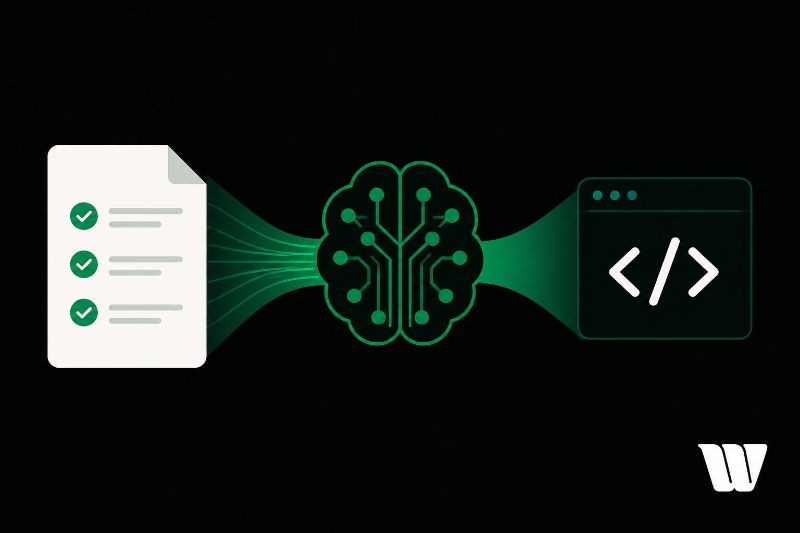
Spec-driven development works with AI by requiring you to define precise specifications before you generate a single line of code. Your spec acts as a contract, outlining objectives, inputs, outputs, edge cases, and acceptance criteria. Without it, AI fills knowledge gaps with plausible but incorrect defaults, producing inconsistent and misaligned results. When you structure your workflow around a complete, unambiguous spec, you'll get reliable, production-ready output every time — and there's much more to unpack ahead.
Key Takeaways
- Spec-driven development defines detailed specifications before coding, serving as a contract that clarifies expected behaviors, inputs, outputs, and edge cases for AI.
- Without a clear spec, AI generates inconsistent code, addresses adjacent problems, and produces multiple incompatible solutions lacking directional clarity.
- Effective AI specs require clear objectives, measurable performance metrics, concise language, and acceptance conditions tied to explicit user requirements.
- Feed AI structured increments tied to acceptance criteria, updating the spec first whenever requirements shift to maintain consistent alignment.
- Omitted context causes AI to fill gaps with plausible defaults, while conflicting instructions create silent, compounding errors without flagging contradictions.
What Is Spec-Driven Development?
Spec-driven development is a software engineering approach where you define detailed specifications before writing a single line of code. These specifications act as a contract between intent and implementation, outlining expected behaviors, inputs, outputs, and edge cases with precision.
You're fundamentally building a blueprint that every stakeholder — developer, tester, or AI tool — can reference consistently throughout the project lifecycle. Spec clarity eliminates ambiguity early, reducing costly mid-development corrections and misaligned assumptions.
Unlike traditional approaches where requirements remain vague until problems surface, spec-driven development forces structured thinking upfront. You document what the system must do, not how it'll do it.
This separation of concern directly improves development efficiency by letting implementation decisions emerge naturally from well-defined requirements rather than reactive problem-solving.
Why AI Generates Inconsistent Code Without a Spec
When you prompt an AI coding tool without a spec, you're feeding it an incomplete problem definition — and it fills the gaps with probabilistic guesses drawn from its training data.
These AI limitations surface quickly during output evaluation: variable naming shifts between sessions, architectural patterns contradict earlier decisions, and error analysis reveals logic that solves adjacent problems instead of your actual one.
Context importance becomes obvious when code generation produces three technically valid but mutually incompatible solutions to the same prompt. Without specification clarity, you're not directing the AI — you're negotiating with it.
Consistency issues compound across files, modules, and iterations. Instruction precision eliminates this drift.
Specification examples give the model bounded constraints, replacing open-ended inference with targeted execution that reflects your actual development challenges and system requirements.
What Every Effective AI Spec Needs to Include
An effective AI spec isn't a single document — it's a structured set of constraints that eliminates ambiguity before code generation begins. Your AI specifications must define clear objectives, explicit user requirements, and measurable performance metrics upfront.
Use concise language throughout — every vague term becomes a potential failure point.
Structure your spec around four core components: functional design constraints that bound the solution space, testing criteria that validate expected outputs, feedback loops that catch drift between iterations, and acceptance conditions tied directly to user requirements.
Don't treat any component as optional. Missing testing criteria means you can't verify correctness. Missing design constraints means the AI operates without boundaries.
Each element reinforces the others, creating a coherent system that guides generation, validates output, and maintains consistency across your entire codebase.
How to Write a Spec That AI Can Execute Accurately
Precision is the foundation of an executable spec — ambiguity at the input stage compounds into compounding errors at the output stage.
Spec clarity directly governs execution accuracy, so structure your requirements precision around concrete user scenarios, not abstract intentions.
Follow these practices for strong AI alignment:
- Define boundaries explicitly — state what's included and excluded
- Apply documentation standards — use consistent formatting, versioning, and terminology
- Build in feedback loops — specify validation checkpoints after each milestone
- Establish testing guidelines — define pass/fail criteria before development begins
- Plan iteration processes — outline revision protocols when outputs miss targets
- Use direct communication strategies — write in imperative statements, not suggestions
Every vague phrase you leave in your spec becomes a decision you're delegating blindly to AI.
How to Integrate Spec-Driven Development Into Your Workflow
To integrate spec-driven development into your workflow, you start by writing a complete, unambiguous spec before touching any AI tool.
Once the spec is locked, you feed it to your AI assistant in structured increments, validating each output against the spec's defined acceptance criteria.
You then iterate by updating the spec first whenever requirements shift, keeping the AI's instructions tightly coupled to a single source of truth.
Starting With Clear Specs
Before writing a single line of code, you'll need a spec that defines what you're building, why it matters, and how success is measured. Use precise language to eliminate ambiguity, and adopt a structured format that organizes requirements logically.
Your spec should include detailed requirements broken into functional and non-functional categories. Apply consistent terminology throughout — don't alternate between "user" and "client" when referring to the same entity.
Provide specific examples to illustrate edge cases and targeted outcomes so AI tools interpret your intent accurately. Comprehensive definitions reduce misinterpretation. Define every system component, constraint, and dependency explicitly.
Clear guidelines keep both your team and AI-generated outputs aligned with project goals. A well-constructed spec isn't documentation — it's the foundation your entire development process builds upon.
Iterating With AI Tools
With your spec in place, you're ready to put AI tools to work — but effective iteration requires more than pasting requirements into a prompt.
Structure your AI collaboration around discrete, testable tasks tied directly to spec components. Feed the AI one feature at a time, using iterative feedback loops to refine outputs before advancing.
Schedule alignment meetings to maintain user involvement throughout design iterations, ensuring prototype validation stays grounded in original requirements.
Apply automated testing after each cycle to catch regressions early. During code reviews, verify that AI-generated logic matches spec intent, not just functional output.
Use real-time adjustments to correct drift before it compounds. Feature prioritization should guide your iteration sequence — high-stakes components first, lower-risk elements later.
Discipline here prevents scope creep and keeps delivery predictable.
The Spec-Driven Mistakes That Silently Break AI Output
Even well-intentioned specs can silently corrupt AI output when they contain vague language, missing context, or conflicting instructions.
If your spec says "make it fast" without defining performance benchmarks, the AI fills that gap with assumptions that may contradict your actual requirements.
You'll compound the problem further when you omit domain-specific constraints or stack directives that directly contradict each other, producing output that looks correct but fails at the implementation level.
Vague Specs Mislead AI
When you hand AI a vague spec, it doesn't stall or ask for clarification—it generates something plausible-looking that silently misses your intent.
Vague definitions force the model to interpolate, while ambiguous terminology produces outputs anchored to the wrong interpretation.
Unclear objectives give AI no measurable target, so it optimizes for surface-level coherence instead.
Inconsistent language across sections creates contradictory statements the model resolves arbitrarily.
Imprecise expectations mean you can't evaluate whether the output succeeded.
Incomplete details get filled with statistically probable assumptions.
Misleading examples train the model toward unintended patterns.
Confusing instructions split attention across competing interpretations.
Unclear outcomes remove the benchmark entirely.
Every gap you leave becomes a decision the AI makes without you—and it won't flag that it made one.
Missing Context Breaks Output
Specs that omit context don't just produce weak output—they produce confidently wrong output. When you leave out system constraints, user roles, or environmental assumptions, the AI fills those gaps with plausible-sounding defaults that may contradict your actual requirements.
That's a contextual clarity failure, and it's harder to catch than an obvious error because the output looks reasonable on the surface.
To maintain output consistency, your specs must include the conditions under which the feature operates—not just what it does. Specify who uses it, what triggers it, what surrounds it, and what it must avoid.
Every missing variable is a decision point you've handed to the AI without knowing it. Reclaiming those decisions means building context directly into the spec before generation starts.
Conflicting Instructions Cause Errors
Conflicting instructions don't cancel each other out—they produce silent, compounding errors that are difficult to trace back to the spec.
When your spec contains conflicting priorities, the AI doesn't flag the contradiction. It resolves it internally, often producing output that satisfies one instruction while violating another. You'll not see an error message. You'll see plausible-looking content that subtly fails your actual requirements.
Unclear objectives amplify this problem. If one section of your spec demands brevity while another demands thorough detail, the AI will attempt to honor both—and succeed at neither.
You'll get bloated content that still feels incomplete.
Audit your spec for logical conflicts before passing it to the model. Contradictions you don't catch upfront will silently shape every output the AI generates.
When Spec-Driven Development Delivers the Most Value
Spec-driven development delivers the most value in scenarios where ambiguity and scope creep pose the greatest risk.
You'll see the strongest returns when managing complex, multi-team projects requiring tight project alignment and consistent stakeholder engagement. Established value metrics and performance benchmarks give you measurable targets, letting you track iterative improvement against defined baselines.
When incorporating user feedback mid-cycle, specs prevent unauthorized scope expansion by enforcing documented boundaries. Risk assessment becomes systematic rather than reactive — you identify failure points before writing a single line of code.
Team collaboration improves because every contributor references the same authoritative source. High-stakes projects with regulatory requirements, legacy integrations, or distributed teams particularly benefit from this structure, transforming what would otherwise be chaotic, assumption-driven development into a controlled, outcome-focused engineering process.
Frequently Asked Questions
What Tools Best Support Storing and Versioning AI Specs Over Time?
You'll find Git excels at spec storage and version control, offering strong historical tracking and collaboration features. Compare tools like Notion or Confluence for richer context, but you'll face integration challenges connecting them to your AI workflows.
Can Spec-Driven Development Work Effectively With Multiple AI Models Simultaneously?
Yes, you can run spec-driven development across multiple AI models simultaneously. You'll maintain specification consistency through a shared spec layer, enabling cross-model coordination where each model receives identical, versioned instructions governing their outputs and behaviors.
How Long Does It Typically Take to Write a Complete AI Spec?
You'll typically spend 2–8 hours on spec writing, though timeline factors like project complexity, domain clarity, and AI model requirements can extend this to several days for large-scale, multi-system implementations.
Should Non-Technical Stakeholders Be Involved in Creating the AI Spec?
Yes, you should involve non-technical stakeholders early. Their domain knowledge drives stakeholder engagement and improves specification clarity, ensuring you capture accurate business requirements, edge cases, and success criteria that technical teams alone would likely overlook or misinterpret.
How Do You Update a Spec When Project Requirements Change Mid-Development?
When requirements change, you'll perform requirement analysis to assess the impact, then apply change management by versioning your spec, updating affected sections, and realigning AI prompts to reflect the new project direction systematically.
Conclusion
Spec-driven development transforms AI from an unpredictable code generator into a reliable execution engine. When you define architecture, constraints, naming conventions, and error-handling rules upfront, you're eliminating the ambiguity that causes inconsistent output. Your spec becomes the single source of truth that every prompt references. Without it, you're gambling on context the AI doesn't have. With it, you're engineering reproducible, maintainable results that scale across your entire development workflow.