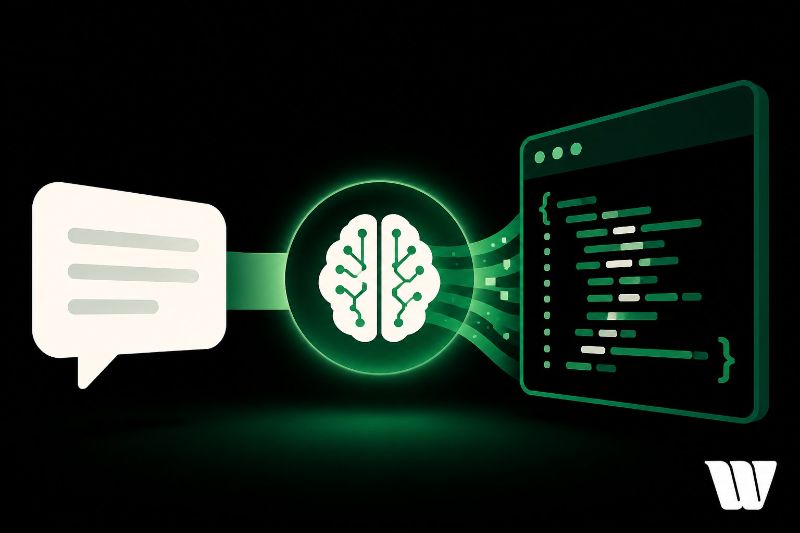
When you use AI code generation, you're not getting a compiler or logic engine — you're working with a pattern-matching system that predicts statistically probable code tokens based on your prompt. The quality of what you get back depends heavily on how well you constrain the solution space. Vague prompts widen the prediction range, producing unreliable outputs. Treat every prompt like an architectural decision, and the generated code like an untrusted draft requiring your judgment — there's considerably more to unpack here.
Key Takeaways
- AI code generators use large language models to produce statistically probable code outputs, not logical reasoning, making prompt clarity critically important.
- Effective prompts constrain the solution space by specifying inputs, outputs, and constraints without over-specifying implementation details.
- Generated code may compile successfully but still fail under edge conditions, requiring thorough testing and security review before deployment.
- Tools like GitHub Copilot, Cursor, and CodeWhisperer vary in context-awareness and integration, making tool selection a key workflow decision.
- Developers must shift from code authorship to oversight, treating AI-generated code as drafts requiring architectural judgment and contextual reasoning.
How AI Code Generation Actually Works
When you prompt an AI code generator, you're not triggering a lookup table or a rules-based compiler — you're feeding text into a large language model (LLM) that predicts the most statistically probable next tokens based on patterns learned from billions of lines of code and natural language.
That's machine learning at scale, not logic. The model doesn't understand your intent — it approximates it.
Code synthesis emerges from transformer architecture, attention mechanisms, and weighted probability distributions across an enormous vocabulary of tokens. You get output that looks functional because it statistically resembles functional code — not because the model reasoned through your problem.
That distinction matters architecturally. When output fails, it's not a bug in traditional terms — it's a probability that didn't hold up under execution.
What Happens Between Your Prompt and the Final Code
The moment you hit submit, your prompt doesn't travel intact to some reasoning engine — it gets dismantled. Tokenization breaks your text into subword units. Each token converts to a vector. That vector moves through transformer layers trained during model training on billions of code repositories, documentation files, and developer forums.
What emerges isn't retrieval — it's probabilistic reconstruction. The model predicts the most statistically coherent next token, then the next, then the next. Your intent exists nowhere in that process explicitly.
This is where prompt engineering matters structurally. How you frame constraints, specify language, and define scope shifts the probability distribution of outputs. Vague prompts produce vague code — not because the model misunderstands you, but because ambiguity genuinely widens its prediction space.
What Makes a Good Prompt for AI Code Generation?
Effective prompts share a structural logic: they constrain the solution space without over-specifying implementation. You're not writing instructions for a compiler—you're shaping probabilistic outputs. That distinction matters.
Prompt clarity determines whether the model resolves ambiguity toward your intent or away from it. Vague requests produce plausible-looking code that solves the wrong problem. Be specific about inputs, outputs, edge cases, and constraints. Name the language, framework, and performance expectations upfront.
Context importance can't be overstated. The model doesn't know your codebase, your team's conventions, or your deployment environment unless you tell it. Paste relevant function signatures, describe what already exists, and explain what you're actually trying to accomplish—not just what you want written.
Treat every prompt as an architectural decision. Weak framing produces structurally weak code.
The Best AI Code Generation Tools Right Now
Choosing the right AI code generation tool isn't a branding decision—it's an architectural one. Each tool carries tradeoffs you'll feel immediately in your workflow.
GitHub Copilot embeds directly into your editor with strong integration capabilities across IDEs, but it leans on pattern completion more than reasoning.
Cursor adds context-awareness, letting you reference entire codebases during generation.
Amazon CodeWhisperer ties tightly to AWS ecosystems—useful if that's your stack, limiting if it isn't.
Tabnine prioritizes privacy with local model options.
Replit targets beginners through user-friendly interfaces but sacrifices depth for accessibility.
Before committing, audit each tool against your actual stack, security requirements, and team skill level.
Pretty dashboards don't ship code—reliable, contextually accurate generation does.
Choose based on output quality, not marketing claims.
Where AI Code Generation Falls Short
Despite the impressive speed and convenience AI code generation offers, you'll quickly notice its cracks when tackling non-trivial problems.
Complex conditional logic, edge cases, and deeply nested dependencies often produce brittle, inaccurate outputs that require significant rework.
Worse, these tools frequently generate code with overlooked security vulnerabilities—improper input validation, exposed credentials, or weak authentication patterns—leaving you with technical debt that's harder to detect than it's to fix.
Handling Complex Logic Poorly
While AI code generation handles boilerplate and repetitive patterns with reasonable competence, it struggles considerably once logic complexity scales up.
When you introduce nested conditionals, multi-threaded workflows, or intricate state management, the generated code often contains subtle logic pitfalls that aren't immediately visible. It might compile cleanly and pass surface-level tests yet fail catastrophically under edge conditions.
These aren't surface errors you can spot quickly. They create debugging challenges that consume far more time than writing the logic yourself would have.
The AI doesn't reason through algorithmic consequences—it pattern-matches from training data. When your architecture demands precision across interdependent systems, that distinction matters enormously.
You're not getting intelligence; you're getting statistically probable code that occasionally, and dangerously, looks correct but isn't.
Security Vulnerabilities Overlooked
The logic failures described above are frustrating, but they're recoverable—you debug, you fix, you move on.
Security vulnerabilities are different. AI-generated code routinely ships with:
- Code injection openings from unvalidated inputs
- Authentication flaws and broken access control logic
- Insecure defaults and misconfigured settings left untouched
- Data exposure through unencrypted storage or logging
- Dependency risks and race conditions buried in third-party calls
The model doesn't reason about threat surfaces. It pattern-matches against training data, producing code that works without understanding what safe means architecturally.
You get functional output with invisible attack vectors embedded inside it. Every insecure default it accepts, every missing authorization check it skips—those become your liability.
Treat AI-generated code as untrusted input requiring mandatory security review before deployment.
What AI Code Generation Means for Developers
AI code generation doesn't eliminate the developer—it reshapes what the developer does. You're no longer just writing code; you're directing collaborative coding workflows, evaluating outputs, and enforcing code quality standards that AI tools routinely miss.
Expect a learning curve. Tool selection matters more than most teams acknowledge—wrong tools compound integration challenges rather than resolve them. The productivity boost is real, but conditional.
You must shift your developer mindset from authorship to oversight, from creation to verification. User feedback loops become critical; AI models improve only when you systematically flag failures.
Treat generated code as a draft, never a deliverable. Your architectural judgment, contextual reasoning, and accountability aren't replaced—they're amplified in importance precisely because the AI produces output faster than you can review it.
Frequently Asked Questions
How Much Does AI Code Generation Typically Cost for Individual Developers?
You'll find AI code generation's affordability analysis reveals mostly freemium pricing models. Free tiers exist, but capable plans typically cost you $10–$20 monthly. Scrutinize what you're actually getting before committing to any subscription.
Can Ai-Generated Code Be Legally Protected Under Copyright Law?
You'll face murky copyright implications with AI-generated code. Current law typically requires human authorship to meet originality requirements, so you can't automatically claim ownership — courts and legislators are still actively debating these evolving protections.
Does AI Code Generation Work Equally Well Across All Programming Languages?
No, you'll find language performance varies considerably. AI handles Python and JavaScript well, but struggles with syntax variations in niche languages. You should skeptically evaluate outputs, especially when architecting systems in less-common or low-resource programming environments.
How Do Companies Ensure Ai-Generated Code Meets Security Compliance Standards?
You can't trust AI-generated code blindly. Companies integrate security audits into CI/CD pipelines and map outputs against compliance frameworks like SOC 2 or OWASP, forcing systematic validation before deployment rather than assuming correctness.
Can AI Code Generation Tools Work Offline Without an Internet Connection?
Yes, some tools support offline capabilities by running local models directly on your hardware. You'll sacrifice cloud-scale performance, but you can deploy solutions like CodeLlama locally, maintaining architectural control without depending on external network connectivity.
Conclusion
AI code generation won't replace your judgment—it'll test it. You're now responsible for evaluating outputs you didn't fully write, integrating components you didn't fully design, and maintaining systems you didn't fully understand at creation. That's a harder job, not an easier one. Use these tools where they demonstrably reduce friction. Reject them where they introduce hidden complexity. The prompt is trivial. The architecture it produces is your problem.