Softr and Willo both use AI so a non-engineer can ship something useful. They are not solving the same problem.
Softr’s homepage headline is “Build business apps with AI – that are actually secure.” You describe a client portal, CRM, intranet, or inventory tool. Softr generates the interface, database, and workflows, then you refine permissions visually. You can also sit Softr on top of data you already have in Airtable, Google Sheets, Notion, SQL, and other sources. The job is internal and client-facing software — portals, trackers, and ops apps — without a developer.
Willo is an AI business builder. You describe an idea. Agents research the market, create a brand, deploy a website to your GitHub repo, prepare Stripe, and keep working on content, marketing, and operations. Chat is free. Credits pay for work that ships.
If you already have a business and need logged-in portals and internal tools with roles, records, and workflows, Softr is usually the better fit. If you want the business to exist — research, brand, public site, payments, and weekly agent work — Willo is built for that job.
Quick decision
| You need… | Better starting point |
|---|---|
| A client portal, intranet, CRM, or inventory app on existing data | Softr |
| Granular login permissions, user groups, and record-level access | Softr |
| Native databases + Airtable / Sheets / SQL / Notion in one frontend | Softr |
| A public marketing site, brand, and Stripe from a one-line idea | Willo |
| Agents that keep writing, marketing, and operating after launch | Willo |
| Code and assets you own in GitHub if you cancel | Willo |
| Native iOS/Android store apps | Neither as a primary product (Softr offers installable PWAs on higher plans) |
What is Softr?
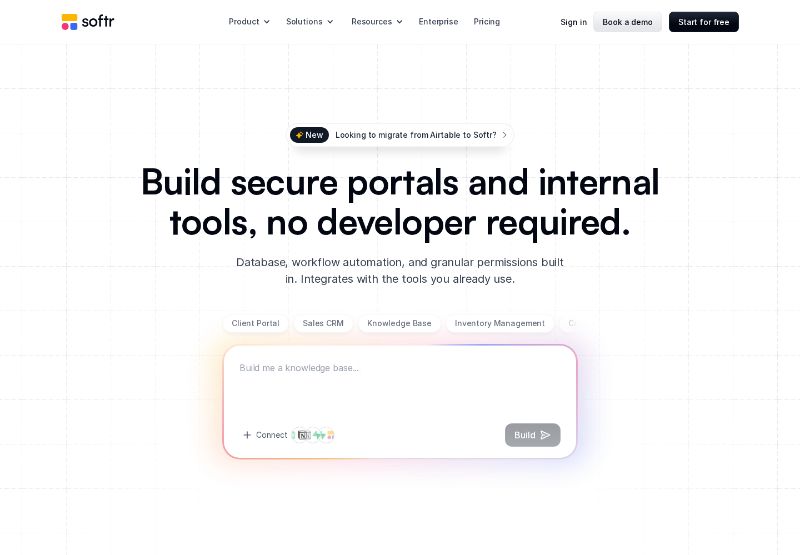
Softr is a no-code / AI platform for business software: apps, databases, workflows, and forms. The company positions it for operations, HR, finance, sales, customer success, agencies, and consultants who need branded portals without hiring a developer.
Official use cases on the homepage include client portals, sales CRMs, knowledge bases, inventory, company intranets, event planning, partner portals, project trackers, recruitment portals, employee directories, and vendor onboarding.
How it works, in Softr’s own framing:
- Co-build with AI. Describe what you need. Softr handles interface, database, and workflows.
- Iterate with AI or visually. You keep control of roles, permissions, and security.
- Ship the same day. Invite teammates or external clients. No developer handoff.
You can store data in Softr Databases or connect sources such as Airtable, Notion, Google Sheets, HubSpot, monday.com, ClickUp, Coda, Supabase, MySQL, PostgreSQL, and REST APIs. OpenAI and Anthropic models are listed for AI agents in databases and workflows.
Softr is hosted. You publish to a Softr subdomain or a custom domain. Docs cover embedding blocks/pages, custom HTML/CSS/JS on paid plans, and exporting table data as CSV/XLSX — not downloading the full app as source code.
What is Willo?
Willo is an AI business builder for founders, operators, solopreneurs, agencies, and local businesses. You describe an idea in chat. Agents research the market, produce a brand and living roadmap, generate a website, deploy it to your GitHub repo, and keep working on content, SEO, email, and operations.
Chat is always free. You spend credits only on work that ships. One plan covers every business in the account through a shared credit pool.
Day 1, according to the What to Expect page: a website, brand, roadmap, repo, plus analytics and an email list ready to capture. Willo is explicit about what it is not: not a get-rich-quick scheme, not a substitute for product-market fit, and not a set-and-forget lottery ticket. You still steer.
Backend functionality isn't limited to paid users. It's provisioned on every plan, including Free. Paid tiers expand what's available with the Autonomous Growth Engine, Stripe Connect, email sending and contacts, and analytics, while higher plans bring custom domains, team access, business transfers, custom agents, more compute, and other advanced capabilities. Shopify integration is on every plan, Free included.
Softr vs Willo: feature-by-feature
| Area | Softr | Willo |
|---|---|---|
| Primary job | Portals, internal tools, CRMs, and ops apps | Launch and operate a business from an idea |
| Starting input | Prompt and/or existing data (Airtable, Sheets, Notion, SQL, Softr Databases) | A business idea in chat |
| AI | AI app builder plus Database AI Agents and workflow AI actions; hybrid editor so you can keep building after AI credits run out | Agents that research, brand, build, write, and run scheduled work |
| Public marketing site | Possible, but the product is framed around logged-in business apps | First-class: AI website, SEO/AEO, GitHub + hosting |
| Backend / data | Softr Databases and 40+ listed integrations (count varies by plan on the pricing page) | Provisioned backend from Free: database, auth, APIs, cloud storage |
| Auth & permissions | App users, Team vs Client users, user groups, granular permissions (Pro+), 2FA / domain-restricted signup (Business), SSO/SCIM (Enterprise) | Authentication & user management from Starter |
| Workflows / agents | Native Softr Workflows with monthly action caps; Database AI Agents | Autonomous Growth Engine, scheduled tasks; custom agents from Builder |
| Payments / commerce | Not the core product (you can connect tools; not a Shopify-class store) | Stripe Connect from Starter; Shopify integration on every plan |
| Mobile | Installable PWA and push notifications on Business+ | Responsive web; not positioned as native store apps |
| Code export | No full source export documented. Custom code blocks (paid). Table CSV/XLSX and PDF export. Embed snippets | Site deploys to your GitHub repo; cancel and keep what was built |
| Custom domain | Included on paid plans (1 included; extras $15/mo or $13/mo annual) | Builder and above |
| Collaboration | Workspace builders (included seats + paid extras) vs app users | Invite your team from Builder; business transfer/handoff from Builder |
| Ownership if you leave | Hosted on Softr; data export from blocks/docs as above | GitHub repo, site, Stripe, email list — “cancel anytime and walk away with everything built” |
AI and building style
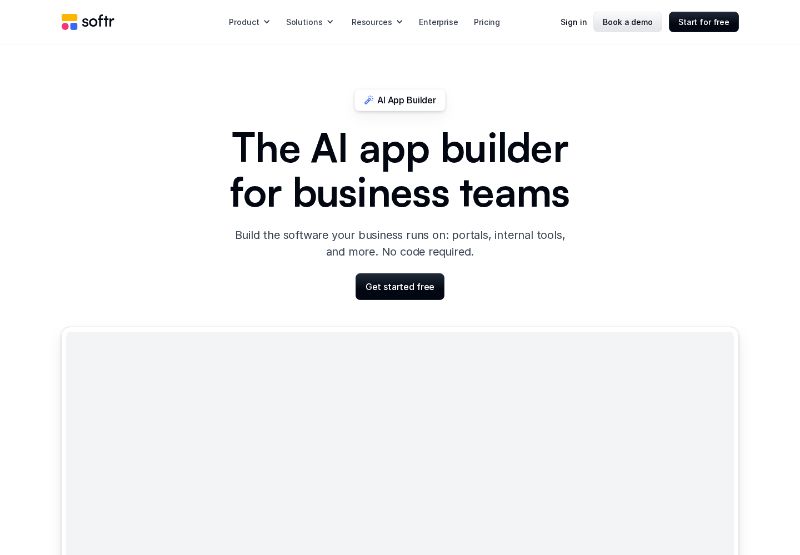
Softr calls itself a hybrid AI app builder. Official FAQ: if you run out of AI credits you can keep building in the no-code editor. Plan AI credits reset monthly and do not roll over; purchased add-on AI credits roll over for one month.
Willo’s AI is an operating team, not a block editor. Unlimited chat is free on every plan. Credits are spent on tasks that ship (site, content, backend work), not on exploring the idea in conversation.
Data and integrations
This is Softr’s strongest contrast. You can keep Airtable, Sheets, or SQL as the system of record and put a permissioned frontend on it. Pro unlocks more connectors (pricing page lists custom code and API connectors). Business lists HubSpot, Excel, and SQL sources among others.
Willo connects APIs from Starter and Shopify on every plan. It is not trying to be an Airtable portal layer.
Hosting, export, and lock-in
Softr apps live on Softr infrastructure. Custom domains are a paid-plan feature. There is no documented “download my app as Flutter/React.” You can embed pages/blocks and export tabular data.
Willo auto-deploys the website to GitHub and hosts it. That is the intended off-ramp.
Pricing and cost
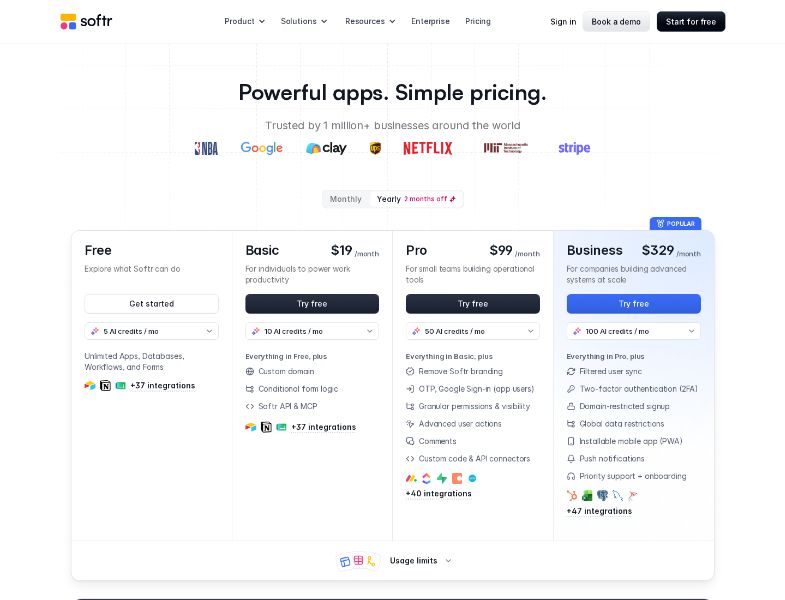
Softr (self-serve)
How Softr meters people (official docs):
- Builders edit apps in Studio. Extra builders: Basic $5/$6, Pro $10/$12, Business $20/$24 (annual/monthly).
- App users log into published apps. Same email across apps counts once. Deactivated users do not count. Workspace builders can be app users without using the allowance.
- Team users share a business email domain with a builder. Free domains (Gmail, etc.) count as Client users.
- Extra users (Pro/Business) are billed monthly even on annual plans, with a 7-day grace period the first time you exceed the included count.
- Extra custom domains: $15/mo or $13/mo billed annually.
- Hitting the workflow action cap pauses workflows until renewal or upgrade.
Trial and refunds (official): Signing up starts a 7-day trial of Business features; adding a card extends it another 7 days (14 days total). You are charged when the trial ends unless you cancel first. Free plan remains free forever after that. Refunds: full refund within 14 days of the first monthly payment or 30 days of the first yearly payment, via support@softr.io. 50% nonprofit and education discount via a form.
Willo
| Plan | Price | Credits | Businesses |
|---|---|---|---|
| Free | $0 | 40 one-time | Up to 2 |
| Starter | $25/mo | 150/mo | Up to 3 |
| Builder | $49/mo | 300/mo | Up to 6 |
| Growth | $99/mo | 600/mo | Up to 12 |
| Scale | $199/mo | 1,300/mo | Up to 25 |
Chat is unlimited and free. Credits are a shared pool across businesses. Rollover: none on Free/Starter; 1 month on Builder+. Top-ups start at 50 credits for $11. No credit card for Free. Support: Community on Free, email through Growth, priority on Scale.
How the bills actually compare
These products do not meter the same unit.
- Softr’s bill grows with builders, logged-in app users, workflow actions, records, and AI credits. A client portal with 80 external users is a Pro/Business conversation even if you barely use AI.
- Willo’s bill grows with credits spent on shipped work and how many businesses you run. It does not sell “app user seats” the way Softr does.
A $19/mo Softr Basic plan can be cheaper than Willo Starter if you only need a small internal tool with a custom domain. A Softr Business workspace at $329/mo (yearly) plus extra users is a different budget from Willo Growth at $99/mo — and it still will not research a market or run a public brand for you.
Ease of use and onboarding
Softr. G2’s generated themes (740 reviews, 4.7/5 as of this research) put ease of use first (169 mentions) and Airtable / app integrations close behind. You can start from a prompt, a template, or an existing base. The editor is block-based. Official FAQ stresses you are not stuck when AI credits run out.
The learning curve shows up when you need permissions, user groups, and data that spans several sources. That is also the product’s point.
Willo. Onboarding is a conversation: describe the idea, review what Day 1 ships, then steer weekly. There is no portal canvas to learn.
Who is Softr best for?
- Ops, CS, HR, and agency teams that need a client or partner portal on Airtable, Sheets, Notion, or SQL
- Companies that already have data and need roles, groups, and record restrictions
- Teams that want databases, apps, workflows, and forms in one Softr workspace
- Organizations that need a path to SSO, SCIM, audit logs, and a SOC 2 report (Enterprise)
- Builders who want AI to draft the app, then finish it in a visual editor
Who is Willo best for?
- Founders, solopreneurs, operators, agencies, and local businesses with an idea (or an existing business to migrate, in beta) who need a public company presence
- People who want research, brand, site, Stripe, and ongoing content/ops from one chat
- Anyone who wants the site in GitHub and to cancel without losing the files
- Operators running multiple small businesses on one shared credit pool
Pros and cons
Softr
Pros
- Purpose-built for portals and internal tools with permissions
- Native databases and live connections to Airtable, Sheets, Notion, SQL, and others
- Hybrid AI + visual editor; work continues if AI credits run out
- Mature review base: 4.7/5 from 740 G2 reviews
- Clear path from Free → Basic → Pro → Business → Enterprise, including SOC 2 access on Enterprise
- PWA / push notifications on Business for an installable mobile experience
Cons
- Not a company-in-a-box: no Willo-style market research, brand system, or growth engine
- No documented full source-code export; you are on Softr hosting
- Cost scales with users and workflows, which G2 reviewers sometimes call prohibitive (30 mentions of pricing)
- G2 themes also flag limited customization (75 mentions) and missing / limited features (67 and 64 mentions), including block-based layout constraints
- Native App Store / Play Store apps are not the product (PWA only on higher plans)
- Plan AI credits do not roll over
Willo
Pros
- Built to start and run a business, not only an internal app
- Free unlimited chat; pay for shipped work
- GitHub deployment and an explicit keep-what-you-built off-ramp
- Shared credits across every business; transfer/handoff for agencies
- Stripe (paid plans) and Shopify (every plan), plus SEO/AEO on the public site
Cons
- Not a replacement for Softr-style permissioned client portals on Airtable
- Custom agents need the Builder plan or higher
When to choose Softr
Choose Softr when the artifact you need is software your team or clients log into: a portal, intranet, inventory tracker, or custom CRM, especially if the data already lives in Airtable or a spreadsheet.
When to choose Willo
Choose Willo when the artifact you need is a business: positioning, brand, a public site customers can find, payments, and an AI team that keeps executing after publish. Choose it when you care about owning the GitHub repo.
Many teams will not treat these as substitutes. A studio might run Willo for the marketing company and Softr for the client portal behind login.
Frequently asked questions
Can Softr replace my public website?
You can publish web apps and connect a custom domain on paid plans. Softr’s own messaging is portals and internal tools, not a marketing-site + growth engine.
Can Willo replace Softr for a client portal?
Willo adds auth and a backend from Free plan, but it is not documented as Softr’s Team/Client user model, granular portal permissions, or Airtable frontend. If the portal is the product, start with Softr.
Does Softr export code?
Official docs cover custom code into the app, embeds, and CSV/XLSX/PDF export from blocks — not a full app source download.
Does Softr have a free plan?
Yes. Official FAQ: the Free plan is free forever. New accounts also get a Business-feature trial (7 days, 14 with a card).
How does Softr count users?
Unique emails across published apps. Team vs Client split on Basic+. Extra users on Pro/Business are pay-as-you-go monthly.
Conclusion
Softr is a strong answer to “we need software our clients and staff can log into, on data we already have.” Willo is a strong answer to “we need the business itself — site, brand, payments, and an AI team that keeps working.”
If you are evaluating Softr because you want an AI that turns an idea into a company, start free on Willo and see what Day 1 ships.
Start free on Willo — no credit card required.