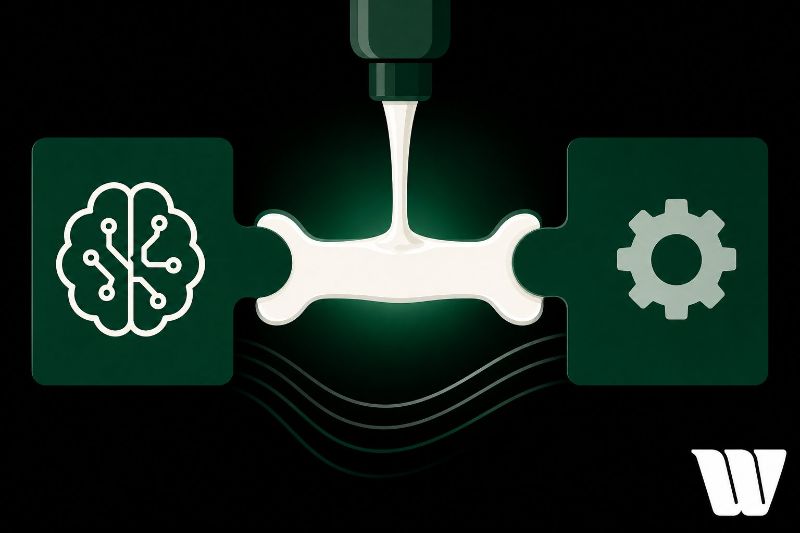
Glue code is the connective infrastructure you write to bind discrete components of your AI pipeline together. It handles data ingestion, schema conversion, API orchestration, and output formatting so your model doesn't choke on incompatible system boundaries. Without it, your inference engine can't transform raw heterogeneous inputs into tensor-ready formats or deliver predictions in consumable downstream formats. It's essential, but it accumulates technical debt fast — and there's a lot more to unpack about managing it effectively.
Key Takeaways
- Glue code connects separate AI components, handling data ingestion, format conversion, API calls, and communication between different systems in a workflow.
- It differs from core AI logic, which focuses on model inference and training, keeping both functions clean and modular.
- AI models depend on glue code to transform incompatible data formats into usable inputs and deliver outputs to downstream systems.
- Common tools for writing glue code include Python, Apache Airflow, and custom adapters built for data normalization and workflow management.
- Poor glue code maintenance creates technical debt, but modular design, schema validation, and automated testing improve long-term pipeline reliability.
What Is Glue Code in AI Workflows?
Glue code is the connective tissue that binds discrete components of an AI workflow together — scripts, adapters, and transformation layers that handle data ingestion, format conversion, API calls, and inter-service communication.
You'll encounter it wherever data flow crosses service boundaries, bridging incompatible interfaces and resolving interoperability issues between heterogeneous systems.
Without deliberate modular design, glue code accumulates technical debt rapidly, creating performance bottlenecks and compounding integration challenges across your pipeline.
Poor version control disciplines make debugging strategies nearly impossible to execute consistently, since undocumented transformations obscure root-cause analysis.
Scalability concerns emerge when ad-hoc connectors can't handle increased throughput.
Prioritizing code efficiency and rigorous testing practices from the outset guarantees your glue code remains maintainable, observable, and capable of supporting production-grade AI systems without becoming an unmanageable liability.
Glue Code vs. Core AI Logic
While glue code manages data orchestration and inter-service communication, your core AI logic encapsulates the model inference pipelines, training loops, loss functions, and algorithmic decision-making that define your system's predictive capabilities.
Understanding this core logic distinction is critical for maintaining architectural clarity.
Glue code importance emerges when integration challenges surface between disparate APIs, data schemas, and runtime environments. Without disciplined separation, your core logic becomes polluted with preprocessing scripts, authentication handlers, and format converters, creating scalability considerations that compound during deployment.
Development best practices mandate strict boundary enforcement between both layers. You should modularize your connective tissue independently, enabling efficiency enhancements through targeted refactoring without destabilizing trained models.
This separation accelerates debugging cycles, reduces technical debt accumulation, and preserves your core algorithmic components from infrastructure-level modifications that would otherwise compromise model reproducibility and performance benchmarks.
Why AI Models Can't Function Without It
Separating your core AI logic from glue code reveals an uncomfortable dependency: your models are functionally inert without the connective infrastructure surrounding them. Your neural network can't ingest raw JSON payloads, negotiate API authentication, or serialize predictions into downstream-compatible formats autonomously.
Data transformation pipelines convert incompatible data schemas into tensor-ready inputs your model actually processes. Without them, your model receives nothing executable.
Model interoperability compounds this dependency further. Your trained artifacts must communicate across heterogeneous systems—microservices, databases, third-party APIs—each enforcing distinct data contracts.
Glue code mediates these negotiations, translating between incompatible protocols and formats. Remove it, and your model becomes an isolated computational unit producing outputs nothing can consume.
The inference engine executes flawlessly in isolation while delivering zero production value without surrounding connective tissue orchestrating every interaction.
Where Glue Code Appears in Real AI Pipelines
When you trace an AI pipeline from end to end, you'll find glue code surfacing at three critical junctures: data ingestion connections, model output formatting layers, and pipeline orchestration points.
At the ingestion layer, you're writing adapters, parsers, and schema validators to normalize heterogeneous data sources into tensors or DataFrames your model can consume.
From there, you'll encounter output formatting logic that post-processes raw logits or embeddings into structured payloads, and orchestration glue that sequences microservices, manages async task queues, and enforces dependency resolution across your DAG.
Data Ingestion Connections
Data ingestion is where glue code proliferates most aggressively in AI pipelines, bridging the gap between heterogeneous data sources—REST APIs, SQL/NoSQL databases, data lakes, and flat files—and the structured tensors or DataFrames your model actually consumes.
Your ingestion layer must reconcile conflicting ingestion formats, enforce security protocols like OAuth2 and TLS, and maintain performance metrics across both real time streaming and batch processing workflows.
Three critical glue code responsibilities emerge here:
- Connection types normalization — abstracting API integrations, JDBC connectors, and Kafka consumers behind unified interfaces
- Data transformations — schema mapping, type casting, and null imputation before downstream consumption
- Data quality enforcement — validating statistical distributions, detecting drift, and rejecting malformed records
Each responsibility demands custom adapter code your orchestration framework won't automatically provide.
Model Output Formatting
Model output formatting demands glue code the moment your model's raw logits, embeddings, or structured predictions collide with the expectations of downstream consumers—REST clients, message queues, dashboards, or chained models.
You'll apply formatting techniques like softmax normalization, threshold binarization, and schema serialization to align outputs with output standards your pipeline enforces. Data normalization transforms floating-point confidence scores into percentages, ranked lists, or categorical labels your consumers actually parse.
You're also instrumenting performance metrics—latency, throughput, and prediction drift—directly inside these formatting layers, feeding model evaluation pipelines without separate instrumentation overhead.
User feedback loops inject correction signals back through the same glue code, enabling online retraining triggers. Without this formatting layer, your model's predictions remain semantically valid but operationally useless—trapped between inference and execution.
Pipeline Orchestration Points
Across a real AI pipeline, glue code doesn't cluster in one place—it erupts at every orchestration boundary where control transfers between discrete computational units.
Orchestration challenges compound as workflow dependencies multiply across ingestion, transformation, inference, and post-processing stages, generating integration complexity that degrades pipeline efficiency.
Critical orchestration points demanding glue code intervention include:
- Data ingestion boundaries — where resource allocation mismatches and schema inconsistencies introduce execution latency requiring normalization logic.
- Model inference handoffs — where error handling middleware intercepts malformed tensors, managing scalability issues during concurrent request surges.
- Output routing junctions — where performance tuning and monitoring strategies govern downstream delivery, preventing silent failures.
You'll find that neglecting these boundaries cascades into systemic degradation, making deliberate glue code architecture non-negotiable for production-grade deployments.
Tools Developers Use to Write Glue Code
When you're assembling glue code for AI pipelines, you'll typically reach for scripting languages like Python, Bash, or Julia to handle data marshaling, API calls, and inter-service communication.
You can extend your toolkit with integration frameworks and libraries—such as Apache Airflow, Luigi, or Prefect—that provide orchestration primitives, dependency graphs, and retry logic out of the box.
Beyond those, workflow automation platforms like Kubeflow, MLflow, and ZenML let you declaratively define pipeline stages, manage artifacts, and enforce reproducibility across heterogeneous compute environments.
Popular Scripting Languages Used
Several scripting languages dominate glue code development in AI workflows, each offering distinct trade-offs in expressiveness, library support, and runtime overhead. You'll encounter these tools constantly across pipelines:
- Python scripts lead due to native ML library bindings, while R integration suits statistical preprocessing layers.
- JavaScript hooks and TypeScript bindings handle real-time API orchestration, offering type-safe contract enforcement across microservices.
- Bash utilities automate environment provisioning, Go connectors manage high-throughput data streaming, Kotlin scripts extend JVM-based pipelines, and Ruby automation drives configuration management tasks.
Your language selection directly impacts serialization efficiency, inter-process communication latency, and dependency resolution complexity.
Each language carries distinct runtime characteristics that influence how effectively your glue code integrates disparate AI components without introducing bottlenecks.
Integration Frameworks and Libraries
Integration frameworks and libraries form the connective tissue of your glue code, abstracting low-level IPC mechanics and serialization protocols into composable, high-level primitives. Your library selection directly impacts framework compatibility across heterogeneous AI pipeline components.
Leverage Apache Kafka for event-driven data streaming, gRPC for low-latency RPC calls, and Celery for distributed task orchestration. Prioritize integration tools that expose clean APIs supporting code modularity and dependency injection patterns.
Implement robust error handling through circuit breakers and retry policies within frameworks like Resilience4j or Tenacity. Apply performance optimization via connection pooling, lazy loading, and async I/O primitives.
Enforce version control discipline on dependency manifests to prevent runtime incompatibilities. Validate integrations using contract-based testing strategies with tools like Pact, ensuring interface contracts remain stable across iterative deployments.
Workflow Automation Platforms
Workflow automation platforms give you 5 core capabilities that raw glue code alone can't efficiently deliver: DAG-based task scheduling, dependency resolution, execution monitoring, failure recovery, and audit logging.
Platforms like Apache Airflow, Prefect, and Dagster address automation scalability challenges by abstracting orchestration complexity into declarative pipelines.
Key workflow optimization strategies include:
- Parameterized DAG templating — enabling dynamic pipeline reconfiguration without redeployment
- Retry logic with exponential backoff — handling transient API failures in ML inference pipelines
- Cross-platform sensor triggers — synchronizing heterogeneous data sources across S3, Kafka, and PostgreSQL
These platforms transform brittle, imperative glue code into observable, maintainable workflows.
You gain native integrations, built-in alerting, and execution metadata — eliminating hand-rolled monitoring scripts that compound technical debt across distributed AI systems.
Why Glue Code Turns Into a Maintenance Problem
What starts as a few lines of adapter logic quickly metastasizes into a sprawling dependency graph that's nearly impossible to reason about.
You'll face mounting maintenance challenges as each API version bump cascades through tightly coupled transformation layers. Long term implications compound when undocumented schema contracts silently break downstream consumers.
Code readability deteriorates as contextless patches accumulate without documentation practices to anchor intent. Your refactoring strategies collapse under implicit runtime assumptions nobody captured in version control.
Team collaboration fractures when engineers inherit glue modules lacking typed interfaces or integration tests.
Testing complexities escalate because glue code sits at system boundaries where mocking fidelity directly determines test reliability.
Every undocumented assumption becomes a latent defect, and without disciplined version control hygiene, regression surfaces multiply faster than your team can triage them.
Why Glue Code Gets Messy and How to Fix It
Glue code devolves into unmaintainable spaghetti because you're stitching heterogeneous APIs together under deadline pressure without enforcing explicit schema contracts, typed adapters, or idempotent transformation pipelines.
Glue code complexity compounds when automation challenges intersect with scalability issues across distributed inference layers.
Implement these refactoring techniques to restore code readability and enforce maintainability:
- Schema validation gates — enforce Pydantic or Protobuf contracts at every API boundary, eliminating silent data corruption.
- Modular adapter patterns — isolate transformation logic into versioned, single-responsibility modules, simplifying debugging methods during regression analysis.
- Automated integration tests — instrument pipelines with contract testing frameworks, validating payload transformations continuously.
Adopt rigorous documentation practices by embedding inline architecture decision records.
Your maintenance strategies must treat glue code as production-grade infrastructure, not throwaway scaffolding.
Frequently Asked Questions
Can Glue Code Introduce Security Vulnerabilities in AI Production Systems?
Yes, your glue code can introduce security risks through unvalidated API calls, insecure data pipelines, and poor code maintenance practices, exposing your AI production systems to injection attacks, credential leakage, and unauthorized data access vulnerabilities.
How Does Glue Code Affect the Overall Latency of AI Applications?
Your glue code's inefficient data serialization, redundant API calls, and synchronous blocking operations directly inflate end-to-end latency. You'll need rigorous performance monitoring to identify bottlenecks and implement latency optimization strategies like caching, async processing, and streamlined middleware pipelines.
Should Junior Developers or Senior Engineers Be Responsible for Glue Code?
Both should share responsibility distribution. You'll want senior engineers architecting glue code frameworks while junior developers implement routine integrations, fostering skill development. This collaborative approach optimizes team efficiency and accelerates junior engineers' technical growth in AI workflows.
Can Glue Code Failures Cause AI Models to Produce Incorrect Outputs?
Yes, glue code failures can corrupt your AI model's outputs. When you neglect glue code reliability, you'll introduce malformed data pipelines, triggering erroneous predictions. You'll face significant debugging challenges tracing whether faults originate in preprocessing logic or the model itself.
How Much of a Typical AI Project Budget Does Glue Code Consume?
You'll typically find glue code consuming 20-40% of your budget allocation, greatly impacting project efficiency. It's an oft-underestimated overhead encompassing API integrations, data pipeline orchestration, and middleware development that compounds across iterative deployment cycles.
Conclusion
When you're building AI pipelines, glue code is unavoidable — but it doesn't have to become a liability. You'll want to enforce strict interface contracts, modularize your adapter layers, and version-control every integration touchpoint. Without disciplined abstraction, your orchestration logic metastasizes into brittle, untestable spaghetti code. Treat your glue code as a first-class engineering artifact, not an afterthought, and you'll maintain interoperability across heterogeneous components without sacrificing system coherence or long-term scalability.