Weebly and Willo can both get a small business online. They are not solving the same problem.
Weebly is a drag-and-drop website builder with hosting, templates, a blog, and an online store. Square acquired it; the homepage states Weebly is now part of the Square product suite, so in-person and online payments can sit in one stack. You pick a theme, drop in elements, and publish. G2 lists the product as Square Online (formerly Weebly).
Willo is an AI business builder. You describe an idea. Agents research the market, create a brand, deploy a website to your GitHub repo, prepare Stripe, and keep working on content, marketing, and operations. Chat is free. Credits pay for work that ships.
If you want a simple site or Square-connected storefront you will keep editing yourself, Weebly is usually the better fit. If you want the business to exist — research, brand, site, payments, and weekly agent work — Willo is built for that job.
Quick decision table
| You need… | Better starting point |
|---|---|
| A drag-and-drop website, blog, or basic store you edit yourself | Weebly |
| Square POS + online store in one merchant stack | Weebly |
| A free plan with a shopping cart (Square ads stay on Free) | Weebly |
| Market research, brand, roadmap, and a live site from one prompt | Willo |
| Agents that keep operating after launch (content, email, weekly growth) | Willo |
| Code and assets in your own GitHub repo | Willo |
| Multiple businesses on one shared credit pool | Willo |
What is Weebly?
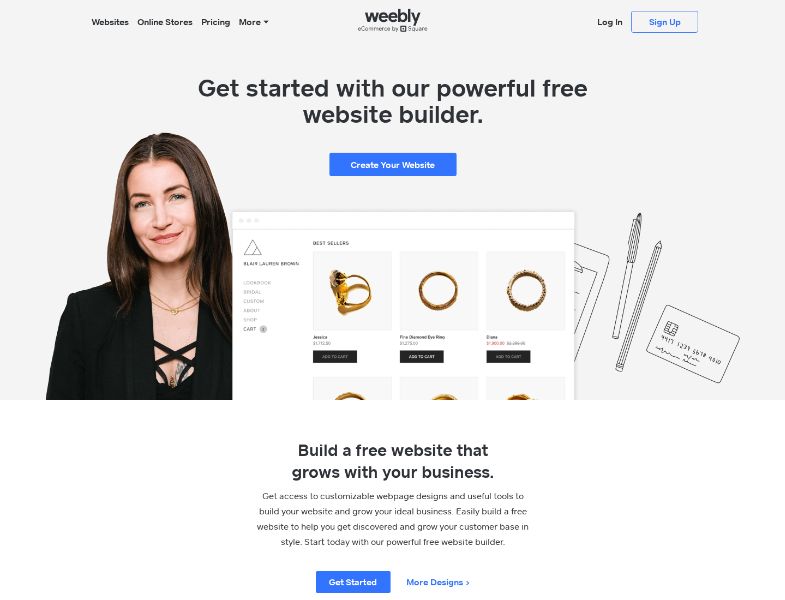
Weebly is a hosted website and ecommerce builder. The homepage headline is “Build a professional website that grows with your business.” Official pages describe a free website builder, customizable themes, an online store, marketing tools, and Square payments.
The product is organized around four jobs on the homepage:
- Get Going — starter guides and planning tools
- Get Online — a professional site you customize in the builder
- Get Selling — ecommerce for orders, shipping, and payments
- Get Growing — marketing tools such as Facebook ads and email campaigns
The features hub covers the drag-and-drop builder, ecommerce, photos, mobile/responsive themes, templates, App Center, domains, SEO, blogging, forms, hosting, video, business tools, and site statistics. The builder page says content elements (text, photos, maps, videos) are dropped onto the page and edited in the browser — nothing to install.
Ecommerce is a first-class path. The online store page lists themes, abandoned-cart and welcome emails, SEO and analytics, shipping rates, inventory (including bulk import/export), coupons and Square gift cards, product search and badges, reviews, and checkout via Square, Stripe, or PayPal.
Weebly is not positioned as an AI site generator or an AI company operator. The official homepage, features, and pricing pages reviewed for this article do not describe prompt-to-site agents, a living roadmap, or weekly autonomous growth cycles.
What is Willo?
Willo is an AI business builder for founders, operators, solopreneurs, agencies, and local businesses. You describe a business or idea. An AI team researches competitors, writes a brand guide, deploys a website to your GitHub repo, prepares Stripe, and keeps a living roadmap.
Willo’s What to Expect page is direct about what it is not: not a get-rich-quick scheme, not a replacement for product-market fit, not set-and-forget, and not a paid-ads manager, lawyer, or accountant.
On paid plans, a Growth Engine runs weekly plan → execute → reflect cycles against real traffic and revenue data. Chat is always free. Credits are spent on work that ships.
You stay the captain: approve strategy, bring domain knowledge, review output, and show up weekly. Cancel anytime and keep the GitHub repo, Stripe, and exportable email list.
Weebly vs Willo: feature-by-feature
| Area | Weebly | Willo |
|---|---|---|
| Job to be done | Build and host a website / blog / store | Launch and operate a business from an idea |
| Starting point | Theme + drag-and-drop editor | Describe the business; agents research, brand, and ship |
| AI | Not described on the official pages reviewed | Multi-agent team (research, CEO, product, marketing, support, finance) |
| What ships on day 1 | A site you assemble | Research report, brand, roadmap, GitHub-hosted site, Stripe prep |
| Website / frontend | Visual editor, responsive themes, elements | Auto-deployed website + visual/text/brand editor |
| Ecommerce | Cart, inventory, shipping, coupons, Square/Stripe/PayPal (plan-gated) | Stripe Connect products and checkout on paid plans |
| In-person retail | Square POS connection is a core pitch | Not a POS product |
| Hosting | Weebly/Square hosted | Cloud hosting; site in your GitHub |
| Code ownership | Hosted builder (HTML self-host export not verified in this research) | Repo in your GitHub; cancel and take what was built |
| Marketing & ops | SEO, lead capture, Instagram, Promote email, ads (you run them) | Research, content, email, outreach drafts, weekly Growth Engine |
| Collaboration | Designer/client path exists on a separate designers site | Team invite and business transfer from Builder |
| Billing unit | Per site plan (Free → Performance) | Per account; one credit pool for all businesses |
| Ads on free sites | Remove Square Ads is a paid-plan line (Professional / Performance) | No Square ads on Willo sites |
| Learning curve | Drag-and-drop; G2 reviewers often call it easy | Chat-first; you review and steer |
Builder vs operator
Weebly’s editor is a website you maintain. You choose layouts, drop elements, add products, and publish. Square can connect the register and the cart. After launch, growth is still your job: write posts, send Weebly Promote emails, run ads, restock.
Willo’s loop is a team that operates. Research writes a competitor report. Product deploys the site. Marketing drafts campaigns for your OK. On paid plans the Growth Engine plans the week from live analytics. You still approve the calls.
Store and payments
Weebly is stronger when you already sell (or will sell) through Square — pop-ups, a shop floor, and a site that shares inventory and customer data. Official store copy names Square, Stripe, and PayPal at checkout. Several ecommerce extras (digital goods, PayPal, abandoned-cart emails, advanced insights) sit on higher plans on the pricing matrix.
Willo is stronger when the missing piece is an offer plus operating cadence, with Stripe Connect on paid plans. It does not advertise Square POS, in-store pickup, shipping labels, or gift cards.
After publish
Weebly will keep hosting the site. It will not research your market, write a brand system, or run a weekly content loop unless you do that work in the editor and in Promote.
Willo’s paid Growth Engine is the after-launch product. It will not give you Weebly’s Square POS depth or a classic drag-and-drop section stack.
Pricing and cost comparison
Weebly
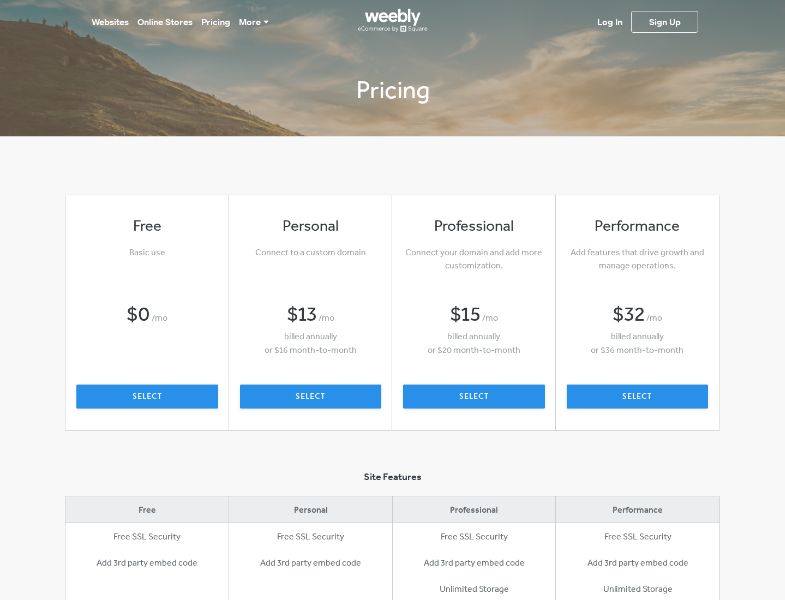
| Plan | Annual (listed / month) | Month-to-month |
|---|---|---|
| Free | $0 | $0 |
| Personal | $13/mo billed annually | $16 |
| Professional | $15/mo billed annually | $20 |
| Performance | $32/mo billed annually | $36 |
What the same page’s comparison matrix lists (checkmarks as they appear on the live page):
Site: Free SSL and third-party embed on all plans. Unlimited storage, custom domain on Personal and up. Advanced site stats, free domain, remove Square ads, and password protection on Professional and Performance.
Ecommerce: Shopping cart, unlimited items, inventory, in-store pickup, and automatic tax on all plans including Free. Item badges, options, quick shop, coupons, Square gift cards, and shipping labels from Personal up. Digital goods and shipping calculator on Professional and Performance. PayPal, item reviews, and abandoned-cart emails appear only on Performance in that matrix.
Marketing: SEO, lead capture, and Instagram feed on all plans. Pop-up notifications from Personal up. Advanced ecommerce insights on Performance.
Support: Community forum on all plans. Chat and email from Personal up. Phone on Professional and Performance. Priority support on Performance.
There is a separate Weebly for Web Designers path (Lite / WebPro) for people who build client sites.
Willo
| Plan | Price | Credits | Businesses (compare table) |
|---|---|---|---|
| Free | $0 | 40 one-time | 2 |
| Starter | $25 / month | 150 / month | 3 |
| Builder | $49 / month | 300 / month | 6 |
| Growth | $99 / month | 600 / month | 12 |
| Scale | $199 / month | 1,300 / month | 25 |
Chat is unlimited and free on every plan. Credits are a shared pool. Rollover starts at Builder (1 month). Custom domains, team invite, Shopify, and business transfer start at Builder. Backend, Growth Engine, Stripe Connect, email, and analytics start at Starter.
Credit top-ups: 50 for $11 through 1,000 for $180.
How to read the two bills
- Weebly’s paid site plans start at $13/month billed annually. That is a website/store subscription. Free is usable for a basic cart, with Square ads until you reach Professional.
- Willo’s Starter at $25/month is more expensive than Weebly Personal on sticker, and cheaper than hiring a team to do research, brand, site, and weekly ops. Custom domain on Willo starts at Builder ($49/month).
Weebly is usually the cheaper way to host a page. Willo is usually the cheaper way to staff the work around the page — if that is the job.
Who is Weebly best for?
- Local retailers and pop-ups already on Square POS who need a matching online store.
- Beginners who want a free or low-cost site, blog, or simple cart and will edit it themselves.
- Small catalogs that fit Weebly’s inventory, coupons, pickup, and shipping tools.
- People who prefer a classic website builder over chatting with agents.
Who is Willo best for?
- Founders, operators, solopreneurs, and local businesses who need research, brand, site, payments, and a weekly operating cadence.
- Agencies that want to stand up a client business and hand it off to the client’s Willo account.
- People who want artifacts they own outside the vendor (GitHub, Stripe, exportable list).
- Anyone who does not want to become the full-time webmaster in order to have a live offer.
Pros and cons of each
Weebly
Pros
- Very low starting price; a real Free plan with cart and SSL.
- Drag-and-drop editor that G2 reviewers often call easy.
- Square POS + online store is the product’s distinctive strength.
- Hosting, themes, blog, forms, App Center, and SEO basics in one place.
- Checkout can use Square, Stripe, or PayPal (plan-dependent for PayPal).
Cons
- Not an AI business operator; you still do research, brand, and weekly growth.
- Square ads on lower plans until Professional / Performance.
- G2 themes include limited customization and thin SEO versus modern builders.
- Support can feel split between Weebly and Square (G2, anecdotal).
- HTML self-host export was not verified in official help during this research — do not assume you can pick up the site and leave.
Willo
Pros
- Built for the whole business, not only the website.
- Chat free; credits on shipped work; one pool across businesses.
- GitHub-hosted site, Stripe, and exportable list — cancel and keep the work.
- Weekly Growth Engine on paid plans.
- Honest scope: no fake revenue guarantees; human-only legal/tax.
Cons
- Not a Square POS or shipping-label product.
- Custom domain starts at Builder ($49/month).
- You still have to show up; it is not passive income.
When to choose Weebly
Choose Weebly when the hard problem is a website or a Square-connected store you will edit. You want templates, a cart, and a bill in the teens per month. You are comfortable being the operator.
When to choose Willo
Choose Willo when the hard problem is getting a business into the market and keeping it moving: positioning, site, offer, payments, content, and a weekly loop. You want agents to do the production work while you approve the calls.
Some Square merchants will keep Weebly (or Square Online) for the storefront and use a human team — or Willo — for everything that is not the cart. They are complementary more often than they are substitutes.
Frequently asked questions
Is Willo a Weebly alternative? For “I need a website,” people search that way. For “I need a drag-and-drop builder with Square POS,” no — that is still Weebly/Square Online’s category.
Does Weebly use AI to build my business? Official Weebly pages reviewed here describe a visual builder and Square commerce, not an AI company-in-a-box.
Can I sell on Weebly for free? The pricing matrix includes a shopping cart and unlimited items on Free. Remove Square Ads is listed on Professional and Performance. Confirm ads and payment fees before you launch.
Which is cheaper? Weebly Personal at $13/month billed annually undercuts Willo Starter. Willo’s $25–$49 plans include research, brand, and (on paid plans) a Growth Engine Weebly does not bundle.
Is Weebly the same as Square Online? Weebly’s own homepage says it is part of the Square product suite. G2’s listing is titled Square Online (formerly Weebly). Square also markets online store pages that may redirect into Square’s own website product.
Conclusion
Weebly remains a straightforward way to publish a site or a Square-friendly store without code. That is the right tool when you will live in a drag-and-drop editor and already think like a merchant.
Willo is the right tool when you are building a business you will keep operating. The output is research, brand, a GitHub-backed site, Stripe, and agents that come back next week.
If your next step is a simple website or Square storefront, start on Weebly. If your next step is a company, start free on Willo — no credit card, chat is free