Shopify and Willo can both get a merchant online. They are not solving the same problem.
Shopify calls itself the world’s best commerce platform. You add products, customize a store, set up payments, and sell online, in person, on social, and in AI chats. Sidekick is the built-in AI assistant. POS, checkout, shipping labels, Markets, and an app store sit in the same admin. Official homepage examples include brands such as Steve Madden, Glossier, and Kotn.
Willo is an AI business builder. You describe an idea. Agents research the market, create a brand, deploy a website to your GitHub repo, prepare Stripe, and keep working on content, marketing, and operations. Chat is free. Credits pay for work that ships. Willo’s Builder plan lists a Shopify integration — the two products can sit in the same stack.
If you need a store that sells — catalog, checkout, POS, shipping, channels — Shopify is usually the better fit. If you want the business to exist — research, brand, site, payments, and weekly agent work — Willo is built for that job.
Quick decision table
| You need… | Better starting point |
|---|---|
| A production online store with checkout, inventory, and unlimited products | Shopify |
| In-person POS synced with the same catalog | Shopify |
| Selling on social, marketplaces, and AI chats from one back office | Shopify |
| Card processing, shipping labels, gift cards, and abandoned-checkout recovery | Shopify |
| Market research, brand, roadmap, and a live site from one prompt | Willo |
| Agents that keep operating after launch (content, email, weekly growth) | Willo |
| Code and assets in your own GitHub repo | Willo |
| Multiple businesses on one shared credit pool | Willo |
| A Shopify store plus an AI team around it | Both — Willo lists Shopify integration |
What is Shopify?

Shopify is a hosted commerce platform from Shopify Inc. The stack is one admin, not a pile of disconnected tools:
- Online store. Themes, templates, or a store from a prompt. Unlimited products on paid plans. Hosting and SSL included. Headless storefronts are listed (1 on Basic in the comparison matrix).
- Checkout. Shopify’s pricing page calls it the “world’s best checkout” and claims it converts 15% better on average than other platforms. Treat that as a company claim.
- Payments. Shopify Payments with plan-based card rates. Third-party processors incur a 2% transaction fee on the plans listed. In-person rates are separate.
- POS. Casual in-person sales on the core plan. POS Pro is an add-on at $89/month per location for brick-and-mortar tools (unlimited staff roles, in-store inventory, pickup and delivery).
- Channels. Social, marketplaces, Shop app, and Agentic selling in AI chats (ChatGPT, Perplexity, and Copilot appear on the pricing creative). Agentic is listed at $0/month — you add products to Shopify’s Catalog and pay when you make a sale.
- AI. Sidekick is the built-in commerce assistant (theme help, product photos, copy, admin tasks). Pricing cards also list a website builder and “millions of tokens.”
- Ops. Inventory locations, staff accounts (plan-gated), 200+ reports, email/SMS marketing, Shopify Markets, Capital, Balance, Tax, and thousands of apps.
Official marketing stats on the pricing page include $1.1 trillion in collective merchant sales and a first sale every 26 seconds. Treat those as company claims.
Shopify is a commerce operating system. It is not a company-in-a-box. You still do (or hire for) product, brand, content, and weekly growth — Sidekick helps inside the admin; it does not replace a research/brand/ops team that ships a business from a sentence.
What is Willo?
Willo is an AI business builder for founders, operators, solopreneurs, agencies, and local businesses. You describe a business or idea. An AI team researches competitors, writes a brand guide, deploys a website to your GitHub repo, prepares Stripe, and keeps a living roadmap.
Willo’s What to Expect page is direct about what it is not: not a get-rich-quick scheme, not a replacement for product-market fit, not set-and-forget, and not a paid-ads manager, lawyer, or accountant. Day 1 is infrastructure — research, brand, roadmap, repo, site, Stripe being wired — not a mock landing page.
On paid plans, a Growth Engine runs weekly plan → execute → reflect cycles against real traffic and revenue data. Chat is always free. Credits are spent on work that ships. Credits are a shared pool across every business on the account.
You stay the captain: approve strategy, bring domain knowledge, review output, and show up weekly. Cancel anytime and keep the GitHub repo, Stripe, and exportable email list.
Willo’s pricing compare table lists Shopify integration from the Builder plan ($49/month) up. That is a connector, not a Shopify replacement.
Shopify vs Willo: feature-by-feature
| Area | Shopify | Willo |
|---|---|---|
| Job to be done | Sell products across channels | Launch and operate a business from an idea |
| Starting point | Add a product, theme or prompt, payments | Describe the business; agents research, brand, and ship |
| AI | Sidekick + store-from-prompt + agentic channels | Multi-agent team (research, CEO, product, marketing, support, finance) |
| What ships on day 1 | A store you configure | Research report, brand, roadmap, GitHub-hosted site, Stripe prep |
| Catalog / checkout | Unlimited products, hosted checkout, Shop Pay | Stripe Connect products and checkout on paid plans |
| POS / retail | Core POS + POS Pro add-on | Not a POS product |
| Channels | Social, marketplaces, AI chats, in person | Site + email + outreach drafts; not a marketplace hub |
| Hosting | Shopify-hosted store | Cloud hosting; site in your GitHub |
| Code ownership | Theme/Liquid/custom apps; CSV export; store stays on Shopify | Repo in your GitHub; cancel and take what was built |
| Payments | Shopify Payments (plan rates) or third-party (+2% fee) | Stripe Connect (paid plans) |
| Marketing & ops | Email, SMS, automations, Shop Campaigns — you run them | Research, content, email, weekly Growth Engine |
| Collaboration | Staff accounts (0 extra on Basic; 5 Grow; 15 Advanced; unlimited Plus) | Team invite and business transfer from Builder |
| Billing unit | Per store plan + processing + apps + POS | Per account; one credit pool for all businesses |
| App ecosystem | Thousands of apps (many paid) | Connect any API on paid plans; Shopify listed at Builder |
| Learning curve | Admin + apps; G2 often calls setup easy | Chat-first; you review and steer |
Commerce engine vs operating team
Shopify’s product is the store. Inventory, checkout, fraud analysis, shipping labels, Markets, and POS are why people stay. Sidekick works inside that admin: pick a theme, rewrite a product, explain a report.
Willo’s product is the company around an offer. Research writes a competitor report. Product deploys the site. Marketing drafts campaigns for your OK. On paid plans the Growth Engine plans the week from live analytics. It will not give you Shopify’s checkout, POS, or marketplace sync.
After the first sale
Shopify will keep taking orders. Growth still needs ads, content, merchandising, and ops — plus apps that often add monthly cost. G2’s generated themes (5,140 reviews, 4.4/5 as of this research) praise ease of use and integrations and repeatedly flag app costs, transaction fees, and customization that needs code or paid apps.
Willo’s paid Growth Engine is the after-launch loop. It will not replace Shopify if you are already a catalog business.
Pricing and cost comparison
Shopify
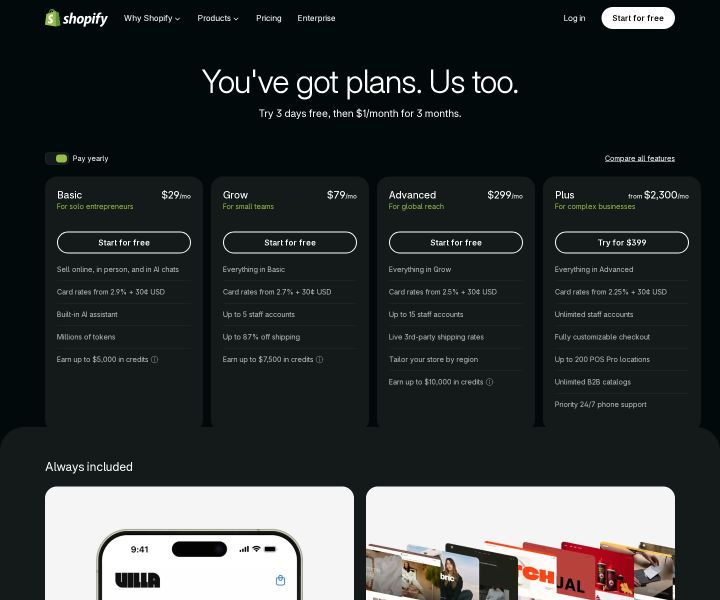
Promotional offer on the same page: 3 days free, then $1/month for 3 months. That is a promo, not the list price.
| Plan | Yearly (listed / month) | Monthly | Stated for |
|---|---|---|---|
| Basic | $29 USD/mo | $39 USD/mo | Solo entrepreneurs |
| Grow | $89 USD/mo | $105 USD/mo | Small teams |
| Advanced | $359 USD/mo | $399 USD/mo | Global reach |
| Plus | from $2,300 USD/mo | Same list (yearly not marked included) | Complex businesses |
Online card rates (Shopify Payments, USD, as listed): Basic 2.9% + 30¢, Grow 2.7% + 30¢, Advanced 2.5% + 30¢, Plus from 2.25% + 30¢. In-person standard card rate on the Basic matrix: 2.6% + 10¢. Third-party transaction fees: 2% if you do not use Shopify Payments.
Also on the page:
- Staff: extra accounts not included on Basic; up to 5 Grow; up to 15 Advanced; unlimited Plus.
- Inventory locations: 10 on Basic (matrix).
- Shopify B2B catalogs: up to 3 on Basic.
- “Earn 1% back on all sales” credits: up to $5,000 / $7,500 / $10,000 / $15,000 by plan.
- POS Pro: +$89/mo per location.
- Agentic: $0/mo; card rates from 2.9% + 30¢ online; pay when you sell.
- Marketplace sync: 50 orders/month free, then 1% up to $99/mo.
- Apps, paid themes, SMS, domains, and hardware are extra.
Help Center: cancel by pausing or deactivating the store; export data (CSV) before you leave; you can reopen within 2 years unless you requested deletion. App subscriptions have their own billing cycle — cancel those separately.
Willo
| Plan | Price | Credits | Businesses (compare table) |
|---|---|---|---|
| Free | $0 | 40 one-time | 2 |
| Starter | $25 / month | 150 / month | 3 |
| Builder | $49 / month | 300 / month | 6 |
| Growth | $99 / month | 600 / month | 12 |
| Scale | $199 / month | 1,300 / month | 25 |
Chat is unlimited and free. Credits are a shared pool. Rollover starts at Builder. Custom domains, team invite, Shopify integration, and business transfer start at Builder. Backend, Growth Engine, Stripe Connect, email, and analytics start at Starter.
Credit top-ups: 50 for $11 through 1,000 for $180.
How to read the two bills
- Shopify’s real cost is plan + processing + apps + POS. Basic at $29/month yearly is the floor, not the ceiling. G2 reviewers often mention that apps and fees add up.
- Willo’s Starter at $25/month is in the same neighborhood as Shopify Basic on sticker and includes research, brand, and a Growth Engine Shopify does not bundle. It does not include Shopify-grade checkout or POS.
- A serious catalog brand on Shopify Grow/Advanced plus POS Pro will outspend Willo Scale. That is the right spend if commerce infrastructure is the product.
Ease of use and onboarding
Shopify. Sign up, add a product, pick a theme or prompt a store, connect payments. Official steps on the homepage: add your first product → customize → set up payments. G2’s generated summary (thousands of reviews) clusters on ease of use, quick setup, and integrations. The same summary clusters on cost, apps, and customization limits.
Willo. Sign up free, no card. Describe the idea; Day 1 ships the skeleton. Onboarding is briefing a team, not merchandising a catalog. It is the wrong classroom if your only goal is a high-volume storefront.
Who is Shopify best for?
- Brands whose product is a catalog — DTC, retail, wholesale, pop-ups.
- Teams that need one back office for web, POS, social, and AI chat selling.
- Merchants who will live in checkout, inventory, shipping, and apps.
- Companies ready for Plus (custom checkout, 200 POS Pro locations, unlimited B2B catalogs, 24/7 phone).
Who is Willo best for?
- Founders, operators, solopreneurs, and local businesses who need research, brand, site, payments, and a weekly operating cadence.
- Agencies that want to stand up a client business and hand it off.
- People who want artifacts they own outside the vendor (GitHub, Stripe, exportable list).
- Merchants who will use Shopify for the cart and want an AI team for everything that is not the cart (Willo).
Pros and cons of each
Shopify
Pros
- Full commerce stack: store, checkout, payments, POS, channels, Markets.
- Sidekick and store-from-prompt inside a real merchant admin.
- Huge app/theme/partner ecosystem; G2 reviewers often call setup easy.
- Scales from Basic to Plus without changing platforms.
- CSV export and a documented 2-year reactivation window after deactivate.
Cons
- You still run brand, content, and growth (or you buy apps).
- Plan + processing + apps is easy to underestimate (G2 theme).
- Advanced design often needs Liquid, a developer, or paid apps.
- Third-party payment processors add a 2% fee.
- The store lives on Shopify; leaving means a rebuild even if data exports.
Willo
Pros
- Built for the whole business, not only the storefront.
- Chat free; credits on shipped work; one pool across businesses.
- GitHub-hosted site, Stripe, and exportable list — cancel and keep the work.
- Weekly Growth Engine on paid plans.
- Shopify integration listed from Builder.
Cons
- Not a replacement for Shopify checkout, POS, or marketplace sync.
- Custom domain starts at Builder ($49/month).
When to choose Shopify
Choose Shopify when the hard problem is selling goods at volume: catalog, checkout, tax, shipping, retail, and channels. You (or a Shopify partner) will live in the admin. Processing fees are a cost of goods.
When to choose Willo
Choose Willo when the hard problem is getting a business into the market and keeping it moving: positioning, site, offer, payments, content, and a weekly loop. You want agents to do production work while you approve the calls.
Many merchants will use both: Shopify for the cart, Willo (or a human team) for research, brand, and operating cadence. Willo documents that path on Builder.
Frequently asked questions
Can Shopify run my whole company? It can run commerce. Market research, brand system, and a weekly editorial loop are not the core product. Sidekick helps inside the store; it does not replace a cross-functional team.
Does Willo replace Shopify checkout? No. Willo uses Stripe Connect on paid plans and lists Shopify as an integration.
How much does Shopify cost? Official pricing page (yearly): Basic $29/mo, Grow $89/mo, Advanced $359/mo, Plus from $2,300/mo, plus card rates, a 2% fee without Shopify Payments, apps, and optional POS Pro at $89/mo per location. Promo: 3 days free, then $1/month for 3 months.
Can I export my Shopify store? Official help: export store data (CSV) before you deactivate. You can reopen within 2 years. That is not a full self-hosted clone of the storefront.
Which is cheaper? Shopify Basic yearly can undercut Willo Builder on the subscription line and still cost more once processing and apps land. Willo’s $25–$49 plans include operating work Shopify never bundled. Compare the job.
Conclusion
Shopify is one of the most complete commerce platforms available: store, checkout, POS, channels, and an AI assistant that lives in the admin. That is the right tool when you are building a business that sells products.
Willo is the right tool when you are building a business you will keep operating. The output is research, brand, a GitHub-backed site, Stripe, and agents that come back next week — with an optional Shopify connector when the cart needs to be Shopify.
If your next step is a store, start on Shopify. If your next step is a company, start free on Willo — no credit card required, and chat is free.