Shopify is a hosted commerce platform for selling online, in person, on social, and in AI chats. In 2026 the homepage leads with “Dream big and build fast” and AI-flavored headlines. You add products, customize a store, connect payments, and run checkout, inventory, and channels from one admin. Sidekick is the built-in AI assistant.
That is a different job from an AI company-in-a-box. Shopify is strongest when you have (or will have) a catalog to sell. It is a weaker match if you mainly need research, a brand system, a GitHub-backed site, and agents that keep operating the business after publish.
Curious how it stacks up against Willo? Check out our comparison between Shopify and Willo.
What is Shopify?

Shopify is cloud commerce software from Shopify Inc. Official positioning: the all-in-one commerce platform — web, mobile, social, marketplaces, brick-and-mortar, pop-ups, and AI chat selling.
The online store page: highest-converting checkout (company claim: 15% better on average than other platforms), themes or headless, options for every size of business. Example storefronts on marketing pages include Glossier, Magic Spoon, and others.
Shopify Plus is the enterprise tier: custom checkout, high volume, extra API limits, expansion stores. List price on the public pricing page starts at $2,300/month, with a Try for $399 signup path.
How Shopify works
- Sign up. Promo on the pricing page (August 27, 2026): 3 days free, then $1/month for 3 months.
- Add products. Unlimited products on paid plans.
- Customize the store. Theme, template, or prompt. Sidekick can help pick a theme, generate photos, and write copy.
- Set up payments. Shopify Payments (plan-based card rates) or a third-party processor (2% extra on the listed plans).
- Connect channels. Social, marketplaces, Shop, POS, Agentic AI chats.
- Fulfill. Labels, inventory locations, B2B catalogs (limits by plan), Markets for localization.
- Market. Email, SMS (pay-per-send), automations, abandoned checkout, Shop Campaigns.
- Extend. App Store, custom apps, Liquid, or headless.
Help Center: to cancel, pause or deactivate the store. Export data first. You can reopen within 2 years unless you requested deletion. Cancel app subscriptions separately.
Key features
Online store and checkout
Hosted store, SSL, custom domain, themes. Checkout is Shopify’s core differentiator in their own marketing. Shop Pay is part of that stack. Headless is available with plan limits (the Basic matrix lists 1 headless storefront).
Sidekick and AI
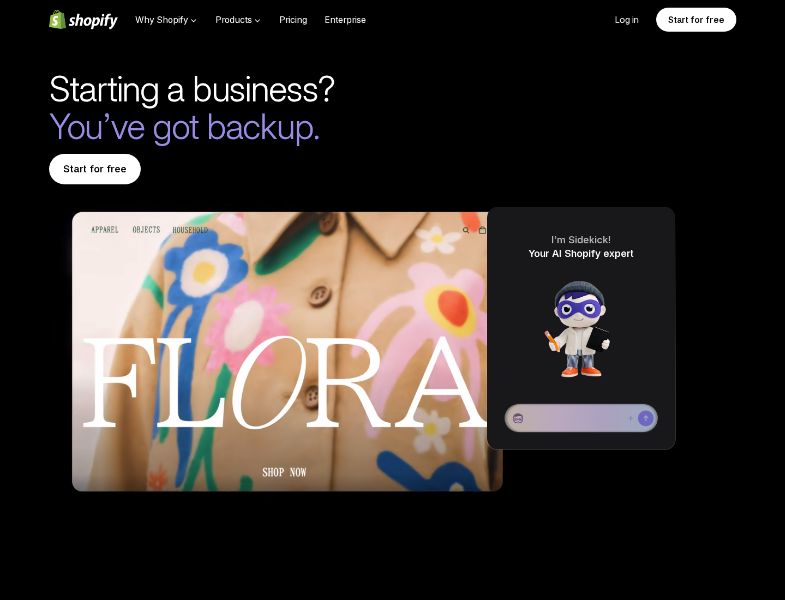
Sidekick is described as your AI Shopify expert: theme help, product photos, design, copy, and admin actions. Official FAQ: it uses your store data and respects staff permissions. Pricing cards also list a website builder and millions of tokens.
Agentic selling (pricing page): $0/month to add products to Shopify’s Catalog and choose AI channels; you pay when you sell; online card rates from 2.9% + 30¢.
This is commerce AI inside Shopify. It is not a research/brand/ops team that launches a company from a sentence.
Payments and fees
- Online standard card rates: Basic 2.9% + 30¢, Grow 2.7% + 30¢, Advanced 2.5% + 30¢, Plus from 2.25% + 30¢
- In-person card rates on the Basic matrix: 2.6% + 10¢
- Third-party processors: 2% transaction fee
- Premium/international/PayPal wallet rates are listed separately on the same matrix
POS
Shopify POS: unified inventory and customer profiles, offline-capable selling, Shop app discovery. Casual in-person sales are included. POS Pro is $89/month per location for advanced retail (roles, in-store inventory, pickup and delivery). Plus lists up to 200 POS Pro locations.
Channels, Markets, apps
Sell on social and marketplaces; 50 synced marketplace orders/month free, then 1% up to $99/mo. Shopify Markets for localization, currencies, duties. Thousands of apps — many paid. That ecosystem is why Shopify scales and why G2 reviewers complain about cost.
Staff, reports, finance
Extra staff accounts start at Grow (5) and Advanced (15). 200+ reports. Shopify Balance, Capital, Credit, Bill Pay, and Tax appear on the pricing matrix (eligibility and rates are their own products — confirm in admin).
What you do not get
- An AI team that researches the market and runs the company outside the store
- A GitHub repo of your whole business as the default artifact
- A store you can fully self-host as a clone (CSV export is the documented data path)
- A replacement for product-market fit
Pricing and plans
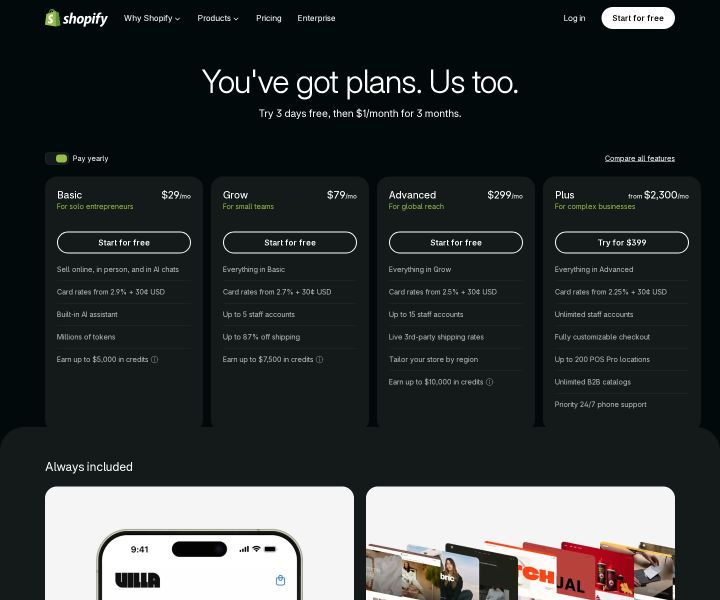
| Plan | Yearly | Monthly | Highlights from the page |
|---|---|---|---|
| Basic | $29 USD/mo | $39 USD/mo | Solo; 2.9% + 30¢ online; Sidekick; up to $5,000 credits |
| Grow | $89 USD/mo | $105 USD/mo | Up to 5 staff; 2.7% + 30¢; up to $7,500 credits |
| Advanced | $359 USD/mo | $399 USD/mo | Up to 15 staff; 2.5% + 30¢; live 3rd-party shipping; up to $10,000 credits |
| Plus | from $2,300 USD/mo | — | Unlimited staff; custom checkout; up to 200 POS Pro locations; 24/7 phone |
Promo: 3 days free, then $1/month for 3 months.
Add-ons: POS Pro $89/mo per location; Agentic $0/mo; apps, themes, SMS, hardware extra.
Help Center: Basic, Grow, and Advanced have multiple rates and fees beyond the subscription. App billing cycles may not match the Shopify plan cycle.
User feedback and reputation
G2 (August 2026): 4.4 / 5 from 5,139 reviews on the main listing (5,140 on the pros-and-cons URL — counts move). Star mix on the listing: 67% five-star, 26% four-star, 5% three-star.
G2’s generated themes:
- Liked: ease of use (273 mentions in the summary widget), integrations (101), quick setup (96), reliability (69).
- Disliked: expensive because of apps and coding for customization (153), limited customization (95), limited features without apps (58), transaction fees (47), third-party app integration issues (19).
Pros and cons
Pros
- Complete commerce admin: catalog, checkout, POS, channels
- Sidekick and prompt-to-store inside a real merchant tool
- Scales from Basic to Plus
- Large app and partner ecosystem
- Documented data export and 2-year reactivation after deactivate
Cons
- Subscription is not the whole bill (processing, apps, POS)
- Customization ceiling without Liquid/apps (G2 theme)
- You still operate brand and growth
- Store lock-in: data exports; the storefront is not a portable repo
- Promo pricing expires; list prices are higher
Limitations and challenges
- It is a store platform. Research, positioning, and weekly content are still yours.
- Fee literacy is part of the job. Plan + Shopify Payments vs 2% third-party + apps.
- App sprawl. The App Store solves gaps and creates a second invoice.
- Retail is an add-on if you need POS Pro depth.
- AI is in-admin. Sidekick will not write your competitor report or run a company you have not merchandised.
- Regional rates. This review used the USD public page.
Who Shopify is best for
- DTC and retail brands with a real catalog
- Teams that need web + POS + marketplaces in one back office
- Merchants who will hire a Shopify partner as they grow
- Enterprises evaluating Plus
Who may want an alternative
- You need the company operated (research, brand, weekly agents) more than a cart
- You need source in GitHub as the system of record
- You are not selling physical or digital goods at volume
- You want a live offer without learning commerce fees and apps
- You need a complex application (roles, custom workflows) more than a store — look at an app builder
Willo as an alternative
Willo is an AI business builder, not a Shopify clone. You describe an idea. Agents research the market, produce a brand, deploy a site to your GitHub, prepare Stripe, and — on paid plans — run a weekly Growth Engine.
Willo is the better starting point if the missing piece is a business, not a checkout. It is the worse starting point if you need Shopify Payments, Shop Pay, POS, or marketplace sync.
Willo’s Builder plan ($49/month) lists a Shopify integration. Some teams will keep Shopify for the cart and use Willo for everything around it.
Willo pricing: Free with 40 one-time credits; Starter $25/month; Builder $49/month; Growth $99/month; Scale $199/month. Chat is free. Credits are shared across businesses. Custom domains start at Builder. See the Shopify vs Willo comparison for a side-by-side.
Frequently asked questions
Is Shopify free? There is a short trial/promo (3 days free, then $1/month for 3 months on the pricing page at research time). Ongoing use is a paid plan plus processing.
How much does Shopify cost? Official USD yearly: Basic $29/mo, Grow $89/mo, Advanced $359/mo, Plus from $2,300/mo, plus card rates and optional POS Pro at $89/mo per location.
What is Sidekick? Shopify’s built-in AI assistant for store and admin tasks. It is not a full AI company operator.
Can I export my store? CSV/data export is documented. Deactivate to cancel. Reopen within 2 years. Do not assume a full self-hosted theme+app clone.
Does Shopify include POS? Casual in-person selling is included. Advanced retail is POS Pro.
Is Shopify good for beginners? G2 reviewers often say setup is easy. Fees and apps are the part that surprises people later.
Conclusion
Shopify remains the default shortlist item when the job is commerce: products, checkout, retail, and channels, with Sidekick inside the admin. It rewards merchants who will merchandize and watch fees. It is the wrong expectation if you wanted a prompt to replace a company.
If you are choosing a tool to sell, start with Shopify. If you are choosing a tool to launch and run a business, choose Willo.