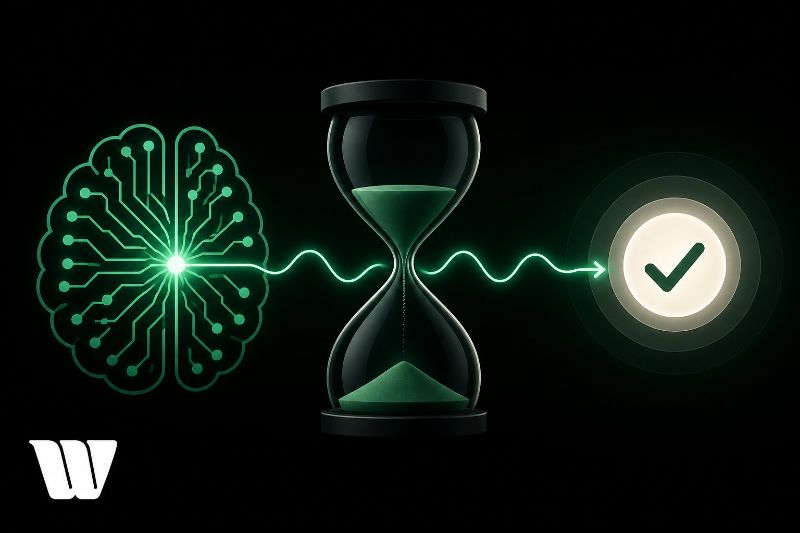
AI latency is the time between when you send a request to an AI system and when it delivers a response. It's a critical performance metric that directly impacts user experience—delays as short as 200–300 milliseconds can disrupt cognitive flow and push users toward faster alternatives. High latency stems from model complexity, infrastructure bottlenecks, and network constraints. Understanding what drives it is the first step toward building AI applications that users actually trust and stick with.
Key Takeaways
- AI latency is the time between a user's request and the system's response, making it a critical performance metric for AI applications.
- High latency disrupts user experience, with delays exceeding 200–300 milliseconds causing cognitive disruption and increased abandonment rates.
- Latency is caused by model complexity, network constraints, infrastructure bottlenecks, and geographic distance between users and servers.
- Different AI applications have unique latency thresholds; voice assistants tolerate up to 300ms, while recommendation engines require under 100ms.
- Low latency builds user trust and serves as a competitive advantage, as fast responses are a fundamental user expectation.
What Is AI Latency?
When you interact with an AI system—whether you're querying a large language model, running an image classifier, or invoking a recommendation engine—some amount of time elapses between your request and the system's response.
That interval is AI latency. It's a core performance metric that directly shapes user experience and user engagement. High latency degrades real-time processing capabilities, disrupting applications like predictive modeling, fraud detection, and conversational AI.
Your system architecture determines where latency originates—network transmission, inference computation, data retrieval, or post-processing. Understanding latency impact helps you prioritize optimization strategies effectively.
Importantly, you'll encounter latency trade-offs: reducing latency often requires additional compute resources or architectural compromises. Treating latency as a measurable, manageable variable—rather than an afterthought—is essential for building responsive, production-grade AI systems.
What Causes High Latency in AI Systems?
When you're diagnosing high latency in AI systems, two primary culprits emerge: model complexity and infrastructure bottlenecks.
Large models with billions of parameters demand intensive computation, forcing your system to process massive matrix operations that directly inflate response times.
Beyond the model itself, network latency, bandwidth constraints, and inefficient hardware allocation compound the problem, creating cascading delays across your entire AI pipeline.
Model Complexity and Size
Larger and more complex AI models directly drive up inference latency by demanding more computational resources per forward pass. When you scale model size, you multiply computation requirements across billions of parameters, stressing hardware capabilities and exhausting resource allocation budgets.
Algorithm efficiency deteriorates as layer depth increases, forcing sequential matrix operations that bottleneck throughput. Your deployment strategies must account for this tradeoff. Larger models extend training time and compound latency during live inference, particularly under high-traffic conditions.
Without deliberate optimization techniques—quantization, pruning, knowledge distillation—you'll face unacceptable response delays in production environments. Matching model complexity to available hardware capabilities is non-negotiable.
You must evaluate whether algorithm efficiency gains from model scale justify the latency cost your application and end users will absorb.
Network and Infrastructure Bottlenecks
Model complexity sets the upper bound on compute demand, but network and infrastructure bottlenecks often determine the actual latency your users experience. Even optimized models suffer when underlying infrastructure can't support efficient data transfer.
Three critical bottlenecks you'll encounter include:
- Bandwidth limitations — Insufficient bandwidth throttles server response times, especially under concurrent request loads requiring immediate latency reduction.
- Geographic distance — Long routing paths between users and cloud servers increase round-trip times; edge computing strategically relocates inference closer to end users.
- Infrastructure inefficiencies — Poorly configured cloud environments reduce cloud efficiency, making infrastructure upgrades essential for consistent performance.
Addressing these issues demands deliberate network optimization across every layer—from physical hardware to deployment architecture—ensuring your AI system delivers predictable, low-latency responses at scale.
Why High AI Latency Drives Users Away
High AI latency doesn't just slow down a workflow—it actively erodes user trust and adoption. When response expectations aren't met, user frustration compounds quickly, degrading interaction quality and pushing engagement levels downward.
Research consistently shows that delays exceeding 200–300 milliseconds noticeably disrupt cognitive flow, triggering abandonment behaviors.
The performance impact extends beyond individual sessions. Poor user experience directly undermines user retention, as users migrate toward faster, more responsive alternatives.
In competitive markets, latency becomes a measurable competitive advantage—organizations delivering sub-second responses capture and hold attention more effectively.
You can't afford to treat latency as a secondary concern. Every additional millisecond of delay represents a quantifiable risk to adoption metrics, revenue potential, and long-term platform loyalty.
Speed isn't a feature—it's a fundamental expectation.
How Is AI Latency Measured?
When measuring AI latency, you'll work with three core metrics: Time to First Token (TTFT), end-to-end response time, and percentile latency benchmarks.
TTFT captures how quickly the model generates its initial output after receiving your prompt, directly reflecting the perceived responsiveness of the system.
You'll use percentile benchmarks—particularly P95 and P99—to identify worst-case latency spikes that averages alone would obscure.
Time To First Token
Measuring AI latency starts with a metric called Time to First Token (TTFT), which tracks how long it takes a model to generate and return its first token after receiving a prompt. TTFT directly reflects how responsive a system feels during interaction.
Three core factors influence it:
- Prompt complexity — longer inputs require more processing before token generation begins
- Model size — larger models introduce additional computational overhead
- Infrastructure load — server congestion delays response optimization pipelines
A lower TTFT signals a faster, more efficient system. For real-time applications like chatbots or copilots, you'll want TTFT measured in milliseconds, not seconds.
Monitoring this metric helps you identify bottlenecks early and prioritize targeted performance improvements across your AI deployment stack.
End-To-End Response Time
While TTFT captures the first moment of responsiveness, end-to-end response time measures the full latency span — from the moment a request leaves the client to the moment the final token arrives. This metric accounts for every processing stage: network transmission, queuing, tokenization, model inference, and detokenization.
For response time optimization, you need visibility into each stage independently. Bottlenecks rarely originate from a single source, so isolating where latency accumulates lets you target interventions precisely.
The user experience impact becomes most pronounced with longer outputs. A model generating 1,000 tokens compounds inference latency markedly compared to a 50-token response.
You should factor output length distributions into your latency benchmarks, ensuring your optimization strategy reflects realistic workload conditions rather than idealized test scenarios.
Percentile Latency Benchmarks
Latency benchmarks lose meaning without percentile distributions — a single average figure obscures the variance that actually defines user experience under load.
During latency testing, you should track:
- P50 (median): Half your requests complete at or below this threshold — it reflects your typical-case performance.
- P95: 95% of requests fall at or below this value — it exposes degradation that averages hide entirely.
- P99: Your worst-case boundary for 99% of traffic — critical for SLA commitments and reliability guarantees.
Percentile ranking reveals where your system actually breaks down under concurrency, not just how it performs in isolation.
If your P99 spikes dramatically above your P50, you're experiencing tail latency — a distribution problem that demands architectural investigation, not surface-level tuning.
AI Latency in Chatbots, Voice Assistants, and Recommendation Engines
AI latency manifests differently across chatbots, voice assistants, and recommendation engines, with each system imposing unique performance constraints that directly affect user experience.
Chatbot responsiveness depends on token generation speed, where delays exceeding 200ms noticeably degrade conversational fluency. You'll notice users abandon sessions when response latency crosses perceptible thresholds.
Voice assistant efficiency operates under stricter constraints—300ms represents the upper tolerance boundary before interactions feel unnatural. Speech-to-text processing, intent recognition, and response synthesis each contribute cumulative latency that compounds quickly.
Recommendation accuracy introduces a different latency challenge: real-time personalization requires sub-100ms inference to remain commercially viable. When recommendation engines exceed this threshold, you risk delivering stale, contextually irrelevant suggestions that reduce conversion rates.
Each system demands precisely calibrated latency budgets aligned with its specific interaction model.
How to Reduce AI Latency in Your Applications
Together, these strategies compress end-to-end latency across your entire stack, making your AI applications faster, more scalable, and production-ready.
Frequently Asked Questions
How Does AI Latency Differ From Traditional Software Latency?
When you experience an AI Response, you're dealing with variable, compute-heavy inference delays. A traditional Software Response involves predictable, deterministic processing. AI latency fluctuates based on model complexity, token generation, and hardware demands you can't always anticipate.
Can High Latency Ever Be Acceptable in Certain AI Applications?
Yes, you'll find high latency acceptable in specific scenarios. When you're running batch data processing, scientific simulations, or offline model training, you can prioritize accuracy over speed, making latency trade-offs entirely justifiable in these acceptable scenarios.
What Latency Benchmarks Should Businesses Target for Their AI Systems?
You'll want to target under 100ms for real-time AI interactions and under 500ms for conversational systems. Prioritize latency measurement against your specific use case, then drive performance optimization to consistently meet those benchmarks.
How Does AI Latency Impact Overall Business Revenue and Profitability?
High AI latency directly erodes your revenue optimization by degrading customer satisfaction, reducing conversion rates, and undermining operational efficiency. You'll lose competitive advantage when slow response times drive customers toward faster, more responsive competitors, cutting into profitability.
Which Industries Are Most Critically Affected by Poor AI Latency Performance?
You'll find healthcare applications and financial services are most critically hit by poor AI latency, where delayed diagnostics or slow fraud detection directly compromise patient outcomes and trigger significant monetary losses respectively.
Conclusion
AI latency isn't just a technical metric—it's a direct measure of your system's usability. Whether you're optimizing a chatbot, voice assistant, or recommendation engine, every millisecond you shave off improves user trust and retention. You now understand what drives latency, how to measure it accurately, and which reduction strategies apply to your architecture. Treat latency as a first-class engineering priority, not an afterthought, and your AI applications will perform at the standard users demand.