Agency-as-software transforms how you deliver services by replacing headcount-dependent workflows with intelligent, automated systems. Instead of hiring more people to grow revenue, you're productizing your expertise into repeatable, AI-driven processes that scale without proportional overhead. Your delivery becomes consistent, your margins improve, and your capacity expands on demand. It's a fundamental shift from selling time to deploying capability—and the strategies that make it work are exactly what you'll uncover ahead.
Key Takeaways
- Agency-as-software transforms traditional service delivery into scalable, AI-driven systems that operate without proportional headcount growth.
- Traditional service models fail because increasing revenue requires hiring more people, eroding margins and creating bottlenecks.
- AI consolidates multiple team roles into one automated system, eliminating coordination overhead and accelerating delivery.
- Subscription-based pricing paired with automation reduces labor costs while maintaining consistent, high-quality service output.
- Scaling requires auditing workflows, automating onboarding, and productizing services into repeatable, systematized offerings.
What Is Agency-As-Software, Really?
When most people hear "agency-as-software," they picture a fancy automation tool or a chatbot with a polished dashboard—but it's far more disruptive than that.
Agency-as-software transforms your entire service delivery model into scalable, automated solutions that operate without proportional headcount growth. You're not hiring more people to handle more clients—you're deploying intelligent systems that execute strategy, manage workflows, and deliver results autonomously.
This isn't incremental improvement; it's a complete digital transformation of how agencies create and capture value. Think of it as productizing your expertise into repeatable, AI-driven processes. Your methodology becomes the engine, and software becomes the workforce.
The result? You scale revenue without scaling overhead—fundamentally restructuring what a modern agency can accomplish.
Why Traditional Service Models Fail the Agency-As-Software Test
Traditional service models are built on a fundamentally broken premise: more revenue requires more people. You hire, train, and manage humans to deliver results, creating a ceiling on what's possible. This isn't just inefficient — it's structurally unsound.
Traditional inefficiencies compound quickly. Margins erode as headcount grows. Delivery quality fluctuates with team turnover. Your service scalability hits a wall the moment demand surges beyond your team's capacity.
Agency-as-software exposes exactly where this model collapses. When your growth depends on human bandwidth, you're not building a business — you're building a bottleneck.
Software doesn't call in sick. It doesn't need onboarding. It executes at scale without proportional cost increases. That's the fundamental gap traditional service models can't bridge, no matter how well you optimize them.
How Agency-As-Software Replaces Work That Once Required Full Teams
Consider what it used to take to run a full-service content operation: a strategist, a writer, an editor, a designer, a scheduler, and a project manager — just to keep one client's pipeline moving.
That's six roles, six salaries, and six points of failure.
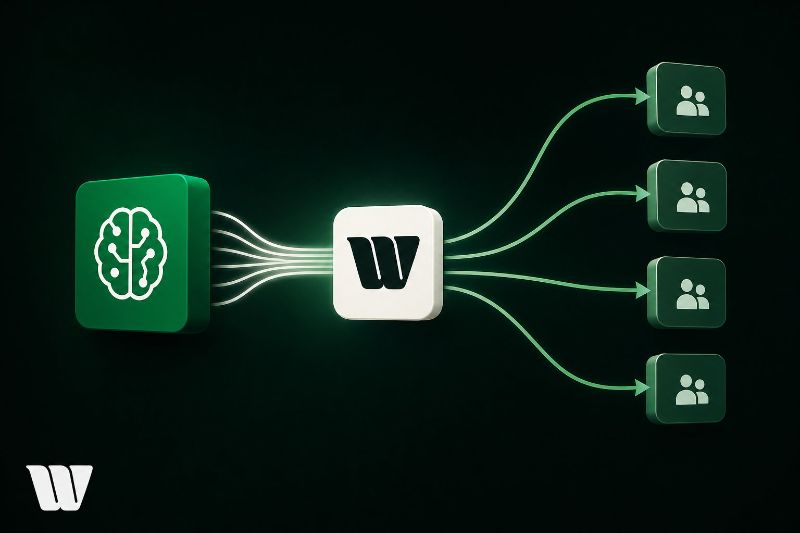
Agency-as-software collapses that structure entirely. Through automated workflows, you're executing what once demanded full team collaboration inside a single, coordinated system.
AI handles research, drafting, optimization, and scheduling simultaneously — without handoff delays or miscommunication.
You're not replacing people arbitrarily; you're eliminating the operational overhead that slowed delivery and inflated costs.
The result is a leaner model where your actual expertise gets amplified, not buried under coordination tasks.
You scale output without scaling headcount.
The Business Models That Make Agency-As-Software Profitable
Profitability in the agency-as-software model isn't accidental — it's structural. You're building revenue around subscription pricing, which creates predictable cash flow instead of chasing project-by-project income.
Your automation tools eliminate labor costs while maintaining consistent output, meaning margins expand as volume grows.
Market trends show that clients increasingly prefer outcome-based agreements over hourly billing. You capitalize on this by packaging deliverables into tiered subscription plans. Each tier reveals greater automation capacity, not more human hours.
Customer feedback loops become data infrastructure. You're continuously refining service quality without proportionally increasing costs. This positions you to scale without the traditional overhead that kills agency profitability.
The result is a business designed for compounding returns — where adding clients doesn't require adding headcount at the same rate.
How to Start Scaling Your Services With Agency-As-Software
Scaling starts the moment you stop treating growth as a headcount problem and start treating it as a systems problem.
Build your foundation around service automation and streamlined client onboarding before you chase volume.
Structure precedes scale—always.
Three moves that accelerate your change:
- Audit your delivery workflow to identify every task a system can handle faster than a human
- Automate client onboarding with AI-driven intake forms, contracts, and kickoff sequences that run without your involvement
- Productize your core services into repeatable, systemized offerings that scale horizontally
Once your infrastructure runs independently, you're no longer selling time—you're deploying capability.
That's the shift that transforms your agency from a labor model into a scalable software-driven operation.
Frequently Asked Questions
What Industries Are Best Suited for Adopting Agency-As-Software Models?
You'll find marketing automation, consulting, legal, and financial services thrive with agency-as-software models. They're perfectly positioned to leverage client onboarding efficiency, capitalize on industry trends, and unleash unprecedented service scalability through AI-driven transformation.
How Does Agency-As-Software Handle Data Privacy and Client Confidentiality?
You'll protect sensitive information through robust data encryption and strict access controls, ensuring client trust remains intact. Agency-as-software embeds privacy protocols directly into automated workflows, so you're delivering compliant, confidential service delivery at scale effortlessly.
What Technical Skills Do Agency Owners Need to Implement AI Systems?
You don't need to be a developer, but you'll need AI Integration fundamentals, System Automation basics, and Technical Training in prompt engineering. Prioritize Skill Development in API connections, workflow tools, and data management to deploy intelligent agency systems confidently.
How Long Does Transitioning to an Agency-As-Software Model Typically Take?
You'll typically spend 3–12 months managing your shift duration, depending on your agency's complexity. Expect implementation challenges like workflow redesign and team adoption, but you're building a scalable, AI-driven future that'll redefine how you deliver services.
Can Small Solo Agencies Realistically Compete Using Agency-As-Software Approaches?
Yes, you can absolutely compete. By embracing solo agency strategies and leveraging AI-driven tools, you'll overcome scalability challenges that once favored larger firms, transforming your lean operation into a powerful, efficient force that punches well above its weight.
Conclusion
You're standing at the edge of a fundamental shift in how services get delivered. Agency-as-software isn't a trend you can afford to ignore—it's the architecture that separates tomorrow's scalable businesses from today's overworked agencies. You've got the blueprint. Now it's time to rebuild your delivery model around AI-driven systems that work harder, faster, and smarter than any traditional team ever could.