WordPress and Willo both help someone get a website on the internet. They are not the same kind of product.
WordPress (the software you download from WordPress.org) is free, open-source publishing software. You install it on hosting you choose, pick a theme, add plugins, and you own the files and the database. Official docs are careful about names: WordPress.org is the software. WordPress.com is a separate hosted service run by Automattic. This article is about the self-hosted software.
Willo is an AI business builder. You describe an idea. Agents research the market, create a brand, deploy a website to your GitHub repo, prepare Stripe, and keep working on content, marketing, and operations. Chat is free. Credits pay for work that ships.
If you want a CMS you fully control — themes, plugins, WooCommerce, custom code, any host — WordPress is usually the better fit. If you want the business to exist on day one — research, brand, site, payments, and weekly agent work — without becoming your own sysadmin, Willo is built for that job.
Quick decision table
| If you need… | Better starting point |
|---|---|
| Free software you can install anywhere (GPL) | WordPress.org |
| Full ownership of files, database, and hosting choice | WordPress.org |
| 70,000+ plugins and 15,000+ free themes | WordPress.org |
| A large store on WooCommerce | WordPress.org |
| Developers, agencies, or a long-term custom stack | WordPress.org |
| Market research, positioning, and a brand guide on day one | Willo |
| A site auto-deployed to your GitHub repo without a LAMP stack | Willo |
| Stripe checkout with no platform cut of revenue | Willo |
| Agents that keep drafting content and planning the week | Willo |
| Several businesses on one shared credit pool | Willo |
| No PHP, MySQL, updates, or security hardening to manage | Willo |
WordPress is a platform you (or your host, or your developer) operate. Willo is an AI team that starts and runs a business with you still approving the important calls.
What is WordPress.org?
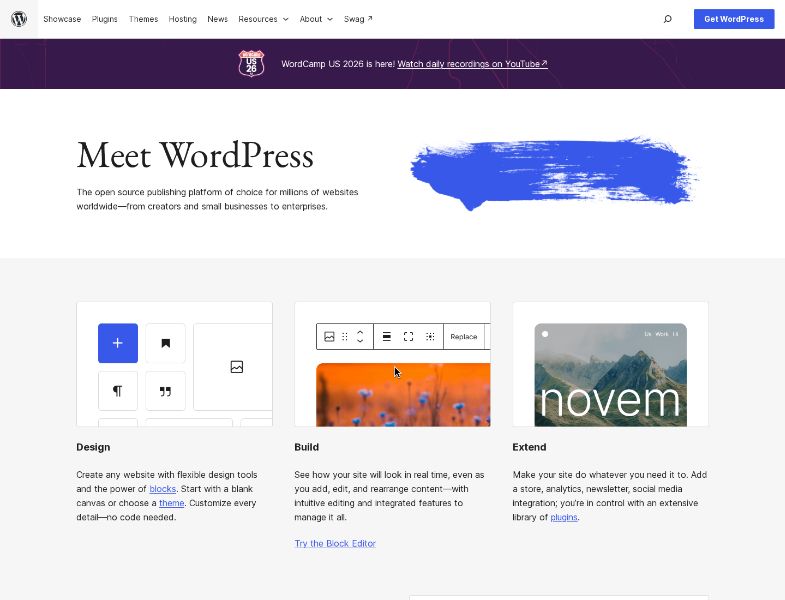
WordPress is free software licensed under the GPLv2 or later. It started in 2003 when Mike Little and Matt Mullenweg forked b2/cafelog. The about page says it is built on PHP and MariaDB and is “the platform of choice for over 43% of all sites across the web.”
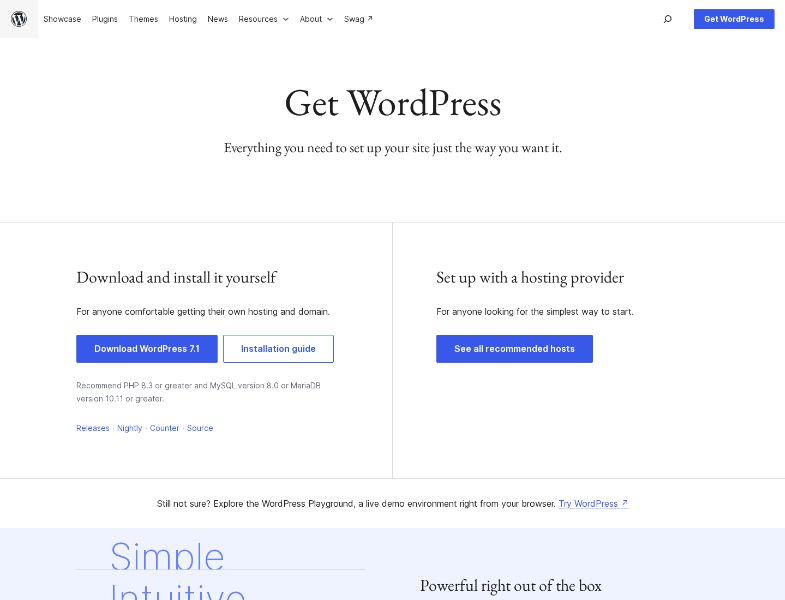
What you get from WordPress.org is software, not a finished hosted company:
- Download WordPress 7.1 (“Mary Lou,” released August 19, 2026) as a ZIP
- Install it on hosting that meets the requirements: PHP 8.3+, MariaDB 10.11+ or MySQL 8.0+, HTTPS; Apache or Nginx recommended
- Edit with the block / Site Editor (try it in the Block Editor demo or Playground)
- Extend with the plugin directory (“over 70,000 free plugins”) and theme directory (“over 15,000 free themes”)
- Add commerce with WooCommerce, a separate open-source store plugin (WooCommerce.com claims 4M+ online stores)
Official recommended hosts on wordpress.org/hosting currently include Pressable, Bluehost, and Hostinger. Clicking through may donate a portion of the fee back to WordPress.org. Hosting is not included in the WordPress download.
Support is community-first: documentation, forums, Learn WordPress, local meetups, and WordCamps. There is no official 24/7 vendor SLA for the software itself.
WordPress.org is not WordPress.com
Official documentation puts it plainly: WordPress is the open-source project, owned by no one company. WordPress.com is a hosted blogging service run by Automattic.
What is Willo?
Willo is an AI business builder for founders, operators, solopreneurs, agencies, and local businesses. You describe a business or idea. Willo stands up an AI team and the infrastructure to run it.
On day one, Willo says agents ship:
- Market, competitor, and audience research
- A brand guide (voice, palette, positioning)
- A living roadmap with milestones and tasks
- A website deployed to your own GitHub repo plus hosting
- Stripe prepared for revenue
- Strategic decisions logged in an auditable Decision Register
The built-in team on the homepage is seven agents: CEO, Product, Research, Marketing, Content, Support, and Finance. Chat is always free. Credits are spent on work that ships.
A provisioned backend is included across all plans, even on Free. Moving to a paid plan adds the Autonomous Growth Engine, Stripe Connect revenue features, email and contact tools, and built-in analytics. Higher plans expand on that with custom domains, team collaboration, business transfers, Shopify integration, increased backend compute, and other features.
WordPress.org vs Willo: feature-by-feature comparison
| Area | WordPress.org | Willo |
|---|---|---|
| Primary job | Self-hosted CMS / publishing platform | Turn an idea into a working business and keep operating it |
| Starting point | Download ZIP or one-click host installer; then theme + plugins | A description of a business or idea |
| Cost of the software | $0 (GPL); no licensing fees | Free tier + paid plans from $25/month |
| Hosting | You buy it (or use a recommended host) | Cloud hosting included |
| Website building | Block editor, Site Editor, themes, page-builder plugins | AI builds and deploys a site to GitHub + hosting |
| Design control | Themes, Global Styles, block patterns; unlimited if you code | Brand guide, Visual Builder, on-page text editing, Brand panel, Assets |
| Backend | Your PHP + MySQL/MariaDB stack | All plans provision database, auth, APIs, cloud storage |
| Code / export | You already have the files and database; move hosts anytime | Site auto-deploys to your GitHub; cancel and keep what was built |
| CMS / content | Posts, pages, custom post types, taxonomies, revisions, roles | Agents write site copy, posts, lead magnets, newsletters |
| AI | Optional plugins; 7.1 is mainly editor/styling/collaboration, not a business team | Seven business agents + Growth Engine on paid plans |
| Marketing | Plugins (email, SEO, social, forms); you assemble the stack | Research, positioning, content, outreach drafts, email capture, weekly growth loops |
| Payments / commerce | WooCommerce and other plugins; you choose processors and fees | Stripe Connect on paid plans; Willo states 0% platform fee; Shopify on Builder+ |
| Collaboration | Built-in roles (Admin, Editor, Author, Contributor, Subscriber) | Team invites and business transfer on Builder+ |
| Security / updates | You (or your host) patch core, themes, and plugins | Platform-managed hosting; you review agent output |
| Support | Docs, forums, Learn WordPress, community events | Priority on all paid plans |
AI capabilities
WordPress is not an AI company operator. Core 7.1 focuses on responsive block styles, a persistent admin bar, a dedicated media editor, richer Notes with @mentions, and new blocks (Playlist, Tabs). There is an official AI plugin for experiments, and many third-party AI plugins. None of that replaces a research → brand → Stripe → weekly growth loop.
Willo’s AI is business-centric. Agents research competitors, lock positioning, ship the site, draft campaigns, and queue weekly work. The Growth Engine on paid plans runs plan → execute → reflect using traffic and revenue data. Custom agents, set up in chat and run on your schedule, start on Builder.
Ownership, hosting, and lock-in
This is WordPress’s strongest argument.
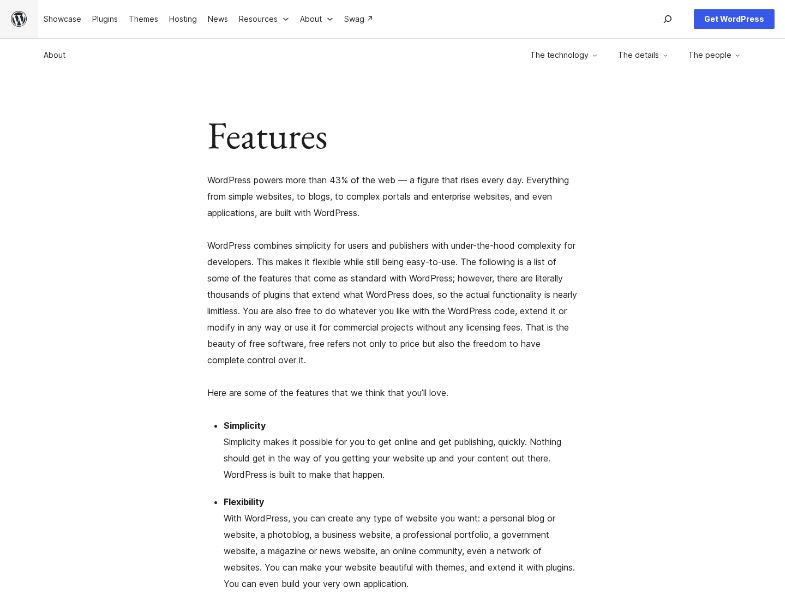
The features page says own your data: your website, your content, your database. The GPL lets you run, study, modify, and redistribute the software. You can change hosts. You can hire any developer who knows WordPress. That freedom is why NASA, Microsoft, Time, and Rolling Stone appear in the showcase — and why millions of smaller sites do too.
The cost of that freedom is operations: PHP versions, backups, SSL, malware, plugin conflicts, and update nights. WordPress will still run on older PHP 7.4 / MySQL 5.5.5, but the requirements page warns those versions are end-of-life and may expose your site to security vulnerabilities.
Willo includes hosting and deploys to your GitHub. That is portable compared with a closed website builder. It is not the same as a 20-year PHP CMS you can put on any $5 VPS. Willo is also not trying to match the plugin directory.
Ecommerce and payments
WordPress + WooCommerce is a real commerce stack. WooCommerce.com markets itself as open-source commerce with full control of checkout, data, and host, and cites 4M+ stores. You still configure taxes, shipping, payment gateways, and performance.
Willo includes Stripe Connect on paid plans, creates products and checkout pages, and states it takes no platform cut. Shopify storefronts start on Builder. It is not WooCommerce’s catalog depth or extension marketplace.
Pricing and cost comparison
There is no WordPress.org pricing page, because the software is free
| Item | What you actually pay |
|---|---|
| WordPress download | $0 |
| Domain | Market rate (not sold by WordPress.org) |
| Hosting | Whatever your host charges. Official recommended hosts advertise free domains, SSL, CDN, and 24/7 support — confirm live host prices |
| Premium themes / plugins | Optional; many are free, many are paid |
| WooCommerce core | Free plugin; extensions and payment processing extra |
| Developer / maintainer | Optional but common |
The honest WordPress bill is hosting + extras + time. A cheap shared plan can look cheaper than Willo Starter. A maintained Woo store with premium plugins and a freelancer on retainer is not.
Willo
From Willo’s pricing page:
| Plan | Price | Credits | Businesses | Highlights |
|---|---|---|---|---|
| Free | $0 | 40 one-time | Plan card says 2; compare table says 1 | Unlimited chat, AI website, cloud hosting, no credit card |
| Starter | $25/month | 150/mo | Up to 3 | App/software building, backend, Growth Engine, Stripe Connect, email, analytics |
| Builder | $49/month | 300/mo | Up to 6 | Custom domains, 1-month credit rollover, team invites, Shopify, custom agents |
| Growth | $99/month | 600/mo | Up to 12 | 2× Builder credits, early beta, more compute |
| Scale | $199/month | 1,300/mo | Up to 25 | Best credit rate, 15× backend compute, priority support |
Chat is always free. Credits are a shared pool across every business. Extra packs start at 50 credits for $11 ($0.22/credit) down to $0.18/credit at 1,000 credits. Custom domains start on Builder.
How the bills actually compare
- WordPress + $0 software + cheap hosting can beat Willo on sticker if you only need a blog or brochure and you will maintain it.
- WordPress + managed host + premium theme + SEO plugin + Woo extensions + updates often lands above Willo Starter or Builder — before you count your hours.
- Willo $25–$49 includes hosting, agents, and Stripe with 0% platform fee. You are not buying Gutenberg’s plugin universe.
Ease of use and onboarding
WordPress can be one click at a recommended host, then a long afternoon of theme setup, permalinks, forms, caching, and backups. The block editor is much easier than the classic editor of a decade ago. It is still a CMS: you publish, you configure, you patch. On G2, WordPress.org was 4.4 / 5 from 9,546 reviews as of August 2026 (64% five-star, 27% four-star). The usual split in that corpus is: flexibility and ecosystem on the plus side; setup, updates, and plugin quality on the minus side.
Willo is built for someone who can describe a business in plain language. There is no plugin grid. Day-one output is a site, brand, and roadmap.
If you enjoy (or already know) WordPress, it feels like home. If you want the first hour to produce research and a live repo without choosing PHP versions, Willo feels like a team.
Who is WordPress.org best for?
- Publishers, media, and content-heavy sites that need a real CMS
- Developers and agencies who live in themes, hooks, and Git
- Stores that want WooCommerce and full checkout control
- Organizations that must own the stack and pick the host
- Anyone who already has a WordPress maintainer
The official showcase (NASA, Microsoft, Time, Harvard, TechCrunch, Rolling Stone) is this profile at the high end. Most sites are smaller. The common thread is control.
Who is Willo best for?
- Founders and operators who have an idea but not a product or marketing team
- Solopreneurs who need research, brand, site, payments, and follow-up work
- Agencies that want to stand up a client business and later transfer it
- People who want Stripe without assembling Woo + a gateway + a cache plugin
- Users who do not want to be on-call for core updates
Pros and cons
WordPress.org pros
- Free software, GPL freedoms, no vendor license
- You own files and data; change hosts when you want
- Enormous theme and plugin ecosystem
- Mature CMS: roles, revisions, custom post types, REST API
- WooCommerce for serious commerce
- Huge community, docs, events, and developer market
- Latest 7.1 improves responsive styling and in-editor collaboration
WordPress.org cons
- Software is free; hosting, security, and maintenance are not
- You assemble marketing, payments, and email from plugins
- Plugin quality and performance vary; conflicts are common
- Support is community forums, not a paid SLA
- Not an AI team that researches a market or runs weekly growth
- Easy to underestimate the operational load
Willo pros
- Idea → research, brand, site, roadmap, Stripe without a LAMP stack
- Named agents plus a weekly Growth Engine on paid plans
- 0% platform fee on Stripe Connect
- GitHub-backed site; cancel-and-keep model
- Hosting included; one credit pool across businesses
- Unlimited free chat
Willo cons
- Not a general-purpose CMS with 70,000 plugins
- Not WooCommerce’s store depth
- Custom agents need the Builder plan or higher
When to choose WordPress.org
Choose WordPress when the bottleneck is owning a flexible publishing (or commerce) stack and you can host and maintain it — or pay someone who can.
Typical cases:
- A magazine, blog, or documentation site that will live for years
- A Woo store you want to take to any host
- An agency delivering client sites on WordPress
- You already speak themes, plugins, and backups
When to choose Willo
Typical cases:
- You can describe the offer but cannot stand up research, brand, site, and ops
- You want agents to keep drafting content and planning the week
- You want the repo and the revenue economics without plugin shopping
- You may later transfer the property to a client
If you later need WordPress’s CMS depth, you can migrate content. That is a later-stage problem.
Frequently asked questions
Is Willo a WordPress alternative?
Only for a specific search. People looking for a “WordPress alternative” sometimes want any tool that publishes a site. Willo can publish a site from a prompt. It does not replace the block editor, the plugin directory, or WooCommerce.
Is WordPress free?
The software is free. Hosting, domains, premium plugins, and your time are not. WordPress.com has paid hosted plans; that is a different product.
Do I need to know how to code?
Official copy says people with limited tech experience can use it out of the box, and more technical users can customize it deeply. Getting a first post live can be easy on a one-click host. Keeping a site healthy is a different skill.
Can I export a WordPress site?
Yes. You have the files and the database. That is the point of self-hosting. Willo deploys to your GitHub repo; you do not get a classic wp-content tree unless you later rebuild on WordPress.
Conclusion
WordPress.org is the default open web CMS for a reason: free software, huge ecosystem, and you own the stack. The tradeoff is that you (or a host, or a developer) still run the company and the server.
Willo is a better choice when you need the business itself: research, brand, website, payments, and an AI team that keeps working after launch — without assembling plugins first.
If you have an idea and no stack behind it, start free on Willo — no credit card required