Generative AI and automation tools are reshaping how teams start and scale their operations. With so many platforms promising to streamline work and reduce overhead, it can be difficult to know which one aligns with your needs. Two names that surface frequently—Willo and n8n—represent very different approaches. Willo runs entire businesses using autonomous agents, while n8n provides a visual, open‑source automation platform that blends no‑code speed with code‑level control. This comprehensive comparison explores what each platform does, the features that make them unique and when you might choose one over the other.
Willo: A Complete Business Builder
What Willo is and does
Willo is an AI business builder platform. Instead of just creating a website or automating a single process, Willo takes a founder’s idea and assembles an AI team that builds, runs and grows the business. The platform automates market research, designs a website, configures hosting, payment processing and analytics, and initiates a growth engine—all from a simple description. By providing a complete stack from day one, Willo allows entrepreneurs to focus on their vision rather than infrastructure.
How it works: multiple agents, one mission
At the heart of Willo is a multi‑agent architecture. Multiple specialised AI agents—CEO, Product, Research, Marketing, Content, Support and Finance—take on roles typically filled by a startup team. The CEO agent sets strategy; the Product agent builds and deploys the website and code; the Research agent analyses competitors and markets; the Marketing agent runs campaigns; the Content agent writes articles and optimises SEO; the Support agent handles customer questions; and the Finance agent monitors revenue and expenses. These agents operate in a consistent plan–execute–reflect cycles: they set goals, carry out tasks, analyse results and adjust strategies accordingly. This continuous loop means the business evolves without constant human prompting.
Key features at a glance
- Full‑stack business creation: Willo automatically builds a custom‑coded website, configures hosting, integrates Stripe payments, sets up analytics and creates growth channels.
- Autonomous agent collaboration: Seven agents handle strategy, research, product development, marketing, content, support and finance.
- Ongoing growth engine: Weekly cycles of planning, execution and reflection drive continual improvement.
Why Willo stands out
Willo’s differentiation comes from its ambition: it isn’t just automating tasks, it’s running a business. Solo founders or small teams can leverage its agents to perform high‑level work that would normally require multiple hires. The integrated stack means you don’t have to piece together hosting, payments, marketing tools or analytics—Willo does it for you. By automating research, content creation and campaign execution, it reduces the friction between idea and market validation.
Who should use it
Willo suits entrepreneurs launching digital products, content businesses or service offerings who want a turnkey system rather than stitching together multiple tools. Coaches, bloggers, SaaS founders and online retailers could benefit from its all‑in‑one approach. However, users requiring fine‑grained control over specific parts of their stack, or businesses with complex custom workflows, may find Willo’s abstraction limiting. Exporting or deeply modifying the underlying code is not as straightforward as with modular tools.
n8n: Open‑Source Workflow Automation for Developers and Operators
What n8n is and does
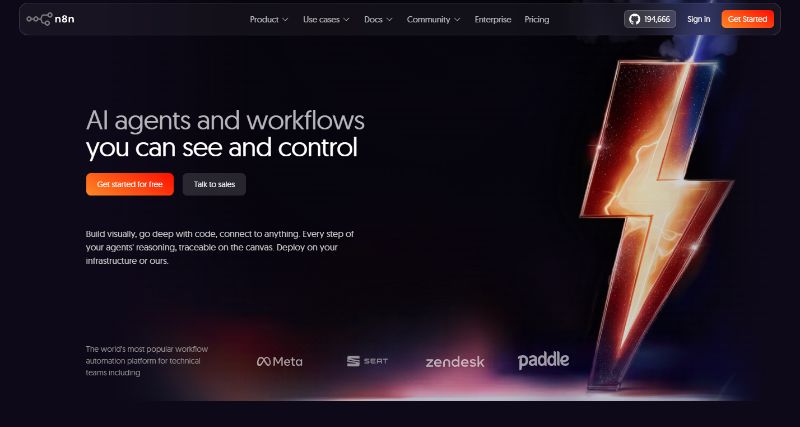
n8n (pronounced “n‑eight‑n”) is an open‑source workflow automation platform. It combines the ease of a drag‑and‑drop interface with the flexibility of writing code, allowing technical and non‑technical users to automate tasks, integrate APIs and build AI pipelines. It’s a developer‑friendly platform blending no‑code speed with full‑code orchestration. It boasts over 200 integrations and a visual editor, yet still allows teams to write custom JavaScript, build modular subflows and integrate APIs directly. Unlike fully managed platforms, n8n can be self‑hosted—users can run it on AWS, Azure, GCP or on‑premises, keeping credentials and data within their own environment. This control makes it attractive for teams handling sensitive or regulated data.
Built for developers and hybrid teams
n8n leans into complexity rather than hiding it. Developers can drop into code at any point in a workflow to manipulate data, apply logic or bridge APIs. The platform supports Function nodes for writing JavaScript directly in the flow and a CLI/SDK for creating custom nodes. Yet the visual editor allows non‑developers to outline automations quickly and test them node by node. This dual approach means product managers can map out logic while engineers add custom functions without switching tools, making n8n suitable for cross‑functional teams.
Core features that set n8n apart
- Visual editor with code flexibility: A drag‑and‑drop canvas scales from simple automations to complex, branching workflows, while native JavaScript support allows fine‑grained control.
- AI workflow builder: Users can describe a process in natural language, and n8n’s AI Workflow Builder generates a working workflow, complete with nodes, logic and configurations that can be refined.
- Triggers, webhooks and error handling: Workflows can start based on real‑time events, scheduled intervals or external API calls; real‑time error handling and visual logs make debugging transparent.
- AI agent builder and integrations: n8n includes native AI agent nodes and connectors for providers like OpenAI and LangChain, enabling context‑aware agents with memory and tools.
- Self‑hosting and cloud options: Teams can self‑host for full control or use n8n Cloud for managed convenience.
Community and ecosystem
n8n has a thriving open community. Active forums, Discord channels and transparent roadmaps support learning and collaboration. According to Automation Atlas, n8n provides over 400 integrations, a free self‑hosted edition with unlimited executions and code nodes for custom logic. The platform’s fair‑code license means the core is open for inspection and modification, though commercial redistribution is restricted.
Data privacy and deployment choices
One of n8n’s biggest strengths is control over infrastructure. The self‑hosted model allows teams to keep all execution and data within their environment, meeting compliance requirements like HIPAA, GDPR or SOC 2. The cloud option offers quick setup and maintenance‑free operation for startups or small teams. The platform can be deployed via Docker for quick experiments or Kubernetes for production‑scale orchestration. Some users suggest starting with the cloud for MVPs and migrating to self‑hosting for regulated industries.
Strengths and limitations
Over 50,000 GitHub stars, 400+ integrations, a free self‑hosted edition, code nodes for JavaScript and Python, and active community support. However, the platform’s fair‑code license is not OSI‑approved; enterprise features require the cloud version; the learning curve is steeper than simpler no‑code tools; self‑hosting demands server administration; and some AI features require technical setup. The UI can be complex, and the cloud free tier limits active workflows. For less technical users, simpler platforms like Zapier may be easier to adopt.
Key Differences Between Willo and n8n
Purpose and scope
The most obvious difference is purpose. Willo is designed to build and run an online business. It delivers a complete stack—website, payments, content, marketing, customer support and financial tracking—through a coordinated set of agents. n8n, on the other hand, is a workflow orchestration tool. It automates processes across services, integrates APIs and builds AI pipelines, but it does not provide business infrastructure like hosting, payments or marketing. In short, Willo acts like a virtual team; n8n is a toolkit for connecting systems and data.
Architecture and autonomy
Willo’s architecture is agent‑driven and continuously autonomous. Its agents plan, execute and reflect each week, driving growth without waiting for user prompts. n8n uses nodes and workflows. While it supports AI agents and natural‑language builders, it requires users to design workflows and trigger them. Agents in n8n operate within workflows rather than running a business end‑to‑end. n8n’s autonomy is task‑based; Willo’s is business‑wide.
Control and customisation
Willo offers convenience and abstraction at the cost of flexibility. You rely on its agents and stack; exporting code or swapping components isn’t its focus. n8n emphasises control: self‑hosting keeps data in your environment, and code nodes let you write custom logic. Developers can build custom nodes, manage versions via Git and integrate internal APIs. For organisations needing full control over infrastructure or compliance, n8n’s open‑source model is a better fit.
Technical barrier and learning curve
Willo is designed to be accessible: you describe your idea and the system does the rest. This simplicity appeals to non‑technical founders. n8n, while usable by non‑developers, still requires understanding nodes, triggers and data mapping. n8n has a steeper learning curve, especially for those unfamiliar with workflow tools, and self‑hosting demands server administration. Teams without technical expertise may need to hire or train staff to leverage n8n effectively.
Deployment and pricing
Willo offers transparent, tiered pricing through its Starter, Growth, and Scale plans, with each level outlining exactly what is included in terms of credits and agent activity. Starter is designed for getting a business off the ground with core AI capabilities and deployment tools. Growth introduces features for monetization and marketing automation, while Scale focuses on higher output, priority processing, and advanced reporting, creating a clear path as needs expand. n8n offers a free, unlimited self‑hosted edition plus cloud plans starting at around EUR 24/month for 2,500 executions, with a Pro tier at EUR 60/month and enterprise plans. For businesses comfortable running their own servers, n8n can be cost‑effective at scale; for those preferring managed services, the cloud option may be competitive with other automation tools.
When to Choose Willo or n8n
Choose Willo if you want:
- End‑to‑end business automation: You need a platform that sets up your website, payments, analytics and marketing from a single description and continues to operate the business over time.
- An autonomous team: You want specialised agents to handle strategy, research, marketing, content, support and finance without hiring staff.
- A simple launch path: You prefer not to manage servers, write code or piece together different tools. Willo provides a complete environment with minimal configuration.
Choose n8n if you want:
- Workflow automation and AI pipelines: You need to automate multi‑step processes, connect APIs, build AI agents or orchestrate tasks across services.
- Customisation and control: You want to self‑host your automation, keep data in your environment and extend functionality with custom code or nodes.
- A developer‑friendly tool: Your team consists of engineers and technical product managers who value the ability to drop into code while still benefiting from a visual editor.
Conclusion
Willo and n8n embody two different visions for the future of automation. Willo acts as a virtual startup team, transforming an idea into a complete business and running it through coordinated AI agents. It’s ideal for founders who want a turnkey approach and are comfortable with the platform handling most decisions. n8n is a flexible, open‑source workflow engine that empowers teams to build automations, AI pipelines and integrations with full control over code and deployment. It shines in technical environments where security, compliance and custom logic matter. Choosing between them depends on whether you want an AI to run your business or a toolkit to automate and orchestrate tasks across your existing systems. In either case, the rise of these platforms signals a broader trend: automation isn’t just about efficiency—it’s becoming a strategic lever for how modern organisations operate.
Jump into Willo today and experience it firsthand.