The explosion of AI‑powered builders has redefined what it means to create something from nothing. A decade ago you needed a team of developers, designers and marketers to turn an idea into a product; today, software and businesses can be scaffolded in minutes. Not all AI platforms, however, solve the same problem. Willo and Emergent both promise to accelerate creation, but they operate at very different layers: one focuses on building and running an entire business, while the other automates the process of engineering full‑stack applications.
This article explores the capabilities and limitations of each platform. It draws on available data about the inner workings of their AI systems and considers where each product is strongest. We’ll look at how Willo turns a vision into a live business, how Emergent’s agentic coding platform converts prompts into production‑ready apps, and what those differences mean for founders, product builders and teams.
Willo: Building and Running Businesses as a System
From idea to operational business
Willo is a business builder, not just another AI tool. Rather than giving users isolated features, the platform spins up a set of AI agents that collectively turn a concept into a live venture. Users start by describing their idea. Willo’s system then performs market research, positions the brand, builds a custom website and product, configures infrastructure, accepts payments and prepares an ongoing growth strategy. The platform bundles what would normally be separate services: hosting, CMS, analytics, email and payment processing, into one unified stack. This makes the initial launch as close to a “push button” as possible.
What makes the process unique is that Willo isn’t just composing a website; it is creating an entire business model. It sets up Stripe for payments, creates a version‑controlled repository on GitHub to manage code deployments, provisions cloud infrastructure and integrates analytics and growth tooling. Customers don’t have to connect individual apps; the business is ready to operate almost immediately.
A team of agents working together
Instead of one AI trying to do everything, Willo employs seven autonomous agents that mirror a small company’s departments. These include:
- CEO agent – interprets the founder’s vision and sets high‑level strategy.
- Product agent – builds and updates the website and backend system, writes code and deploys changes.
- Research agent – analyses competitors and market trends to inform product and content decisions.
- Marketing agent – develops positioning and runs campaigns to drive traffic and conversions.
- Content & SEO agent – writes articles, landing pages and marketing materials optimised for search and readability.
- Support agent – handles customer inquiries and prepares replies.
- Finance agent – monitors revenue and expenses, alerts users to spending issues.
These agents collaborate through a “plan‑execute‑reflect” loop. At regular intervals, they plan next actions based on performance data, execute tasks such as publishing blog posts or running ads, and then reflect on results to adjust strategy. This cycle ensures that the business continues to grow without a founder manually coordinating tasks.
Why Willo matters
Willo’s significance lies in its scope. It removes the cognitive overhead associated with piecing together tools and services and offers a systematic approach to entrepreneurship. By automating research, coding, marketing and support, it frees founders to focus on vision and product direction rather than operations. This can reduce the time and cost required to test and scale an idea, making entrepreneurship more accessible. However, because it handles so many layers, the platform assumes responsibility for the entire stack; users must trust its automation and may need to accept less customisation than hand‑built solutions. Even so, for solo founders and small teams who value speed and integrated workflows, Willo offers a compelling path from idea to operational business.
Emergent: An Agentic Platform for Building Full‑Stack Applications
Vibe coding and multi‑agent architecture
While Willo orchestrates a business, Emergent focuses on generating production‑ready applications through natural‑language prompts. Marketed as the “world’s first agentic AI vibe coding platform,” Emergent enables users to describe an app in plain English and watch a system of AI agents produce the code. Its multi‑agent architecture emulates a high‑quality engineering team, assigning specialised tasks (architecture, coding, testing and deployment) to different models working together. Essentially, the AI performs like a set of software engineers collaborating on your project.
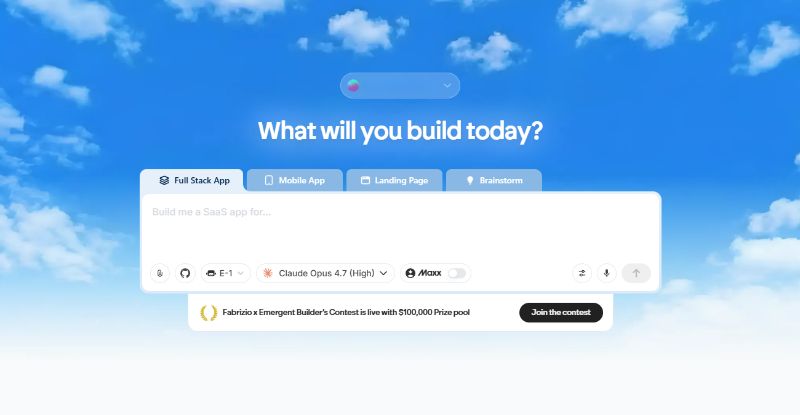
The platform supports building full‑stack web apps, mobile apps or landing pages. Users can provide text prompts, upload image references or voice notes, and even attach a GitHub repository to give the system context. At its core, Emergent uses large language models (LLMs) such as Claude Opus, GPT, and Gemini. The typical output uses a React or Next.js frontend paired with Node.js or FastAPI on the backend and a MongoDB database. For mobile, it leverages React Native and Expo to allow real‑time testing via QR code.
Workflow and features
Emergent’s build process resembles a conversation with an AI team. After selecting the type of app (full‑stack, mobile or landing page) and LLM model, users set a credit budget and provide their prompt. The system then decomposes the request into subtasks and shows progress as it generates prompts for code modules, installs dependencies and configures hosting. If it encounters issues, such as UI navigation problems, it diagnoses and resolves them automatically. Throughout the build, Emergent may ask clarifying questions and provide visual snapshots of the app in progress.
Once the initial build is complete, Emergent offers several powerful features:
- Mobile app development – It can generate iOS and Android apps using React Native and Expo, allowing users to test their app live via QR code.
- GitHub integration – Projects can be exported to a user’s GitHub repository for manual editing or further collaboration.
- One‑click deployment – Apps can be deployed instantly on Emergent’s hosting (approximately 50 credits per deployment), or the code can be exported for self‑hosting.
- Large context windows – Higher‑tier plans allow the system to use more context from user prompts and documents, enabling complex builds.
- Team collaboration – Multiple users can work on the same project with shared environments.
- Third‑party integrations – Emergent integrates with platforms such as Shopify, Webflow, Attio and Zendesk.
Emergent uses a credit‑based billing model. The free plan includes 10 credits per month; a standard subscription costs $20 per month for 100 credits, and a pro subscription costs $200 per month for 750 credits. Credits are consumed based on the complexity of builds and the models selected; rebuilding an app to implement design changes or additional features consumes further credits.
Strengths and limitations
Emergent shines when teams need to create prototypes quickly. It’s well suited for startups testing minimal viable products (MVPs), developers needing boilerplates and product managers wanting to explore ideas without writing code. The multi‑agent approach ensures the platform handles architecture, coding, testing and deployment cohesively, saving time and reducing the need for a full development team. Mobile support, GitHub export and large context windows broaden the range of use cases.
However, there are trade‑offs. Reviewers note that the output quality varies for complex architectures and that design defaults can be generic. Because changes require the system to rebuild the app, iteration can take several minutes and consume credits. Heavy usage can quickly exhaust credit budgets, especially if users try different models or variations. Teams with robust engineering resources may find the platform less compelling than those without developer capacity.
Why Emergent matters
Emergent offers a glimpse into how AI can transform software development. It reduces the technical barrier for building production‑ready applications and allows non‑developers to participate in creating working software. By structuring tasks across multiple agents and providing a conversational interface, it shortens the path from concept to code. For businesses that primarily need a functioning product rather than a fully integrated business system, Emergent can deliver rapid results. Its limitations, credit consumption, generic design and variable quality, suggest it’s best viewed as an accelerant for prototyping and early‑stage products rather than a complete replacement for experienced engineers.
Comparing Willo and Emergent
Scope and purpose
At a high level, Willo and Emergent tackle different problems. Willo’s mission is to build entire businesses, from brand positioning and infrastructure through ongoing marketing and support. It automates both creation and operations, acting as a company in a box. Emergent, by contrast, is an agentic coding platform. It generates applications and landing pages based on user prompts but doesn’t manage the business that surrounds those products. If you need content strategy, SEO, marketing or finance tracking, you must provide those separately.
Automation versus assistance
Both platforms leverage AI, but they do so differently. Willo is built around full automation. Its agents not only generate assets but also run them week after week. Emergent focuses more on assistance: it helps you build code and deploy it quickly but stops short of running your business or marketing. You still need to decide how to promote your product, handle customer feedback and manage finances.
Complexity and customisation
Willo simplifies complex decisions by providing a complete stack out of the box. That also means less flexibility: you must accept its chosen infrastructure and growth strategy. Emergent gives more technical freedom (you can export to GitHub and host anywhere), but that flexibility requires more understanding of code and architecture. In addition, changes in Emergent typically require a rebuild and consume credits, while Willo’s agents continuously iterate without additional cost, though customising deep technical details may be harder.
Cost and pricing models
Willo uses a transparent tiered structure across its Starter, Growth, and Scale plans, where each tier clearly defines usage limits and included features. Starter focuses on core setup and execution, including AI strategy and landing page deployment. Growth adds scaling capabilities like automated marketing and monetization tools, while Scale offers expanded usage, priority performance, and more advanced insights, ensuring predictable growth without hidden complexity. Emergent uses a credit‑based model with free, standard and pro plans. Credit consumption varies by model and project complexity; iterating can consume credits quickly. Businesses will need to weigh whether agent runs (Willo) or pay‑per‑build (Emergent) suits their experimentation style.
When to choose Willo versus Emergent
Because the platforms address different challenges, choosing between them depends on your goals. You might choose Willo if you want:
- A complete business system that handles marketing, sales, customer support and operations.
- Integrated infrastructure ready to accept payments, host content and manage analytics.
- Continuous execution where AI agents plan, execute and reflect on growth without requiring manual rebuilds.
On the other hand, Emergent is compelling when you need:
- Rapid prototyping of web or mobile applications without writing code.
- A multi‑agent coding environment that can handle architecture, coding, testing and deployment.
- The ability to export projects to GitHub, integrate with third‑party services and host apps wherever you choose.
Wrapping it up
Willo and Emergent both illustrate how AI can reduce barriers to creation, but they serve distinct purposes. Willo is a holistic business builder that automates research, coding, marketing and operations through a system of specialised agents. It offers speed and simplicity at the cost of flexibility and assumes control over much of the stack. Emergent is a multi‑agent coding platform that turns prompts into production‑ready apps. It shines for quick prototypes and technical experimentation but places more responsibility on users for design, marketing and ongoing operation.
For founders and product teams, the choice hinges on whether you need to build a business or a product. If your goal is to validate an idea with minimal effort and instantly set up payments, marketing and growth, Willo delivers a cohesive solution. If you already have a marketing plan or prefer to control infrastructure and code, Emergent offers a way to jump‑start development.
You can learn more about Willo by signing up for a free account today.